A grey minivan rattled through São Paulo’s hilly suburbs, loaded with spray cans, paint rollers, buckets and a ladder as five street artists drove to the Atibainha river, rap lyrics blaring from their speakers.
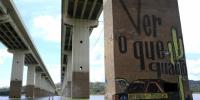
On the sweltering afternoon of 26 February, they painted colourful protest murals on the legs of a bridge that crosses one of São Paulo’s most important water sources, nestled in the Serra da Cantareira mountain range.
From a distance they look like supermarket promotion ads, but up close, the text says the reverse: it details the skyrocketing food prices.
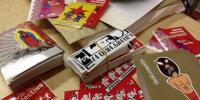
This is the proposal of the action “Bolsocaro”, which spread posters (those known as lambe-lambes) by walls in different regions of the São Paulo capital accompanied by phrases such as “It’s very expensive”, “It’s in Bolsonaro’s account” and “This account it is not ours.
Daniel Arzola, a digital artist and activist originally from Maracay, Venezuela, began his series, 'No Soy Tu Chiste' ('I Am Not A Joke') in 2013 intent on combating the stereotypes and cruelty so often facing LGBT identifiers; youth in particular. The project went viral in 2014, around the same time it teamed up with the It Gets Better Project based in the United States.
If you're a bibliophile you'll get a kick out of the car-turned-library that can be found in Buenos Aires, Argentina. Artist Raul Lemesoff took an old 1979 Ford Falcon, a popular mode of transport amongst the military forces of its time, and transformed it into a mobile library shaped like a tank.
El Sistema, also known as The National System of Youth and Children’s Orchestra and Choir, was established in Venezuela in 1975 by José Antonio Abreu, a Venezuelan educator, musician and activist. The music education program operates within the voluntary sector and is funded publicly.
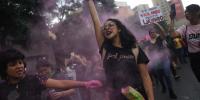
Thousands took to the streets in Lima, Peru, on March 11 to protest conservative presidential frontrunner Keiko Fujimori, daughter of former dictator Alberto Fujimori, and demand that her candidacy be revoked amid accusations of vote buying.
Sublevarte, a Collective of Mexican artists, was born out of the ENAP (National School of Fine Arts) of UNAM (the National Autonomous University of Mexico), during the student strike of 1999-2000, the longest student strike in history.
In 1995, Bogota was a chaotic city. Among others, it presented high ranges of homicides, delinquency, corruption, no sense of belonging, traffic chaos and financial problems.
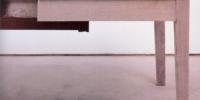
Doris Salcedo talked extensively with victims of the violence in Colombia. For the project titled Unland she spoke specifically with children who had witnessed the murder of their parents. This piece was a poetic response and representation of their testimony. Salcedo combined halves of tables together to make a whole. In the seam where the tables joined Salcedo meticulously sewed the tables together using white silk thread, dark hair and bone.
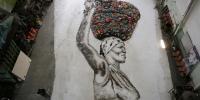
Over the course of 3 years, from 2006 until 2009, the production team behind the film Wasteland (2010), also known as "Lixo Extraordinário" followed Brazilian, Brooklyn-based mixed-media artist, Vik Muniz, as he traveled back to Brazil to create self portraits with the catadores (tr. garbage pickers) of Jardim Gramacho, one of the largest city dumps in the Americas.
In 1998 Hacker-Poet-Artist Yucef Mehri breached the security of CANTV at the time the largest telecommunications company in Venezuela. He was able to access the personal data kept by the company which contained the names, addresses, phone numbers, working places, and even checking accounts, credit cards, and expiration dates of it's customers.
I think this is a very interesting project that is intended to pay hommage by showcasing portraits of survivors of the Cuban revolution. They are displayed in the streets of Havana and, as the artists explains, this is a place that lacks commercial advertising/ billboards in the streets. So they are displaying the courage and strength of those, people who should be admired, earned their place in a sense.
Students from the School of Communication and Art of the University of Sao Paulo perform a skit titled 'Blind Ones' as a protest against consumerism inside a shopping mall of Natal, capital of Rio Grande do Norte state, December 9, 2013.
Related Story:
Brazil shopping malls: New epicenter for social protest?
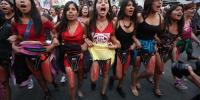
On August 16, 2019 thousands of women marched in various cities across Mexico. One particular case may have triggered them, but these marches were an answer to the systematic violence against women and girls in our country.
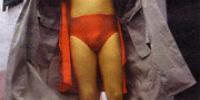
The protagonism of the body in the dramatization of marginalized groups is also central to Emilio García Wehbi's Proyecto Filoctetes, an urban intervention staged November 15, 2002, on the streets of Buenos Aires. The project consisted in placing twenty-five lifelike latex mannequins in central, highly trafficked locations around the city in varying positions of injury, physical distress, and abandonment.
Beating Cancer is a hard task. Cancer patients spend endless days in the hospital receiving a multitude of tolling treatments that we understand are necessary to save our lives. However, when you're a kid, it isn't always so easy to understand what's going on. As the chemo kills bad cancer cells, it also kills good cells in your body, which causes various unpleasant side effects.
The Acción Poética movement is a literary phenomenon that began in Monterrey, Mexico in 1996. It was founded by Mexican poet Armando Alanis Pulido and involves painting and intervening abandoned walls in cities with fragments of poetry. The content is usually love poems or optimistic phrases. Also, some phrases refer to the current situation in the cities (though one of their rules is to not talk about politics or religious beliefs).
Many artists are inspired to bring climate change into their work after a direct experience with it. Catherine Sarah Young hopes her work helps people understand and talk about their experiences with climate change.
The Eye that Cries (El Ojo que Llora, in Spanish) is a memorial that was born as a private initiative designed to honor the thousands of victims as a result of terrorism in Peru, to strengthen the collective memory of all Peruvians and to promote peace and reconciliation in the country.
Bit Rosie showcases female music producers in high quality performance videos and short documentaries. Our videos and digital archive project with the New York University library document the work of women using music technology to make sounds across genres and locales.
Bit Rosie is directed and produced by Adele Fournet.
http://www.adelefournet.com/
Vem Pra Rua is a nonpartisan, democratic, and pluralist movement that emerged in response to society’s fight for a better Brazil. Brazilians of all regions, social classes, and ages began mobilizing at the end of 2014—building on the 2013 marches that protested corruption, inequality, and other socio-economic and political problems.
Cosmic Generator presents a network of characters working in nonsensical, and at times absurd, economies. Artist Mika Rottenberg uses footage from actual discount dollar stores in Calexico, CA; Mexicali, Mexico; and Yiwu, China to recreate the imaginary “life” of a product, from its production in the factory to the moment it is sold.
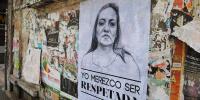
Last September, Fusion commissioned artist Tatyana Fazlalizadeh, 29, to travel to Mexico City and create an installation of her highly-acclaimed art project protesting street harassment, “Stop Telling Women to Smile.” Fazlalizadeh’s visit to Mexico was her first to the country; it was also the first time the STWTS project — for which Fazlalizadeh papers city streets with hand-drawn portraits of women pushing back against their street harassers — had eve