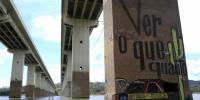
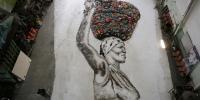
A grey minivan rattled through São Paulo’s hilly suburbs, loaded with spray cans, paint rollers, buckets and a ladder as five street artists drove to the Atibainha river, rap lyrics blaring from their speakers.
On the sweltering afternoon of 26 February, they painted colourful protest murals on the legs of a bridge that crosses one of São Paulo’s most important water sources, nestled in the Serra da Cantareira mountain range.
"The walls of the streets of downtown Santiago are covered with stickers, art, words and posters.
The messages are varied and range from "Feminist power" to "All cops are bastards". They have taken over the walls of Zona Cero (Ground Zero), the name given to the area around Plaza de la Dignidad, where anti-government protests have been held - and at times brutally repressed by police - since 18 October.
In 1998 Hacker-Poet-Artist Yucef Mehri breached the security of CANTV at the time the largest telecommunications company in Venezuela. He was able to access the personal data kept by the company which contained the names, addresses, phone numbers, working places, and even checking accounts, credit cards, and expiration dates of it's customers.
FloodNet was a conceptual artwork and a tool for online collective action.
Developed by the collective Electronic Disturbance Theater (EDT), it took the form of a Java applet that allowed users to send useless requests or personalized messages to a remote web server in a coordinated fashion, thereby slowing it down and filling its error logs with words of protest and gibberish—a kind of virtual sit-in.
"Beginning in 1910, the Mexican Revolution spawned a cultural renaissance, inspiring artists to look inward in search of a specifically Mexican artistic language. This visual vocabulary was designed to transcend the realm of the arts and give a national identity to this population undergoing transition.
Directed by Fernando Sariñana, Todo el poder centers around the politics and corruption that shroud the Mexican police system. Featuring Demián Bichir as Gabriel, a filmmaker whose career has left him assaulted and robbed in broad daylight more times than he cares to remember, the film itself was inspired by Sariñana's personal experience with urban crime oftentimes perpetrated by the police themselves. ~ Tracie Cooper, Rovi
From 1995 to 1997, Colombian families reunited in front of the TV to watch Quac: El Noticero, a comedy newletter performed by the comedian Jaime Garzon and the actor Diego Leon Hoyos.
It has been the only space in which the Colombian society was allowed to see a well made newsletter about the reality of the country and their politicians from a comedy perspective.
Cosmic Generator presents a network of characters working in nonsensical, and at times absurd, economies. Artist Mika Rottenberg uses footage from actual discount dollar stores in Calexico, CA; Mexicali, Mexico; and Yiwu, China to recreate the imaginary “life” of a product, from its production in the factory to the moment it is sold.
The Shifting View on Anthropofagia
Tarsila is closely associated with the establishment of the Brazilian art movement known as cultural “cannibalism,” or “Anthropofagia”: the then-radical idea that a truly Brazilian art would emerge by ingesting all the different cultures that intermingled within the country, rather than simply copying European styles.
A young man melting into a puddle of himself is something you don’t see everyday, much less in a busy public square. Yet this humourous but surprisingly effective spectacle is the latest effort by the Red Cross of Argentina to raise awareness about climate change.
The protagonism of the body in the dramatization of marginalized groups is also central to Emilio García Wehbi's Proyecto Filoctetes, an urban intervention staged November 15, 2002, on the streets of Buenos Aires. The project consisted in placing twenty-five lifelike latex mannequins in central, highly trafficked locations around the city in varying positions of injury, physical distress, and abandonment.
This is an organization and online platform that registers cases of street harassment in Peru and disseminates information about the subject. People can report cases and get in touch with the organization to talk or learn more about what to do when being sexually harassed.
Spanish organization the ANAR Foundation (Aid to Children and Adolescents at Risk) releases a campaign that takes advantage of the process of lenticular printing to send an offer of help to abused children without alerting their abusers, even if they’re walking together.
Lenticular printing is a process that allows for different photos to be seen depending on the angle the image is viewed from.
Five hundred volunteers with shovels gathered at a huge sand dune on the outskirts of Lima, Peru, and over the course of a day moved it by several inches. Alÿs developed the idea after first visiting Lima in October 2000. The political context was inescapable: “This was during the last months of the Fujimori dictatorship. Lima was in turmoil with clashes on the streets, obvious social tension and an emerging movement of resistance.
Doris Salcedo talked extensively with victims of the violence in Colombia. For the project titled Unland she spoke specifically with children who had witnessed the murder of their parents. This piece was a poetic response and representation of their testimony. Salcedo combined halves of tables together to make a whole. In the seam where the tables joined Salcedo meticulously sewed the tables together using white silk thread, dark hair and bone.
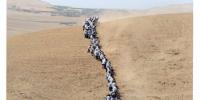
Chilean students ran for 1,800 consecutive hours around Chile's presidential palace, La Moneda, from June 13 to August 27, 2011 to protest the cost of education. The 1,800 hours stand for the 1,800,000,000 Chilean pesos, or approximately US$4 million which would cover the cost of higher education for 300,000 students. They carried Chilean flags and signs with "Free Education Now" written on them.
During the 2020 and 2021 social protests in Chile, Colombia, and Peru, Latin American fans of K-pop, Korean popular music and culture that mixes rhythms, styles, dance routines and has a defined aesthetic, went from using social networks to support their favorite artists to using them to sabotage the hashtags of conservative influencers that discredited the mobilizations.
It was a long time coming - but it was worth the wait.
Nearly two years ago, more than a dozen of Mexico’s biggest performing artists came together in a mega-event aimed at saving Wirikuta, one of the country’s most sacred sites, from devastation at the hands of Canadian gold and silver mining operations.
Over the course of 3 years, from 2006 until 2009, the production team behind the film Wasteland (2010), also known as "Lixo Extraordinário" followed Brazilian, Brooklyn-based mixed-media artist, Vik Muniz, as he traveled back to Brazil to create self portraits with the catadores (tr. garbage pickers) of Jardim Gramacho, one of the largest city dumps in the Americas.
An artist in Culiacan, Mexico—which has the highest rate of gun deaths in the country—has found a way to transform the agents of death into seeds of life.
In 2008, artist Pedro Reyes started running television ads urging locals to exchange their guns for food coupons to be redeemed at local stores.
The campaign—Palas Por Pistolas, or “Shovels for Guns"—collected 1,527 guns, which Reyes publicly smashed with a steamroller.
Huelga decir, gráficas de brazos caídos, es un libro digital de gran importancia estético-política, dados los recientes acontecimientos sociales a escala mundial, en los que el llamado a la huelga de nueva cuenta se pone de manifiesto en las plazas públicas como instrumento de transformación social.
A group of young adults under the name of "Love Tijuana" (Amemos Tijuana) celebrated the one year "Birthday" of a pothole located at the Via Rapida (Tijuana's Freeway) with balloons, banners, and even hats.
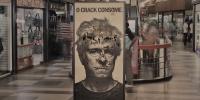
To show the harmful effects of cocaine on a drug addict, Brazilian advertising agency Talent created ‘living’ poster ads that are consumed by live mealworms over time.
Printed on dough, the ads initially show the faces of drug addicts.
However, as time passes, the mealworms slowly eat away at the posters, causing holes to form on the printed faces—highlighting the harmful effects of the drug.
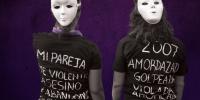
El acoso sexual a las mujeres en México, no es novedad. Desde un chiflido o grito de “mamacita” en la calle hasta una alarmante cifra de seis feminicidios diarios, la violencia machista es un asunto cotidiano.
Lo que sí es novedad es que este año las mujeres no se estén quedando calladas, y que salgan a las calles, ya no con miedo, sino con determinación de defender su derecho a ser respetadas.
Sublevarte, a Collective of Mexican artists, was born out of the ENAP (National School of Fine Arts) of UNAM (the National Autonomous University of Mexico), during the student strike of 1999-2000, the longest student strike in history.