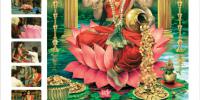
“Badass Indian Pinups” is a series of paintings by Indo-Canadian artist Nimisha Bhanot, that features paintings of Indian women being confident and sexually liberated.
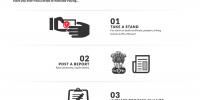
ipaidabribe.com is an online tool that allows the users to report when they pay bribes, are asked to pay and refuse, and when they find an honest officer.
They have a well designed site with apps for mobile phones, and although it started in India it has now grown and you can select multiple countries on different continents.
There are no whistles, no loud speakers, and no placards held up high in this quiet act of subversion. Pimsiri Petchnamrob stands silently in a mass of sharply dressed Bangkok commuters, her hands clutched around a copy of George Orwell's 1984.
Next to her a small group of young men and women, their faces sombre and their heads bowed low, also read books about fictional and real totalitarian worlds in silence.
In her peppy and helpful online video tutorial, Reshma Bano Quereshi promises to teach her viewers “how to get perfect red lips.”
But unlike the more than 200,000 other online videos dedicated to the application of lipstick, this one goes beyond plumping and priming.
T.I.E. is a residential, 24-hour, intensive experience during which participants will be: introduced to aesthetics of Immersive Theatre, guided through a practical exploration of these strategies, and mentored in the creation of an immersive, theatrical experience about a social justice issue -- a piece that can be shared at the end of the workshop with an invited audience of their choice
The Kiss of Love campaign in India is a non violent protest against moral policing. It started out as a Facebook page but gained momentum across India when a mob of conservative, right-wing party members attacked and demolished a coffee shop in Kozhikode, Kerala. Their grounds to do so was public display of affection by couples inside the coffee shop, which they saw as immoral activity.
A new comic book with a female rape survivor as its "super hero" has been launched to focus attention on the problem of sexual violence in India.
Priya's Shakti, inspired by Hindu mythological tales, tells the story of Priya, a young woman and gang-rape survivor, and Goddess Parvati as they fight against gender crimes in India.
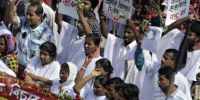
"Thousands of people, some wearing funeral shrouds, staged demonstrations at the site of the Rana Plaza factory complex on Thursday on the one-year anniversary of the Bangladesh disaster that claimed 1,138 lives.
Zubair Magray, who goes by the stage name Haze Kay, raps about the conflict in Indian-administered Kashmir. The 23-year-old, one of the first rappers to emerge from the valley, blames the Indian military for "ruining" his homeland.
"Thai artists and art students are on the frontline of their country’s swelling pro-democracy movement, calling for reforms of Thailand’s military-backed government, and breaking both taboo and national law to criticise the nation’s monarchy.
Most nights since a coup returned Myanmar to military rule on Feb. 1, a spectral symbol of protest has glowed on a mildewed side of a building.
Where the next illumination will appear in Yangon, the country’s biggest city, is a mystery. But, suddenly, a projected image appears in the dark. Three fingers raised in a rebellious pose. A dove of peace. The smiling face of Daw Aung San Suu Kyi, whose government was ousted in the army putsch.
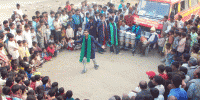
In 1989, playwright, actor, and activist Safdar Hashmi was fatally attacked by political thugs while performing a street play outside of Delhi. His death led to the founding of Sahmat, an influential artist collective that has taken a consistent stance against the threats of religious fundamentalism and sectarianism in India through a vibrant mix of high art and street culture.
In response to a memo from Afghanistan's education ministry, Ahmad Sarmast, the founder of Afghanistan's Institute of Music, began a Twitter campaign with the hashtag #IAmMySong. In response to the hashtag, Afghan girls have taken to Twitter with videos of themselves singing tagged with Sarmast's hashtag and spreading petitions against the ban. The ministry memo banned girls 12 years old and older from singing at school functions.
The “Wearable/Portable Architecture project” discussed the possibilities of having a locale create portable architecture based on the conditions of its environmental, urban and cultural conditions. It is structured to find ways in providing new arguments and sustaining an artistic impetus to our immediate environment.
Seeking to use war-time waste for social good, Saught was set up by Pamela Yeo, Adeline Heng and Ng Sook Zhen in December 2010. Based in Singapore, the company uses the metal from de-activated landmines to create pieces of jewellery. The organisation employs citizens from conflict-ravaged regions, offering a source of employment for those who may have lost as a result of the fighting in their nation.
We are sitting at a dhaba – a roadside tea-shop in Pakistan often frequented by lower-to-middle income men. At our table: four women and camera crew. The reporter from ‘one of the most globally viewed’ [read: western], mainstream British outlets looks me in the eye: “So, how safe do you feel at the moment? We were just surrounded by a group of little boys [because of the cameras], do you think the situation can ever turn on you?"
Namo Nazi
Namo Nazi is a group which is dedicated to the cause of spreading awareness about fascism. They create anti-fascist T-Shirts and say this about themselves:
From 1998 to 2004, pro-democracy activist Htein Lin was jailed for challenging the military dictatorship in his home country of Myanmar (formerly Burma) in Southeast Asia. Prior to his imprisonment, Lin acted in films and with a theater troupe. While behind bars, he continued to organize performance artworks with his fellow prisoners.
Mukti Caravan, the Campaign on Wheels, is a mobile cultural group of former child bonded labourers. Started by the Bachpan Bachao Andolan (Save Childhood Movement), a movement started by now Nobel laureate Kailash Satyarthi, it involves activists visiting villages to create awareness about need for education, emphasizing on the need for improving access to education and quality of education, to completely eradicate child labour from the society.
Myanmar has been engulfed in protest since February 1, when Burmese army general Min Aung Hlaing seized control of the government in a military coup, refusing to accept the landslide election victory of the National League for Democracy and its leader, Aung San Suu Kyi.
The bruised and beaten faces of these beautiful Hindu goddesses have an important point to make -- that despite the reverence for women that is a part of Hinduism, India's most populous religion, the country has become extremely unsafe for its female citizens.
Singaporean artist Lee Wen’s series Journey of a Yellow Man (1992–2012), one of his most famous and long-standing performances, was not simply a personal affront, it was a political affront. At the intersection of Asian art history, critical race theory, and migration and diasporic studies, one is never far (enough away) from the chromatic framing of race and ethnicity: yellow race, yellow peril, yellow face, the forever foreigner.