Zubair Magray, who goes by the stage name Haze Kay, raps about the conflict in Indian-administered Kashmir. The 23-year-old, one of the first rappers to emerge from the valley, blames the Indian military for "ruining" his homeland.
Dogs featured in one ruse to ridicule the regime—pictures of dictator Than Shwe were hung around the necks of the stray dogs that roam the streets of Rangoon. The pictures, which rapidly found their way onto the Internet, are the work of an exiled Burmese satirist who goes by the name of Mr Creator. Downloaded copies of his pictures and cartoons are popular items among cyber dissidents.
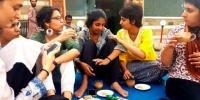
We are sitting at a dhaba – a roadside tea-shop in Pakistan often frequented by lower-to-middle income men. At our table: four women and camera crew. The reporter from ‘one of the most globally viewed’ [read: western], mainstream British outlets looks me in the eye: “So, how safe do you feel at the moment? We were just surrounded by a group of little boys [because of the cameras], do you think the situation can ever turn on you?"
New Delhi: With his ‘climate fast’ entering its fourth day at Khardungla pass (18,000 ft) at -40 °C, Sonam Wangchuk — the renowned engineer, educationist and reformer from Ladakh took to Twitter, urging the people of India to join him on the last day of his fast in support of Ladakh.
The egregious practice that some Muslim men employ to divorce their wives instantaneously and without their consent, merely by uttering the word talaq (divorce) three times, has finally been declared unconstitutional and illegal by the Indian Supreme Court. The country’s ruling Bhartiya Janata Party (BJP) party claims that the ban is a victory for its administration, which had been advocating its abolition since it came to power in 2014.
Dark Matter is a trans South Asian performance art duo comprised of Alok Vaid-Menon and Janani Balasubramanian, a prominent pair of voices operating at the intersection of the arts and activism.
Brother Gao are two China artists. Their works are aims at reflecting the reality of Chinese society in an artistic and critical view. In 2003, the brothers held an event to invite many strangers for a dinner.
"Thai artists and art students are on the frontline of their country’s swelling pro-democracy movement, calling for reforms of Thailand’s military-backed government, and breaking both taboo and national law to criticise the nation’s monarchy.
In late January 2009, a group of 40 members of right-wing Hindu group Sri Ram Sena attacked women and men in a pub in the Indian city of Mangalore. They were upset with the women for engaging in behavior they found immoral, claiming that the girls were disrepecting traditional Indian values. Video footage of the event spread across Youtube in India, sparking outrage among many at the attack on innocent women.
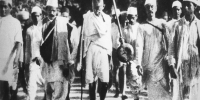
In 1930, the Indian National Congress adopted satyagraha (essentially, nonviolent protest) as their main tactic in their campaign for independence. Mahatma Gandhi was appointed to develop a plan of action; he proposed marching to the sea to make salt in defiance of the Salt Act of 1882.
There are no whistles, no loud speakers, and no placards held up high in this quiet act of subversion. Pimsiri Petchnamrob stands silently in a mass of sharply dressed Bangkok commuters, her hands clutched around a copy of George Orwell's 1984.
Next to her a small group of young men and women, their faces sombre and their heads bowed low, also read books about fictional and real totalitarian worlds in silence.
Founded in India, this collective creates participatory murals that transform public spaces into affirmations of love and resistance. Collaborating with marginalized communities, they co-create artworks that challenge narratives of fear and oppression
Seeking to use war-time waste for social good, Saught was set up by Pamela Yeo, Adeline Heng and Ng Sook Zhen in December 2010. Based in Singapore, the company uses the metal from de-activated landmines to create pieces of jewellery. The organisation employs citizens from conflict-ravaged regions, offering a source of employment for those who may have lost as a result of the fighting in their nation.
Miku is a Japanese virtual idol. She is 16 years old. Miku is created in 2007 and has been heavily promoted since 2008 and was originally aimed at professional musicians. On September 12, 2007, Amazon.co.jp reported sales of Hatsune Miku totaling 57,500,000 yen, making her the number one selling software of that time. She was the first vocal to be developed and distributed by Crypton Future Media and sung in Japanese.
The Voice of Dissent
“I am not here to entertain you; I am here to disturb you. Those who are here for entertainment, I request them, please go.” It’s unusual, if not rare, for a live performer to begin by saying that to the audience. The compact of patronage that’s implicit is what Sambhaji Bhagat smashes right at the onset of his performance. For him, this art is a quest for the truth that will liberate the people he represents.
To call attention to bullying, the Singapore Coalition Against Bullying for Children and Youth has released a video that gets shorter each time it is viewed.
Hosted on a site called Share It To The End, the short animated video depicts a boy getting bullied at school and telling us he always feels alone and doesn’t feel safe anywhere.
With World Comics India, the organization he started, Sharad has pioneered a cheap and easy medium for poor people to communicate meaningfully on issues that are neglected by the conventional media. While the urban elite dominates public media, the grinding day-to-day concerns of millions are rarely heard. Layers of discrimination and abuse heaped on huge numbers of people keep their problems out of sight and out of mind.
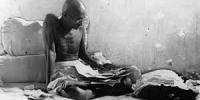
On September 16, 1932, in his cell at Yerwada Jail in Pune, Mohandas Karamchand Gandhi begins a hunger strike in protest of the British government’s decision to separate India’s electoral system by caste.
Meet To Sleep, a campaign started by Blank Noise, asks citizens from all across India to come to different public spaces like parks, and sleep there in order to take back free spaces without being afraid for their safety. The first meet was organised in November, 2014, in Bengaluru’s Cubbon Park. And since then there have been eleven meets across various cities including Jaipur, Pune, Mumbai, and Bengaluru.
Delhi- based graffiti artist who goes by the name Daku went around South Delhi, one of the poshest places in the city, and painted on overflowing garbage cans.
"An atmosphere of fear and anger spread across Myanmar this week as millions of people awoke to find out the military had taken control, ousting the elected government.
But how do you fight back in a country where protests have been violently suppressed before?
For some, it has meant putting pen to paper and taking the battle online.
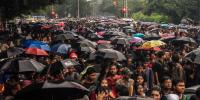
Myanmar has been engulfed in protest since February 1, when Burmese army general Min Aung Hlaing seized control of the government in a military coup, refusing to accept the landslide election victory of the National League for Democracy and its leader, Aung San Suu Kyi.
Hok Kolorob. Let there be noise.
It was perhaps these two words of protest that eventually led to the arrest of two engineering students for allegedly molesting a fellow student at Kolkata’s Jadavpur University last month.