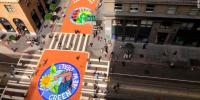
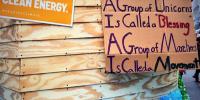
The group Art Not Oil did a campaign to raise awareness about the oil industry, and their funding of Art. "Art Not Oil has campaigned against Big Oil cultural sponsorship since 2004.
DOHA — In an interview with the Paris Review in 1993, the late Toni Morrison once said,
I think of beauty as an absolute necessity. I don’t think it’s a privilege or an indulgence. It’s not even a quest. I think it’s almost like knowledge, which is to say it’s what we were born for.
Artist Maya Lin first burst onto the scene in 1981, when her design was selected for the Vietnam Veterans Memorial while she was still a senior at Yale. Since then, Lin has turned her focus to environmental issues, with her most recent show at Pace Gallery investigating Manhattan’s landscape and environmental history.
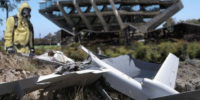
Students at the University of California-San Diego were surprised when an Unmanned Aerial Vehicle, commonly referred to as a drone, crashed in the middle of campus — or at least they thought that’s what happened.
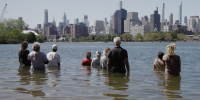
A site-specific, community-engaged process: Sarah and NYC collaborators gathered at the water’s edge every month from September 2020 (when the work was initially scheduled to take place but was postponed due to the pandemic) until September 2022, to build Kin To The Cove, a site-specific community-powered environmental public art process that connects local residents to the Cove and Water that surrounds NYC.
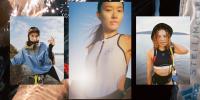
Is your favorite apparel brand a fashion trendsetter, greenwasher, or laggard? Find out by taking a spin on Greenpeace International's "Detox Catwalk" . Unveiled Thursday, the interactive online platform examines which companies are "walking the talk" to a toxic-free future.
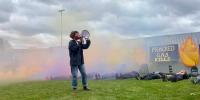
A group of protestors and organizers from Sunrise Movement, Earth Guardians, 350 Eugene, Cascadia Wildlands and more staged a bike march culminating with a die-in outside of the Northwest Natural Gas headquarters in Eugene, Oregon.
The protestors lie on the ground outside the NWN building, beneath tombstones donning the dangers of natural gas.
When we think about the protectors of our oceans, our mind is instantly drawn to the image of the lifeguard. Pamela Anderson and David Hasselhoff in bright red swimsuits, their enviable bodies on show, as they run along the coastline. As a result our concept of the role has an elitism about it.
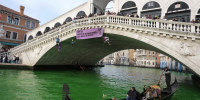
Italian environmentalists used a dye to turn Venice's Grand Canal green on Saturday in protest at what they said was a lack of progress at the COP28 climate summit in Dubai.
The protesters from the Extinction Rebellion group, dangling from the Rialto Bridge over the canal with the aid of climbing ropes, also displayed a banner that read: "COP28: While the government talks, we are hanging by a thread."
The inspiration for the creation was the Common Snapping Turtle. A big shout-out to local member, Kristin Rubin and local college students, Sarah Lockhart and Alanis Gonzalez, for their assistance in the construction of the artwork.
The Survivaball made its first appearance in 2006, when "Halliburton representatives" attended a conference on catastrophic climate change and demonstrated the functionality of the large inflatable suits ("a gated community for one"), which keep corporate managers safe from global warming. Not long afterward, in Berlin, the Yes Men learned they also work as disruptive, arrest-resistant tools.
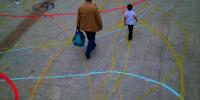
In the 1970s, Jaime Lerner, the former mayor of Curitiba, Brazil, transformed six blocks of the main downtown shopping street into a pedestrian zone in 1972, despite fierce objections from the merchants. He quickly accomplished this change in just three days by installing paving, lighting, planters, and furniture. The once-resistant merchants were impressed by the increase in their business and soon demanded an expansion of the traffic-free district.
The coronavirus outbreak has prompted climate activists to abandon public demonstrations, one of their most powerful tools for raising public awareness, and shift to online protests.
This week, for example, organizers of the Fridays for Future protests are advising people to stay off the streets and post photos and messages on social media in a wave of digital strikes.
By a pond inside one of the entrances to Beijing’s Chaoyang Park lies a cluster of one and two storey red pyramid-shaped buildings. Sculptures of Gandhi and Lincoln and other famous figures sit in the quiet woods nearby. This is Yuan Xikun’s Jin Tai Art Museum.
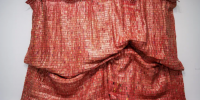
In December 2015, she stepped out in a wedding dress adorned with hundreds of air pollution masks and walked the streets appealing to Beijingers to take public transport rather than contribute to the choking smog by driving. The year before, she was photographed outside the Beijing Exhibition center in another, wedding dress complete with a 10-metre-long train in a piece entitled “Marry the Sky”.
Many artists are inspired to bring climate change into their work after a direct experience with it. Catherine Sarah Young hopes her work helps people understand and talk about their experiences with climate change.
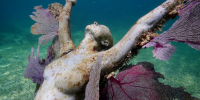
Angel Azul is an environmental documentary that follows the work of eco-sculptor Jason deCaires Taylor. Jason creates artificial coral reefs from statues he's cast from live models and installed on the ocean floor in an underwater museum off the coast of Cancún. The film explores issues that threaten the world's coral reefs which are suffering unprecedented losses.
Four months ago, I was in a multifaith brainstorm for the People’s Climate March when someone said, “What if we had a giant ark?” I think we all had the same reaction: Great … but how do you build an ark?
In 1982, for documenta 7, Beuys proposed a plan to plant 7000 oaks throughout the city of Kassel, each paired with a basalt stone. The 7000 stones were piled up on the lawn in front of the Museum Fridericianum with the idea that the pile would shrink every time a tree was planted. The project, seen locally as a gesture towards green urban renewal, took five years to complete and has spread to other cities around the world.
by Natalie Pompilio
Natalie Jeremijenko wants you to feed the animals. She encourages you to text the fish—and makes sure they'll text you back. She turns moths into movie stars and believes the next big thing in urban transportation is human flight.