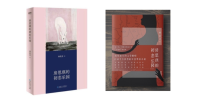
Fang Si-Qi’s First Love Paradise, a 2017 novel by Taiwanese writer Lin Yi-han, has become one of the most haunting and politically charged literary works in the Chinese-speaking world. Although presented as fiction, the novel closely mirrors Lin’s own lived experience of being groomed and sexually abused by a private tutor during her adolescence.
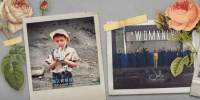
“Rose Boy” (玫瑰少年) refers to Yeh Yung-chih, a 15-year-old junior high school student in Taiwan who died on April 20, 2000, after years of bullying due to his non-conforming gender expression. Though the official cause of death was ruled accidental—he allegedly slipped in a school bathroom—the circumstances surrounding his death, including prior complaints from his mother about repeated verbal and physical harassment, drew widespread public attention.
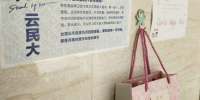
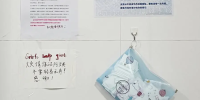
Since 2020, university students across China have launched a grassroots initiative to combat menstrual stigma by placing “menstrual pad mutual aid boxes” in campus restrooms. These boxes, often accompanied by signs reading “Take one if you need it, donate if you can,” provide free sanitary pads to anyone caught off guard by their period—offering both practical relief and a symbolic challenge to the cultural silence surrounding menstruation.
In her 2021 graduation project from the Central Academy of Fine Arts (CAFA), Chinese performance artist Zou Yaqi staged a provocative social experiment titled “21-Day Survival Challenge.” For three weeks, Zou assumed the persona of a wealthy socialite, using counterfeit luxury items, strategic self-presentation, and social engineering to access elite spaces in Beijing—such as five-star hotel lobbies, first-class airport lounges, and high-end restaurants
The “Occupy Men’s Toilets” movement, initiated by Chinese feminist activists including Li Tingting (Li Maizi) and Wu Rongrong, emerged in 2012 as a creative, non-violent protest against gender inequality in access to public facilities.
HONG KONG — It started when a single box of free sanitary pads appeared in a middle school classroom in October. Then a plastic container with pads was attached to the walls of four bathrooms in a university in Shanghai. By Monday, boxes and bags of individually wrapped pads had popped up outside bathrooms in at least 338 schools and colleges across China. Each carried a version of the same instructions: “Take one, then put one back later.
In June 2011, the Beijing Local Taxation Bureau demanded a total of over 12 million yuan (US$1.85 million) from Beijing Fake Cultural Development Ltd in unpaid taxes and fines, and accorded three days to appeal the demand in writing. According to Ai's wife, Beijing Fake Cultural Development Ltd has hired two Beijing lawyers as defense attorneys.
The Nanjing Yangtze River Bridge, completed in 1968, is one of China’s most iconic infrastructural projects and a potent symbol of national pride. Spanning over 6,700 meters across the Yangtze River, it was the first double-decked road-rail truss bridge designed and built entirely by Chinese engineers, without foreign assistance, during a time of intense geopolitical isolation.
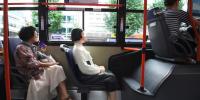
Buses serving several routes in central Seoul have acquired a new and highly controversial passenger: a barefoot “comfort woman”, wearing a traditional hanbok dress with her hands resting on her knees.
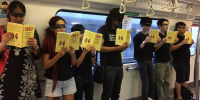
A group of activists took to the trains to protest the horrendous treatment that the Singapore government meted out upon 22 individuals who were detained 30 years ago under an operation that was entitled,"Operation Spectrum" with the use of the Internal Security Act (ISA).
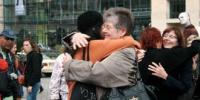
On the afternoon of September 11th, nearly a hundred people hugged each other to feel the beauty of the hug on the Paris Square in front of the Brandenburg Gate in Berlin, under the leadership of the Chinese artist Gao Brothers. At the beginning of the event, the Germans have not yet adapted to the behavior of embracing strangers, but encouraged by Gao brothers, people have opened their arms and gave the strangers around them a warm hug.
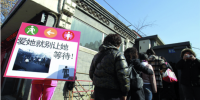
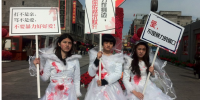
On February 14, 2012, three female college student volunteers wore blood-stained wedding dresses and appeared as "wounded brides" in Beijing Qianmen Pedestrian Street.
One of the oldest forms of human expression is art, so it’s no surprise that art is constantly used to critique another of humanity’s oldest practices, violence and war. In the world of art activism, the power of creativity and innovation has been used to create commentary about war since the beginning of time. Art that speaks out against the atrocities of violent conflict embodies empathy, care, and a plethora of other human emotions.
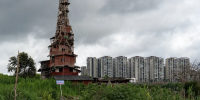
The structure teeters over fields of knee-high grass, looking like a cross between a camping tent and a giant wedding cake. Eleven stories of dark red wooden rooms, diminishing in size as they ascend, balance atop one another, seemingly held together by only the thicket of cords that stretches from the peak to the ground.
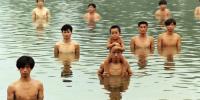
Zhuang Huan invited more than 40 men - laborers, fishermen, construction workers––who had recently migrated to Beijing from other areas of China to participate. Zhang Huan said, “In order to find these workers, I visited many of the shacks where they live.”
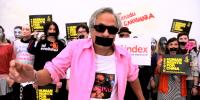
Earlier this year Chinese dissident artist Ai Weiwei recorded a gangnam style video, dancing handcuffed, sending a message to the Chinese authorities who responded by banning the video as soon as it came online. British-Indian artist Anish Kapoor
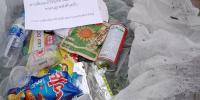
Officials in Thailand had an unorthodox approach to deal with visitors who left a tent filled with litter in a national park: mail the trash to the offenders.
Many girls in China may have seen the advertisements of egg donation as a surrogate, in hospitals, schools, public toilets, shared bikes, ATMs...... They are everywhere and the number of this kind of advertisements is large. Though there are lots of girls who have never seen such advertisements or would never believe in them, there would still be some girls who would dial the numbers on the advertisements.
China's only seaside theater festival has been held in the resort town of Aranya in north China's Hebei Province. Artists from around the world traveled there to take deep dive into the world of dramatic performance. For theatergoers, there were interactive activities including cross-border installations such as seaside talks, environmental drama readings, screenings, theater houses, parades and bonfires by the sea.
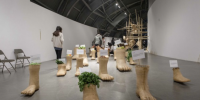
South Korean artist Do Ho Suh is internationally known for his ghostly, diaphanous architecture and fabric-made objects, which create imaginary spaces that are physically present yet impossible to inhabit. His large-scale, immersive, but impermanent installations serve as “acts of memorialization,” exploring themes of identity, home, and the tension between personal and public space.
“I performed at Tiananmen Square in 1989, 15 days before the crackdown. I sang A Piece of Red Cloth (一块红布), a tune about alienation. I covered my eyes with a red cloth to symbolize my feelings. The students were heroes. They needed me, and I needed them. After Tiananmen, however, authorities banned concerts. We performed instead at “parties,” unofficial shows in hotels and restaurants”.
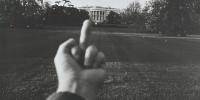
The son of an exiled political dissident, Chinese artist and activist Ai Weiwei’s work is inherently political. Since 1995 Ai Weiwei has been traveling the world, photographing himself flipping off iconic monuments of power in his Study of Perspective series.
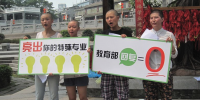
In early July 2012, after the Chinese college entrance examination results were announced, the media found that many colleges and universities had gender bias on the admitted scores, and the maximum difference between men and women was up to 40 points. This finding aroused widespread concern and dissatisfaction from the public.
From Public Delivery:
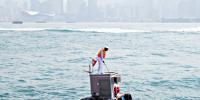
Kacey Wong has a knack for creating art that investigates the space between people and their surrounding environment. Paddling Home, which was performed on the Hong Kong Victoria Harbor, was a star feature in the Hong Kong contemporary art scene.
"Myanmar has been engulfed in protest since February 1, when Burmese army general Min Aung Hlaing seized control of the government in a military coup, refusing to accept to the landslide election victory of the National League for Democracy and its leader, Aung San Suu Kyi.