GreatFire was set up in 2011 by three anonymous individuals to counter the “Great Firewall of China”, the systematic blocking by the Chinese government of any website deemed controversial, including any that touch on news, human rights, democracy or religion.
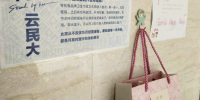
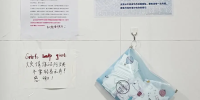
Since 2020, university students across China have launched a grassroots initiative to combat menstrual stigma by placing “menstrual pad mutual aid boxes” in campus restrooms. These boxes, often accompanied by signs reading “Take one if you need it, donate if you can,” provide free sanitary pads to anyone caught off guard by their period—offering both practical relief and a symbolic challenge to the cultural silence surrounding menstruation.
These thirteen life-like sculptures resemble familiar politicians, admirals, generals, bishops, and dictators. Portrayed as frail seniors, they sit dozing off and drooling in electric wheelchairs. They roll on a slow collision course, crashing into each other like bumper cars.
In Cut Piece—one of Yoko Ono’s early performance works—the artist sat alone on a stage, dressed in her best suit, with a pair of scissors in front of her. The audience had been instructed that they could take turns approaching her and use the scissors to cut off a small piece of her clothing, which was theirs to keep. Some people approached hesitantly, cutting a small square of fabric from her sleeve or the hem of her skirt.
Slippery When Wet proposes a wet ontology of Hong Kong—a city in ongoing transfiguration shifting into an uncanny vision of itself. Hong Kong secretes, leaving a trail of ink, tears, humidity, logistic flows, and leaks.
China's underground hiphop became an art movement since early 2000s. With characteristics of self-expression, localization and social criticism, Chinese hip hop music quickly gained popularity among students and working-class Chinese. Some notable music groups from Beijing include Yin Ts'ang (隐藏) and In3er (阴三儿).
“There are many problems in rural areas. For example, agriculture is declining, no one is farming, traditional things are falling apart, farmers are brainwashed by the idea of urbanization, and they don’t like their hometown. They all want to move to the city.”Activist Ou Ning said. Rural construction is an important issue. As an activist, he chose Bishan village in Anhui, China as the field to start his experiment, which is “Bishan Project”.
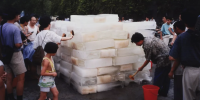
HONG KONG — It started when a single box of free sanitary pads appeared in a middle school classroom in October. Then a plastic container with pads was attached to the walls of four bathrooms in a university in Shanghai. By Monday, boxes and bags of individually wrapped pads had popped up outside bathrooms in at least 338 schools and colleges across China. Each carried a version of the same instructions: “Take one, then put one back later.
Two pairs of dusty, pastel-orange roller skates. A ram's skull. Several meters of tangled, bright red rope. They aren't the sort of items you'd find in the great fashion houses of Europe or on North American catwalks.
But, for unconventional Chinese designer and performance artist Wan Yunfeng, they are perfect.
From his small apartment in eastern Beijing, Wan makes fashion that only he wears.
In 2016, Zhou Zhenfeng, who was a student at a college in Hebei at the time, discovered that there were a lot of waste tires in the streets and alleys. Zhou Zhenfeng learned that tires are made of infusible or refractory polymer elastic materials. It takes hundreds of years for these materials to decompose in the soil to the extent that they do not affect the growth of plants.
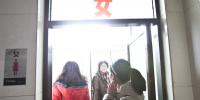
The young Chinese feminists shaved their heads to protest inequality in higher education and stormed men’s restrooms to highlight the indignities women face in their prolonged waits at public toilets.
Women around the world fed up with long lines for the ladies’ restroom have a new folk hero: a Beijing college student leading her own version of an “occupy” movement in southern China.
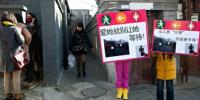
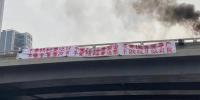
Direct Cause: Students' freedom to enter and leave the campus has been restricted for two weeks, but the university has not even issued an official document, only a verbal rule of "not leaving the campus unless necessary."
Objective: To protest the arbitrary closure policy of Beijing Film Academy.
Since the 1980s, revitalizing the economy has always been the country's development strategy. Although China's economy has grown rapidly in just twenty years, attracting worldwide attention, environmental destruction has also become a problem. For example, the Fu Nan River in Chengdu, like many rivers nationwide, is severely polluted.
China's only seaside theater festival has been held in the resort town of Aranya in north China's Hebei Province. Artists from around the world traveled there to take deep dive into the world of dramatic performance. For theatergoers, there were interactive activities including cross-border installations such as seaside talks, environmental drama readings, screenings, theater houses, parades and bonfires by the sea.
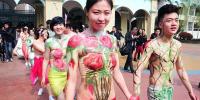
Ten couples covered in body paint wearing only their underwear have celebrated their “naked weddings” at Hangzhou Paradise amusement park in Zhejiang province. The couples, some of whom have been married for many years, said they were rejecting modern Chinese values, which place greater value on money than love. In China, a naked wedding involves a couple marrying without owning a house or car.
In a private Tokyo dinner party artist Mao Sugiyama served his genitals to five of the events guests. Several months prior to the event he chose to have his genitals surgically removed. He released invitations to the event on social media, 70 paid attendees were present for the event.
Self-identifed as asexual, Sugiyama stated that he intended to raise awareness for "sexual minorities, x-gender, asexual people."
As the cold air bit our faces, and we hid deeper into our layer of sweaters, my family and I continued to wander around Manhattan, seeking a place which would provide warmth and food. And there it was, dimly lit: the Michelin-starred ramen restaurant, Tonchin. We ordered the highly-sought after ramen bowl, Tonkotsu, and awaited our meal. Out of the kitchen, the steam arose from a bowl of a warm, salty pork broth.
Young Japan: For too long, Japan's youth have been a silent minority. Now, on the eve of a crucially important general election, they seek a bigger voice in forging the future of their aging nation
BEIJING — Like many art students, Zou Yaqi often worried she’d be unable to afford to live in Beijing after graduation. So, earlier this year, she decided to set herself a daunting challenge: Survive in the city for three weeks without spending a single yuan.
It turned out to be a piece of cake.
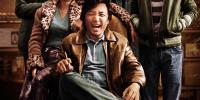
The screen portrayal of a cancer sufferer whose illegal import of foreign medicines into China spurred national policy changes has become a box-office smash as audiences flock to a rare Chinese film on a hot-button issue.
Dying To Survive is based on Lu Yong, who was arrested in 2013 after illegally importing a generic cancer drug in a case that sparked public debate about high medical costs.
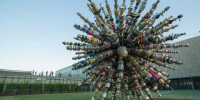
For one artist, the ugly and the beautiful are equivalent concepts. In 2018, designer and artist Choi Jeong Hwa featured an exhibition titled 'Alchemy' at The Artling where he uses recycled and non-biodegradable materials in his work that he has been collecting for 30 years, such as household trash, glass, and steel. 'Dandelion' is one of his masterpieces installed in the outdoors in Seoul, South Korea.
A Chinese Independent Photographer, Xiyouxiu (Twitter ID@xiuxiukong) published a set of photos called "Father" on both Chinese social platforms like Weibo and Little Red Book, and international platforms like twitter.