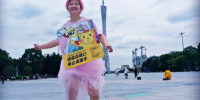
Women around the world fed up with long lines for the ladies’ restroom have a new folk hero: a Beijing college student leading her own version of an “occupy” movement in southern China.
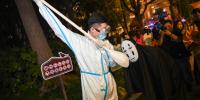
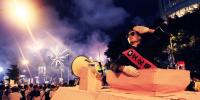
Several nights of Halloween celebration in Shanghai provided a vivid, if indirect, commentary this week on the malaise gripping the world’s second-largest economy.
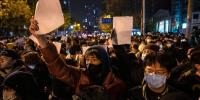
In Shanghai, a vigil grew into a street protest where many held blank sheets of white paper in a symbol of tacit defiance.
In Beijing, students at Tsinghua University raised signs showing a math equation devised by the Russian physicist Alexander Friedmann, whose surname in Chinese is a homonym for “free man.”
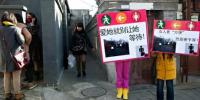
In March 2016, Chinese feminist activists had planned to launch a crowdfunding campaign against sexual harassment advertisements, and they worked hard to raise 40,000 yuan in a month and a half. However, after perfunctory, evasive, and rejection by the relevant departments, anti-sexual harassment advertisements finally failed to go online.
BANGKOK — The rhymes came to Nutthapong Srimuong before dawn, when Bangkok is as still as it can be and the night jasmine overpowers the Thai capital with its perfume.
The country whose capital is turned into a killing field
Whose charter is written and erased by the army’s boots
The country that points a gun at your throat
Where you must choose to eat the truth or bullets
China's "Punchline Queen" Yang Li is no stranger to controversy.
The 29-year-old is now one of the country's most well-known comedians, having risen to fame in recent months on a Chinese television show called "Rock and Roast".
Every week, in front of a national audience of millions, she addresses controversial gender issues using a style unfamiliar to many Chinese viewers - stand-up comedy.
In 2016, Zhou Zhenfeng, who was a student at a college in Hebei at the time, discovered that there were a lot of waste tires in the streets and alleys. Zhou Zhenfeng learned that tires are made of infusible or refractory polymer elastic materials. It takes hundreds of years for these materials to decompose in the soil to the extent that they do not affect the growth of plants.
Leilei Zhang was harassed on a public bus when a man gripped her hand, glared at her and refused to let go. With the determination to raise public awareness, Leilei began a crowd-funding campaign to raise money for what could have been China's first public anti-sexual harassment advertisement. She approached the authorities of her home city, Guangzhou, but it did not want to take on the advertising for fear it would panic the public.
“Everything is art. Everything is politics.” Globally renowned artist Ai Weiwei (Chinese, b. 1957) is celebrated as a disruptor of artistic canons and a champion of free expression. In his work—ranging across performance, photography, sculpture, video, and installation—he deploys humor and provocation, calling upon his viewers to examine history, society, and culture.
Japan has begun discharging nuclear wastewater into the ocean four times a year, each time lasting 17 consecutive days. Under their 30-year plan, it is estimated that approximately 1.34 million tons of wastewater from the Fukushima nuclear power plant will be released into what was once a clean and fertile sea. Countless marine species are forced to leave their natural habitats. About 7.6 billion people in the world face life threats.
The Guardian
By Tania Branigan
In the opaque world of Chinese censorship, a few red lines shine through the murk. One of the clearest is: no gossip about top political leaders, their families or internal party affairs.
The action art performance themed "War on smog, we are taking action" was held by some environmental activists and volunteers on the commercial center and famous tourist spot Yangren Jie (Foreigners’ Street) in Nanan district, Chongqing municipality in Southwest China on Friday, Febuary 28.
For his latest project, Mark Manzi found himself outside of his comfort zone. For the Amsterdam-based photographer and designer, People of Japan was an attempt to break from his photography-first portfolio. “In the past, my work was very image-focused, whereas with this book I wanted to scan objects, collect receipts, record noises, add copy, and really create something visually striking,” he says.
Students at art colleges across China are taking a strong stance in the midst of the largest wave of protests to have gripped the country since 1989. As demonstrations against the government’s strict Covid-19 policies erupted across the country over the weekend, students rallied on campuses to create protest art and graffiti.
Officials in Thailand had an unorthodox approach to deal with visitors who left a tent filled with litter in a national park: mail the trash to the offenders.
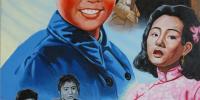
"Stand Up, Sisters" tells the story of a rural girl who journeys to Beijing for a family visit, only to be deceived and forced into prostitution, suffering unthinkable hardships. After the founding of the People's Republic of China, these women are rehabilitated. The narrative reaches its peak with her and her younger sisters' victorious achievement of self-reliance.
In early July 2012, after the Chinese college entrance examination results were announced, the media found that many colleges and universities had gender bias on the admitted scores, and the maximum difference between men and women was up to 40 points. This finding aroused widespread concern and dissatisfaction from the public.
“Girl’s Day” in China was supposed to be a way for boys on college campuses to show the girls how much they care. This year it went too far.
Have you heard about “Girl’s Day?” It’s a big holiday for Chinese college students. Every year on March 7, students throughout the country celebrate the day as a campus version of International Women’s Day.
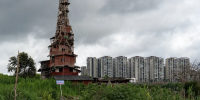
The structure teeters over fields of knee-high grass, looking like a cross between a camping tent and a giant wedding cake. Eleven stories of dark red wooden rooms, diminishing in size as they ascend, balance atop one another, seemingly held together by only the thicket of cords that stretches from the peak to the ground.
Female staff members at a new shop in Osaka, Japan are being encouraged to wear badges to indicate when they’re on their period to tackle the stigma surrounding menstruation in the country.
Women working at the Michi Kake store, which sells an array of female sexual and menstrual health products, do not have to take part in the scheme, but those that do will pin one of the “period badges” next to their regular name tags.
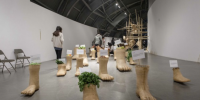
Ahead of a recent exhibition at the prestigious modern art museum OCAT Shanghai, the artist Song Ta described the process of creating his multimedia piece “Uglier and Uglier.” After secretly filming thousands of unsuspecting female college students, Song and three assistants painstakingly ranked them by their perceived attractiveness; those deemed most appealing featured early in the show, with the women on display getting progressively “uglier” as the
The Hong Kong 1 July protests are a surprising sight on the often chaotic stress. This day marks the transfer of Hong Kong from the United Kingdom to China (PRC) and is a public holiday it was originally thought to be a day of celebration. However, now it is mostly known for hundreds of thousands of people flooding the streets who protest for democracy, universal suffrage, and other political concerns.
The Nanjing Yangtze River Bridge, completed in 1968, is one of China’s most iconic infrastructural projects and a potent symbol of national pride. Spanning over 6,700 meters across the Yangtze River, it was the first double-decked road-rail truss bridge designed and built entirely by Chinese engineers, without foreign assistance, during a time of intense geopolitical isolation.
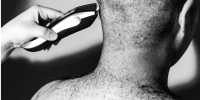
In this black-and-white image, there are no strands of hair or remnants of makeup to be found, except a shaved head belonging to a South Korean. Jeon photographed this image in 2019 for her exhibition that aimed to "destroy the socially defined idea of a woman” (Kuhn 1). The visuals in this image is a brazen response to the conventional beauty standards that has been gripping South Korean women.
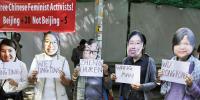
Nancy Lindisfarne and Jonathan Neale write: Five Chinese feminists have been arrested for planning to protest against sexual harassment. They face five to ten years in jail. This post explains the background to the case, and suggests ways that other activists around the world can show solidarity.