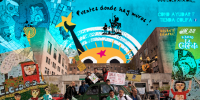
The "I'm Not A Joke" campaign from Daniel Arzola is a series of images inscribed with compelling truths about human diversity that encourages individuals to live as their authentic selves. He wants the images to eventually appear on buses and subways, exposing audiences to the realities of queer experiences in an attempt to break down prejudice in a form of activism that he calls "Artivism."
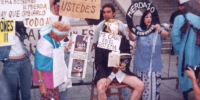
After the economic crisis of December 20, 2001 in Argentina, there was a growth in the participation in all types of protests and claims of the different sectors affected by the crisis (against banks by savers, roadblocks and mobilizations of picket movements, state employees in municipalities and government houses, neighborhood assemblies, etc). The situation that was experienced led the protesters to seek new and varied reporting strategies.
Through his environmental, social justice organization, Instituto-E, Dr. Oskar Metsavaht, the creative director behind ethical fashion brand, Osklen, joined forces with Rainer Nolvak, founder of international civic sanitation movement, Let's Do it and Umer Pter, head of External Relations and Estonian delegate at the Rio+20 U.N.
In Women Are Heroes, JR introduces women who sometimes look death in the face, who go from laughter to tears, who are generous, have nothing and yet share, who have had a painful past and long to build a happy future.
Regina Galindo is a Guatemalan performance artist that uses her body as a means to explore many of the human rights violations in Guatemala. In one of her performances, " no perdemos nada con nacer," or " we don't lose anything by being born," the artist "disposes" of herself in a plastic bag.
Directed by Fernando Sariñana, Todo el poder centers around the politics and corruption that shroud the Mexican police system. Featuring Demián Bichir as Gabriel, a filmmaker whose career has left him assaulted and robbed in broad daylight more times than he cares to remember, the film itself was inspired by Sariñana's personal experience with urban crime oftentimes perpetrated by the police themselves. ~ Tracie Cooper, Rovi
Born as a side project Las hijas de Violencia approaches the subject of street harassment and gender based violence through performance art, punk and video that is addressing socially legitimized male violence. "As actresses and as women we feel directly affected and consider it urgent to address the real cause of the problem: its ideological nature.
From this article: https://www.bbc.com/news/magazine-27632527
A campaign by one of Brazil's biggest football clubs to encourage fans to become organ donors has led to a massive rise in the number of life-changing transplants and reduced waiting lists for organs in the area almost to zero.
Aníbal López, also known by his government identification number A-153167, is a pioneer of performance art in Central America. ArtBus describes his work as, "Generally aimed at immersing viewers into the region’s social and political tensions, his works combine the dry language of 1960/1970s conceptual art with the revolutionary ethos of a Latin American guerrillero.
The notorious, wanted, and merciless leader of the Sinaloa drug cartel in Mexico,"Jouquin "El Chapo" Guzman, was captured by Mexican Marines last month. This marked a small victory for Mexico's fight to rid the country of its corrupted drug trade. How did this happen? Through intelligence of course, but let us remember Anonymous in Mexico.
Many artists are inspired to bring climate change into their work after a direct experience with it. Catherine Sarah Young hopes her work helps people understand and talk about their experiences with climate change.
El Sistema, also known as The National System of Youth and Children’s Orchestra and Choir, was established in Venezuela in 1975 by José Antonio Abreu, a Venezuelan educator, musician and activist. The music education program operates within the voluntary sector and is funded publicly.
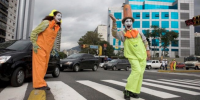
"Mimes gesture as they stand in a crosswalk in Caracas, Venezuela, Friday Oct. 7, 2011. The mayor of the city's eastern district of Sucre has launched a unique program aimed to encourage civility among reckless drivers and careless pedestrians, putting 120 mimes at intersections to politely and silently scold violators"
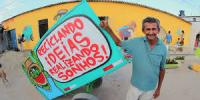
With the intention of recognizing the work of the Latin American carreteros (garbage pickers) that collect recyclable materials in wheel carts, and increase environmental consciousness, artist Mundano created “Pimp My Carroça"
New York Times
January 28, 2012
By SIMON ROMERO
SÃO PAULO, Brazil — This mega-city’s authorities have waged war for years against what they call “visual pollution,” banning billboard advertising, demolishing abandoned skyscrapers and planning to raze concrete eyesores like the elevated highway known as the Big Worm.
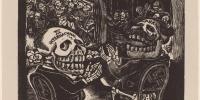
Born on June 30, 1902, in Mexico City, Leopoldo Méndez would become one of Mexico’s most significant and beloved graphic artists of the twentieth century. Méndez was one of eight children in a poor household. At a young age, Méndez used art as a means to bring joy to the Mexican community and attended the Academy of San Carlos located in Mexico City.
The work of a radical theater and puppetry collective, known as Papel Machete, produces and performs throughout Puerto Rico and the United States. Papel Machete was established on May 1, 2006 during protests responding to the government shutdown and political and economic crisis prompted by Puerto Rico’s status as a United States colony.
More than 20 years ago, a psychology student doing his training at one of Argentina's oldest psychiatric wards kept being asked by his family and friends what it was like to work in there. So he came up with an idea: to let the patients explain in their own words.
The first radio station to broadcast from inside a mental hospital was born.
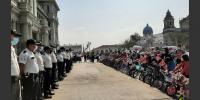
Non-profit organizations and a multitude of Guatemalan girls protested together demanding justice and security from the government. Guatemala's insecurity and cases of girls' disappearances have increased over the years. The protest started outside the Government Ministery (Ministerio de Gobernación) early in the morning, where protestors gathered riding their bikes.
Prison inmates in Mexico have suffered from coronavirus infections at a higher rate than the country as a whole, and pandemic lockdowns have reduced their already limited contact with the outside world.
But one group of women inmates at a prison west of Mexico City have managed to benefit, as the lockdown spurred a wave of professionals with time on their hands to donate online classes.
Thousands took to the streets in Lima, Peru, on March 11 to protest conservative presidential frontrunner Keiko Fujimori, daughter of former dictator Alberto Fujimori, and demand that her candidacy be revoked amid accusations of vote buying.
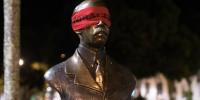
An artist in Brazil, who remains anonymous, placed red blindfolds on the eyes of statues across the city of Rio de Janeiro to protest the country's political crisis.