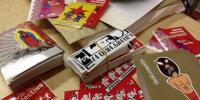
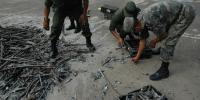
Palas por Pistolas initiated in the city of Culiacán, a city in western Mexico with a high rate of deaths by gunshot. The botanical garden of Culiacán has been comissioning artist to do interventions in the park and my proposal was to work in the larger scale of the city and organize a campaign for voluntary donation of weapons.
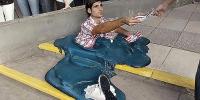
A young man melting into a puddle of himself is something you don’t see everyday, much less in a busy public square. Yet this humourous but surprisingly effective spectacle is the latest effort by the Red Cross of Argentina to raise awareness about climate change.
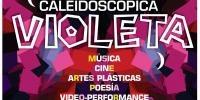
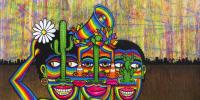
Caleidoscópica Violeta, is a creative space for reflection, dialogue, critique, and praxis of pop contemporary feminism. It is also an initiative that seeks to reflect on the role of women in the history of modern art. Historically, the role of women in art has been stolen by the patriarchy. Recognizing this as a feminist artist, I propose this festival as a way to open new spaces for women protagonists in the arts.
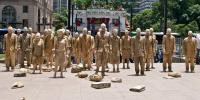
A troupe of approximately thirty women and men of various ages, sizes, ethnicities and performance backgrounds marched through the performance art space of SESC-Vila Mariana in Sao Paulo and then through the streets of downtown Sao Paulo, silent, blind folded, dressed in business attire, and covered completely with a gray mud. The performances walked slowly in unison at turtle's pace.
Covenant House has started a ‘Sleep Out’ movement that shines light on the youth homelessness crisis and raises funds for young people who seek shelter. "Covenant House empowers young people to overcome homelessness and trafficking by providing them with safe housing, food and clothing, and relentless support. Sleep Out events are held for people who want to join the movement as they give up their bed for one night in NYC.
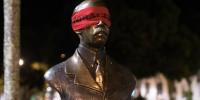
An artist in Brazil, who remains anonymous, placed red blindfolds on the eyes of statues across the city of Rio de Janeiro to protest the country's political crisis.
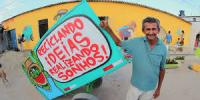
With the intention of recognizing the work of the Latin American carreteros (garbage pickers) that collect recyclable materials in wheel carts, and increase environmental consciousness, artist Mundano created “Pimp My Carroça"
Beating Cancer is a hard task. Cancer patients spend endless days in the hospital receiving a multitude of tolling treatments that we understand are necessary to save our lives. However, when you're a kid, it isn't always so easy to understand what's going on. As the chemo kills bad cancer cells, it also kills good cells in your body, which causes various unpleasant side effects.
Sublevarte, a Collective of Mexican artists, was born out of the ENAP (National School of Fine Arts) of UNAM (the National Autonomous University of Mexico), during the student strike of 1999-2000, the longest student strike in history.
An artist in Culiacan, Mexico—which has the highest rate of gun deaths in the country—has found a way to transform the agents of death into seeds of life.
In 2008, artist Pedro Reyes started running television ads urging locals to exchange their guns for food coupons to be redeemed at local stores.
The campaign—Palas Por Pistolas, or “Shovels for Guns"—collected 1,527 guns, which Reyes publicly smashed with a steamroller.
While governmental support for arts and culture is often meager, the Brazilian national government has recently demonstrated great interest in the industry. They've just introduced a "cultural stipend," which provides workers with 50 real (roughly $25) per month for arts and cultural expenses. The allowance covers personal spending on things like movies, concerts, books or museums.
“ARTICULO 6: narratives of gender, strength and politics” is an activist design project that aims to raise awareness about the case of forced sterilizations implemented during the government of Alberto Fujimori in Peru.
São Paulo went through a process of privatization of the public spaces. The local government implemented several rules that beneficiated the real state speculation, the city is expensive, and it's not for the poor.
Besides that, in october the elections were a hard game for the progressive party, PT, since two conservative candidates had big shares.
"Brazilian artist Mundano is used to spending his time on the road and in the streets, making art as an act of protest. Known for leaving his colorful works of graffiti on walls around the world, Mundano is especially dedicated to issues of environmental and social justice and spotlighting the overlooked work of Brazil’s trash collectors through his Pimp My Carroça campaign.
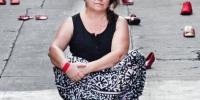
Elina Chauvet’s red shoes are worldly. They’ve been in Milan, Italy, and Grand Rapids, Michigan. Not just one pair, but hundreds — red boots, red heels, red toddler shoes. They’re not there to see the sights, but to take up space. Especially when the women or girls who would have worn them no longer take up any space, except in the lives of their loved ones.
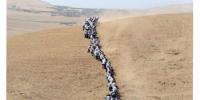
Five hundred volunteers with shovels gathered at a huge sand dune on the outskirts of Lima, Peru, and over the course of a day moved it by several inches. Alÿs developed the idea after first visiting Lima in October 2000. The political context was inescapable: “This was during the last months of the Fujimori dictatorship. Lima was in turmoil with clashes on the streets, obvious social tension and an emerging movement of resistance.
It was October 31st, 2012, when a new artist appeared on social media. In a series of video clips, she proposed with a soft and slow speech that Peru hide its poverty. Her project consisted of installing vinyl pieces to avoid what she called "the visual pollution." She titled the project Don't be poor, be fashion(able).
The following is a description of the action that Huffington post published online on 6/25/2011:
"Student demonstrators took to the streets of Santiago dressed as goblins and ghouls from Michael Jackson’s 'Thriller' video in their latest spirited pursuit of higher education reforms."
FloodNet was a conceptual artwork and a tool for online collective action.
Developed by the collective Electronic Disturbance Theater (EDT), it took the form of a Java applet that allowed users to send useless requests or personalized messages to a remote web server in a coordinated fashion, thereby slowing it down and filling its error logs with words of protest and gibberish—a kind of virtual sit-in.
ARTS/CULTURE
FOKAL is the hub in Haiti where locals and international visitors from all walks of life -- artists, writers, citizens, activists-- come together to discuss the most pressing nation- and community-building issues, enjoy cutting edge artistic expressions, and share their ideas.
Puerto Rico doesn’t know what’s going on here, and if they do, they’re ignoring us.” So opens Gabriel Miranda’s documentary Vietnam, Puerto Rico. Focused on the coastal community of Vietnam, which is located in the Guaynabo, the doc tells the story of a disenfranchised population being displaced over the past two decades to make room for a glitzy new waterfront development.
This project consisted of an articulation between research, public policy and art. Corpovisionarios por Colombia was implementing a social change initiative in one of the poorest and most violents neighborhoods in Cali, Colombia. The demographic information showed that the most implicated population in the violence and murder cases were young men. They informed their masculinity through ideas of territory and its violent protection.
“How different. Exotic,” commented one women as she watched a group of almost 50 people — mostly young and black, many wearing bright fabrics with African designs — stroll through the Shopping Leblon mall.