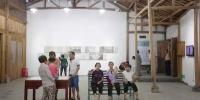
“There are many problems in rural areas. For example, agriculture is declining, no one is farming, traditional things are falling apart, farmers are brainwashed by the idea of urbanization, and they don’t like their hometown. They all want to move to the city.”Activist Ou Ning said. Rural construction is an important issue. As an activist, he chose Bishan village in Anhui, China as the field to start his experiment, which is “Bishan Project”.
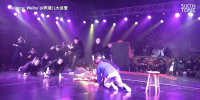
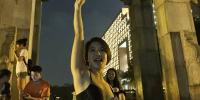
A viral video of a student dance performance in southern China’s Guangxi Zhuang Autonomous Region has won praise for speaking out against so-called ghost marriages, which many today see as an archaic and even dangerous tradition.
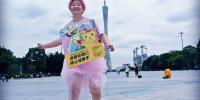
Leilei Zhang was harassed on a public bus when a man gripped her hand, glared at her and refused to let go. With the determination to raise public awareness, Leilei began a crowd-funding campaign to raise money for what could have been China's first public anti-sexual harassment advertisement. She approached the authorities of her home city, Guangzhou, but it did not want to take on the advertising for fear it would panic the public.
Just the other day, we were hearing about Samsung getting in legal trouble over patent violations with Apple. A federal court decision ruled that Samsung owes Apple more than $1 billion in restitution.
By NAZANIN LANKARANI
PARIS — Five years after his rise to the top of the Chinese contemporary art market, Yue Minjun has something new to smile about.
Best known for his large-scale paintings depicting his own smiling face, Mr. Yue, who is based in Beijing, has long been a star of the Chinese contemporary art scene, having achieved commercial success through a highly singular aesthetic.
The New Culture Movement was initiated by Chen Duxiu, Li Dazhao, Lu Xun, Hu Shi, Cai Yuanpei, Qian Xuan and other writers who had received Western education (called the new-style education at the time). It is an ideological and cultural innovation and literary revolutionary movement.
If there’s one thing we know for certain about China in 2019, it’s that people there love their apps. They use WeChat to talk with friends; they spend hours battling virtual enemies on PUBG; they binge-watch short videos on Douyin. And so why shouldn’t the Communist Party get in on the action?
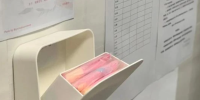
From October to December 2020, Chinese university students nationwide launched a viral movement to install “menstrual pad mutual aid boxes” in women’s restrooms—free, wall-mounted containers stocked with disposable pads on a take-one, replace-one basis. Nearly 250 campuses joined within weeks. Some sustained their boxes for over a year, while others saw them vanish after bureaucratic pushback, logistical hurdles, or dwindling volunteer resources.
In early January, constructions workers in Wuhan, China staged a Gangnam Style protest in front of their employer's building. Using the Gangnam Style dance, the men sought to bring media attention to their mounting unpaid wages.
Yu Hong’s Female Writer, a painted and photographic portrait of the writer Zhao Bo 趙波 (b. 1971), recalls courtly images of idealized beauties. Yu, however, deliberately complicates the perspective in her composition: she asked the sitters for her She series to select photographs of themselves that could be paired with her paintings, meaning that the images together convey dual female perspectives, both the artist’s and the subject’s.
As the summer warms up, bringing with it sleeveless tops, Xiao Meili, a women’s rights advocate, is collecting photos of women’s armpits. Her goal: to challenge a growing belief in China that a woman must have hair-free armpits to be attractive.
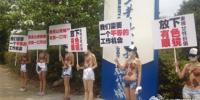
Female students from the Guangdong University of Technology in Guangzhou called for equal job opportunities and for people to "pay attention to the value of women" while protesting on the school's campus, shirtless and covered in body paint.
The photos, taken by ogling passersby, have been circulating on Weibo and naturally netizens stand divided on whether the semi-naked protests were empowering or counterproductive...
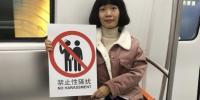
Zheng Xi 郑熹, a Ph.D. candidate with a focus on gender studies at Zhejiang University in Hangzhou. Zheng has launched a campaign asking city governments around China to display anti-sexual-harassment logos, complete with a groper’s “salty-pig hand” visual (etymological context here), alongside other commonly displayed public safety logos on places like subway trains and buses.
Zuoxiao Zuzhou is a Chinese singer whose accented, croaky voice is hardly ever in tune. But for his fans he's the voice of a generation — one of the very few voices who dare to speak out. After a collaboration, Cowboy Junkies member Michael Timmins called him "China's Leonard Cohen."
This is a series of paintings reflecting the struggle and sacrifices made by the Tibetan people for independence. The author is Tenzing Rigdol, who is a Tibetan and influenced a lot by the Dalai Lama and traditional Tibetan culture. The paintings are full of Tibetan cultural elements. For instance, the characters created in the paintings are Tibetan monks, who are the typical representatives of their culture.
Women in China are covertly resisting government crackdowns on discussions over their Me Too movement with a clever workaround.
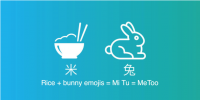
The phrase “rice bunny” (米兔), pronounced as “mi tu,” has popped up on social media networks after censors removed posts that mentioned sexual harassment or the hashtag #MeToo. While those phrases are heavily monitored, Rice Bunny isn’t.
Ahead of a recent exhibition at the prestigious modern art museum OCAT Shanghai, the artist Song Ta described the process of creating his multimedia piece “Uglier and Uglier.” After secretly filming thousands of unsuspecting female college students, Song and three assistants painstakingly ranked them by their perceived attractiveness; those deemed most appealing featured early in the show, with the women on display getting progressively “uglier” as the
Simple Wedding Movie is an organization in China that cares about love and marriage and offer marriage service. It made a short video with the theme: experience getting old before getting married. Most people would get married in a young and beautiful age. During that time, they are young and beautiful. Because of that, young couple may more likely to have passion and love for each other.
Whose Utopia? was made by the Chinese artist Cao Fei and filmed at the OSRAM lighting factory in Foshan in the Pearl River Delta in southern China during 2005 and 2006. It was commissioned as part of a project entitled ‘What Are They Doing Here?’ that was run by the Siemens Art Program from 2000 to 2006 and involved Chinese artists undertaking six-month-long residencies at industrial facilities across the country.
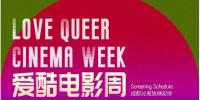
Founded 19 years ago, the Beijing Queer Film Festival (aka Love Queer Cinema Week) is one of the grassroots film festivals in China focusing on independent queer film screenings and cultural exchange activities. We aim to expand public discussions on sexuality / gender identity / gender expression, we aim to give a platform to sexual and other minorities in China and the World, and we celebrate diversity.
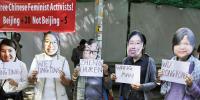
Nancy Lindisfarne and Jonathan Neale write: Five Chinese feminists have been arrested for planning to protest against sexual harassment. They face five to ten years in jail. This post explains the background to the case, and suggests ways that other activists around the world can show solidarity.
With delicate composition, striking details and strong emotion, five editorial posters drawn by Wuheqilin have attracted some half million followers to his account on Sina Weibo, China's Twitter-like social media platform. His political views expressed in his art have led to some netizens dubbing him the "Wolf Worrier artist."
The screen portrayal of a cancer sufferer whose illegal import of foreign medicines into China spurred national policy changes has become a box-office smash as audiences flock to a rare Chinese film on a hot-button issue.
Dying To Survive is based on Lu Yong, who was arrested in 2013 after illegally importing a generic cancer drug in a case that sparked public debate about high medical costs.