After J.Cole posted a song that implies that Noname can get her message across to a wider audience if she changes her tone, she releases another song in response. However, instead of explicitly responding to his critique, she uses the controversy to shed light on the death of Black female activist Oluwatoyin Salau, who was killed by her assaulter.
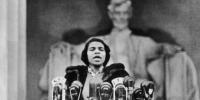
Marian Anderson, the legendary African American contralto, sang at the Lincoln Memorial on Easter Sunday in 1939 after she was refused a performance at Washington’s Constitution Hall by the Daughters of the American Revolution because she was black. Over 75,000 people attended the performance, which was broadcast live on the radio and arranged in part by First Lady Eleanor Roosevelt with the support of her husband, President Franklin D.
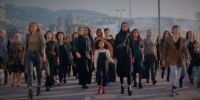
Last month, on the International Day for the Elimination of Violence Against Women, dozens of women gathered outside the supreme court building in Santiago, Chile—a country now beset by popular uprisings against inequality—for a feminist flash mob.
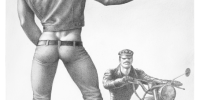
Touko Valio Laaksonen (8 May 1920 – 7 November 1991), known by the pseudonym Tom of Finland, was a Finnish artist who made stylized highly masculinized erotic art, and influenced late 20th-century gay culture. He has been called the "most influential creator of gay pornographic images" by cultural historian Joseph W.
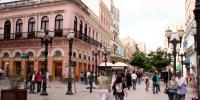
In the 1970s, Jaime Lerner, the former mayor of Curitiba, Brazil, transformed six blocks of the main downtown shopping street into a pedestrian zone in 1972, despite fierce objections from the merchants. He quickly accomplished this change in just three days by installing paving, lighting, planters, and furniture. The once-resistant merchants were impressed by the increase in their business and soon demanded an expansion of the traffic-free district.
The Stanford Daily:
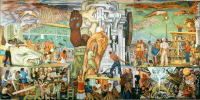
There is no word short of “spectacular” that better describes the experience of examining “Pan American Unity,” Diego Rivera’s 1940 mural, housed since 2021 at the San Francisco Museum of Modern Art (SFMOMA). The piece is the crux of SFMOMA’s soon-closing exhibition, “Diego Rivera’s America,” curated by James Oles and Maria Castro.
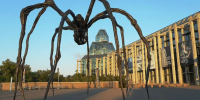
Through the use of mythical and archetypal iconography, Bourgeois translated her encounters into a very individualized symbolic imagery, employing things such as swirls, arachnids, cages, surgical equipment, and sewed appendages to represent the feminine mind, beauty, and mental agony.
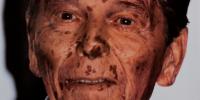
Ronald Reagan was elected President of the United States on November 4, 1980. In less than a year, in the Summer of 1981, AIDS was first identified in medical journals. However, it took until 1987 before he would give his first major address on AIDS.
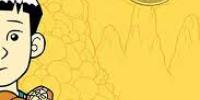
American Born Chinese is a graphic novel published in 2006 by the American author and illustrator Gene Luen Yang. Through three interweaving stories that span from the 16th century to the present, the novel explores issues of Chinese American identity, anti-Asian racism, and assimilation. American Born Chinese is the first graphic novel to be nominated for a National Book Award.
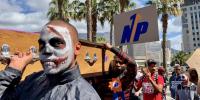
The Yes Men join Reclaim the City in their fight against unjust housing policy. On September 30, 2019, a horde of zombies attended a "#natsneverdie rally" at the Cape Town Civic Centre in order to celebrate Mayor Dan Plato and the Mayoral Committee and to support their policies, which are increasingly similar to those of the National Party under Apartheid.
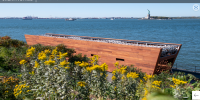
Moving Chains is a monumental 110-foot long kinetic sculpture that evokes the hull of a ship, built from steel and Sapele, a tree native to West Africa commonly referred to as African Mahogany. Inside of the sculpture, nine chains run overhead: rotating on a maritime sprocket system, eight of the chains represent the pace of the currents in New York Harbor, while a ninth central chain moves more quickly, mimicking the pace of a ship in transit.
Brother Gao are two China artists. Their works are aims at reflecting the reality of Chinese society in an artistic and critical view. In 2003, the brothers held an event to invite many strangers for a dinner.
Máximas de Seguridad, a survival manual written and illustrated by Jhafis Quintero creates a new voice for the voiceless, vulnerable and underprivileged groups in prisons and creates empathy for those that are labeled as dangerous by society. The manual aims to provide empathy and humanity in light of the public scrutiny that ex-prisoners endure in the transition to social reintegration.
In early 2016, I began paying attention to reports about the incredible number of unarmed black people being killed by the police. The posts on social media deeply disturbed me, but one in particular brought me to tears: the killing of Alton Sterling in my hometown Baton Rouge, La. This could have happened to any of my family members who still live in the area. I felt furious, hurt and hopeless.
Work ideology centers around sustainable work. Through fifteen interviews, workers and prospective workers were interviewed about their experiences with work and the job search. Those interviews are analyzed and compiled on work ideology. However, work ideology goes further than showcasing the interview results, it allows for anonymous responses to be entered as well, expanding the research’s accessibility to every worker.
To honor their battle, Lebanese women's rights organization ABAAD launched a powerful song and music video titled Not Your Honor. The clip was launched on the occasion of the "16 Days of Activism against Gender-Based Violence" initiative which took off on Nov. 25, the International Day for the Elimination of Violence against Women.
Mis(s)placed Women? (2009-2022), is a collaborative art project, consisting of performances, performance series, performance art workshops and delegated performances, including contributions by over 180 individuals from six continents. Many of them are artists, mainly identifying themselves as women from diverse backgrounds. Mis(s)placed Women?
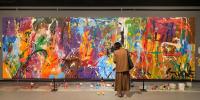
At a gallery within a shopping complex in the South Korean capital, a couple saw paint cans and brushes at their reach and use next to what was actually a finished portrait worth hundreds of thousands of dollars. Thinking the available paint and brushes was a signal to be a part of the art, they ended up technically vandalizing the artists' work.
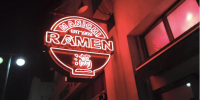
As the cold air bit our faces, and we hid deeper into our layer of sweaters, my family and I continued to wander around Manhattan, seeking a place which would provide warmth and food. And there it was, dimly lit: the Michelin-starred ramen restaurant, Tonchin. We ordered the highly-sought after ramen bowl, Tonkotsu, and awaited our meal. Out of the kitchen, the steam arose from a bowl of a warm, salty pork broth.
On a drizzly, overcast afternoon, all is quiet at the intersection of Bartholomew and Prieur streets in New Orleans’ historic Ninth Ward. The quiet neighborhood around the Ellis Marsalis Center for Music (EMCM) feel worlds away from the historic French Quarter packed with jazz clubs, bars, restaurants, and markets.
This is the sixth piece of the series Tatlin’s Whisper which examines the relationship between apathy and anaesthetization of the images in the mass media. This series intends to activate images, well-known because of having been repeatedly seen in the press, but are here decontextualized from the original event that gave way to the news and staged as realistically as possible in an art institution.
"The Second October Revolution"
105 NY-110, Melville, NY 11747
August 14, 11 am – September 8, 7 pm
Tuesday – Saturday, 11 am – 7 pm, free admission
Please write to racc.ny@mail.ru or call (347) 662 1456
The artist is available for interviews
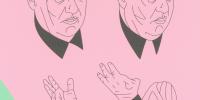
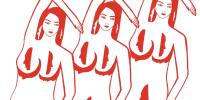
“My image was inspired by the #MeToo Revolution, my personal experiences with the male gaze and a healthy amount of frustration and repulsion. What I hope to convey in this image is the sense of verbal, physical and energetic male ownership that is placed on women in society.”
— Beata Kruszynski is a freelance illustrator and art teacher in Ontario, Canada.
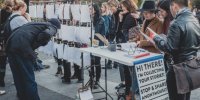
The Strangers Project is a celebration of the stories we’re surrounded with every day—both from the strangers we share our space with every day, and our own stories we carry. It’s about a connection with ourselves, with people around us, and with something greater than ourselves.