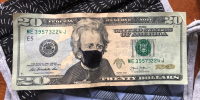
#thisisnotamask
Covid-19 Pandemic Rubber Stamp Currency Intervention
Website: https://thisisnotamask.tumblr.com/
For more information:
Joseph DeLappe artist/activist – j.delappe@abertay.ac.uk
Brent Richardson media artist – brent@BrentRich.com
Let’s mask the presidents!
Share Your Water Story invites every global citizen to participate in a creative conversation around the different ways in which water impacts our lives. The project encourages people to contribute original expression of any kind via online platforms on the global justice issue of water and sanitation.
Benjamin Von Wong’s latest art-as-activism installation looks like something Photoshopped onto reality. A large brass-looking faucet, suspended in the air, pours a river of plastic out of its spout.
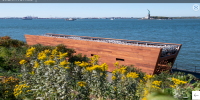
Moving Chains is a monumental 110-foot long kinetic sculpture that evokes the hull of a ship, built from steel and Sapele, a tree native to West Africa commonly referred to as African Mahogany. Inside of the sculpture, nine chains run overhead: rotating on a maritime sprocket system, eight of the chains represent the pace of the currents in New York Harbor, while a ninth central chain moves more quickly, mimicking the pace of a ship in transit.
"Beginning in 1910, the Mexican Revolution spawned a cultural renaissance, inspiring artists to look inward in search of a specifically Mexican artistic language. This visual vocabulary was designed to transcend the realm of the arts and give a national identity to this population undergoing transition.
Dan Perjovschi is one of Romania’s foremost artistic voices. Although known as a talented multi-disciplinary artist in his home country, particularly for his early performance work, he is most widely known internationally for his massive drawing installations.
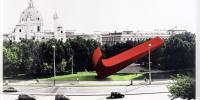
In September 2003 the news went out nationwide: Karlsplatz, one of Vienna's main squares, is soon to be renamed Nikeplatz. Apart from the new name, it appears that a huge monument in the shape of Nike's famous "Swoosh" logo will be built in Nikeplatz. Needless to say, it is all fake.
"The Red Power Movement of the 1960s and 70s was a time of profound social change and progress for American Indians in the United States and Canada. In her outspokenness about the injustices facing Indigenous people, Buffy Sainte-Marie also sang for peace, the environment, women and children—believing that art can have impact and make a difference.
Over the past few years, the public’s understanding of the issues that transgender people face has grown exponentially, but many people have never actually spoken to a transgender person.
Work ideology centers around sustainable work. Through fifteen interviews, workers and prospective workers were interviewed about their experiences with work and the job search. Those interviews are analyzed and compiled on work ideology. However, work ideology goes further than showcasing the interview results, it allows for anonymous responses to be entered as well, expanding the research’s accessibility to every worker.
In 1996, filmmaker John Akomfrah created the character of the Data Thief as a narrative device to offer an insightful study of Afrofuturism in his film The Last Angel of History, which links Black musicians including George Clinton, Derrick May, and Sun Ra to Akomfrah’s thesis about the role of technological fantasy in Black artistry across genres and mediums.
Topless queer men light spliffs on the beach. A trans man injects testosterone on the toilet. Drag queens nonchalantly scroll through their phones and smoke. These are just some of the images that make up the new book from Leo Adef. Titled WARP, it’s comprised of photographs captured across four years spent in Barcelona's queer underworld
On the small island of Teshima in Japan’s Seto Inland Sea, Multibasket – No One Wins invites visitors to reconsider competition, collaboration, and the intersection of art and play.
At first glance, it seemed like any other Monday evening in Görlitz, the most eastern town in Germany — where Poland sits just across the river. It was July 31, and a couple hundred people had gathered as part of the so-called Monday demonstrations to protest refugees, the COVID-19 vaccine and the government’s green energy politics.
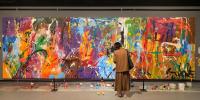
At a gallery within a shopping complex in the South Korean capital, a couple saw paint cans and brushes at their reach and use next to what was actually a finished portrait worth hundreds of thousands of dollars. Thinking the available paint and brushes was a signal to be a part of the art, they ended up technically vandalizing the artists' work.
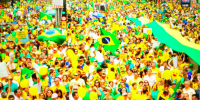
Vem Pra Rua is a nonpartisan, democratic, and pluralist movement that emerged in response to society’s fight for a better Brazil. Brazilians of all regions, social classes, and ages began mobilizing at the end of 2014—building on the 2013 marches that protested corruption, inequality, and other socio-economic and political problems.
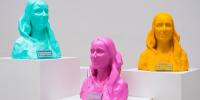
MONUMENT #1 is a series of sculptures by the Bulgarian artist and designer Erka, created in collaboration with Fine Acts. The work seeks to raise awareness about the lack of monuments honoring notable women in Sofia, the capital of Bulgaria - a EU member state.
The brightly-coloured busts were placed at some of the most central locations across Sofia during a covert early-morning action on Wednesday, March 22.
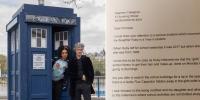
When the boys were sent on a field trip to a hardware store and girls went to get their hair done, this modern dad didn’t get mad, he got hilarious. He wrote a letter notifying the school that there was a rift in the time space continuum somewhere in the school and that his kids had been sent back to 1968. He requested that the administration fix the timewarp immediately. This kind of humor is a hallmark of creative nonviolence.
Iran is a nation with a fine art tradition that stretches back thousands of years; its reputation for contemporary fashion design less so. Writing that from an external, Western perspective may read unduly dismissive, but it’s a statement that holds up even from within the country’s borders, Shiva Vaqar assures us. “Being a designer has never really been considered a serious job here,” she says over the phone from Tehran.
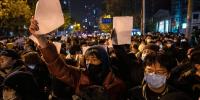
In Shanghai, a vigil grew into a street protest where many held blank sheets of white paper in a symbol of tacit defiance.
In Beijing, students at Tsinghua University raised signs showing a math equation devised by the Russian physicist Alexander Friedmann, whose surname in Chinese is a homonym for “free man.”
I Shop Therefore I Am (1987) is the work of Barbara Kruger . It became an iconic artwork, being reproduced on items such as shopping bags and other consumer products such as t-shirts. Kruger has often derived images from the mass media and pasted the words over them, particularly in Futura Bold . She then uses advertising to design her works.
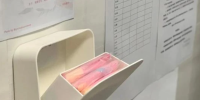
From October to December 2020, Chinese university students nationwide launched a viral movement to install “menstrual pad mutual aid boxes” in women’s restrooms—free, wall-mounted containers stocked with disposable pads on a take-one, replace-one basis. Nearly 250 campuses joined within weeks. Some sustained their boxes for over a year, while others saw them vanish after bureaucratic pushback, logistical hurdles, or dwindling volunteer resources.
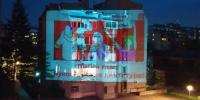
For the past few years around election time in Serbia, people have taken to the streets to protest government corruption, attacks on free press and voter suppression. This Spring, despite a nationwide lock-down to combat the COVID-19 pandemic, activists are finding new ways to protest the country’s increasingly-repressive government.
Sixth Tone - "A group of women trying to raise awareness of LGBT rights by advertising their single, gay sons and daughters at Shanghai’s “marriage market” were forced to disperse after a heated confrontation with other parents and security personnel.The so-called “marriage market” at Shanghai’s centrally located People’s Park draws a large crowd of parents who post signs each weekend describing their children in an effort to find a suitable partne
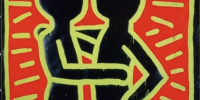
Keith Haring is known to be one of the biggest artists raising awareness for HIV and AIDS, considering he had also passed away from HIV. Starting his career covering ads with spray paint and chalk in subway stations in New York City, his work started trending and he became an activist for this cause.