The egregious practice that some Muslim men employ to divorce their wives instantaneously and without their consent, merely by uttering the word talaq (divorce) three times, has finally been declared unconstitutional and illegal by the Indian Supreme Court. The country’s ruling Bhartiya Janata Party (BJP) party claims that the ban is a victory for its administration, which had been advocating its abolition since it came to power in 2014.
New Delhi: With his ‘climate fast’ entering its fourth day at Khardungla pass (18,000 ft) at -40 °C, Sonam Wangchuk — the renowned engineer, educationist and reformer from Ladakh took to Twitter, urging the people of India to join him on the last day of his fast in support of Ladakh.
In her peppy and helpful online video tutorial, Reshma Bano Quereshi promises to teach her viewers “how to get perfect red lips.”
But unlike the more than 200,000 other online videos dedicated to the application of lipstick, this one goes beyond plumping and priming.
A social experiment testing the public’s reaction to gay people in China has gone viral.
The blindfolded activists stood in public wearing T-shirts that said “I’m gay would you hug me?” and video of the protest then spread rapidly on Weibo, a hugely popular social media platform in China.
The social experiment follows a recent announcement by Weibo to ban gay content on its platform of 400 million active users.
Miku is a Japanese virtual idol. She is 16 years old. Miku is created in 2007 and has been heavily promoted since 2008 and was originally aimed at professional musicians. On September 12, 2007, Amazon.co.jp reported sales of Hatsune Miku totaling 57,500,000 yen, making her the number one selling software of that time. She was the first vocal to be developed and distributed by Crypton Future Media and sung in Japanese.
Brother Gao are two China artists. Their works are aims at reflecting the reality of Chinese society in an artistic and critical view. In 2003, the brothers held an event to invite many strangers for a dinner.
Dear Team
Please find below the links of the video and detail of Kind Coins Pakistan, Kids for Peace Pakistan School
and Peace Centre, hope you will publish it on your website and circulate it at large,
your this publication and circulation can change the lives of Pakistani kids and children
Kind Coins for Pakistan
The Propaganda Machine is a battle cry delivered in the language of extreme metal. On Sahil Makhija’s fourth solo album as Demonstealer, he takes aim at the right-wing politicians, racist nationalists, disinformation artists, and religious extremists who manipulate and exploit the masses, in his native India and all over the world. He doesn’t mince his words; just about every lyric on the album could easily be printed on a protest sign.
The forests of India are a critical resource for the subsistence of rural peoples throughout the country, but especially in hill and mountain areas, both because of their direct provision of food, fuel and fodder and because of their role in stabilising soil and water resources.
“Badass Indian Pinups” is a series of paintings by Indo-Canadian artist Nimisha Bhanot, that features paintings of Indian women being confident and sexually liberated.
The Kodaikanal Won't video by Chennai artist Sofia Ashraf, asking Unilver to 'clean up their mess' in connection with the Kodaikanal mercury dumping, has gone viral with over 783,533 views at the time of writing this, in just over two days. It has been shared on social media by prominent personalities such as Nandita Das, Varun Grover, Vishal Dadlani and was even praised by Nicki Minaj, on whose song Anaconda, the rap is based on.
Many artists are inspired to bring climate change into their work after a direct experience with it. Catherine Sarah Young hopes her work helps people understand and talk about their experiences with climate change.
Dogs featured in one ruse to ridicule the regime—pictures of dictator Than Shwe were hung around the necks of the stray dogs that roam the streets of Rangoon. The pictures, which rapidly found their way onto the Internet, are the work of an exiled Burmese satirist who goes by the name of Mr Creator. Downloaded copies of his pictures and cartoons are popular items among cyber dissidents.
Namo Nazi
Namo Nazi is a group which is dedicated to the cause of spreading awareness about fascism. They create anti-fascist T-Shirts and say this about themselves:
Concept
1. This is a participatory art action initiated by Action Office, aiming at questioning current democratic elections in Singapore and shaping an alternative possibility.
2. Design the pocards to resemble ballots, inviting people to fill out election results and mail them to the corresponding country’s polling stations or current government.
Delhi- based graffiti artist who goes by the name Daku went around South Delhi, one of the poshest places in the city, and painted on overflowing garbage cans.
Meet To Sleep, a campaign started by Blank Noise, asks citizens from all across India to come to different public spaces like parks, and sleep there in order to take back free spaces without being afraid for their safety. The first meet was organised in November, 2014, in Bengaluru’s Cubbon Park. And since then there have been eleven meets across various cities including Jaipur, Pune, Mumbai, and Bengaluru.
To call attention to bullying, the Singapore Coalition Against Bullying for Children and Youth has released a video that gets shorter each time it is viewed.
Hosted on a site called Share It To The End, the short animated video depicts a boy getting bullied at school and telling us he always feels alone and doesn’t feel safe anywhere.
Zubair Magray, who goes by the stage name Haze Kay, raps about the conflict in Indian-administered Kashmir. The 23-year-old, one of the first rappers to emerge from the valley, blames the Indian military for "ruining" his homeland.
She seeks to utilize her feminist art to spread awareness on mental health issues. Sravy is a nomad in her own right, and throughout her experiences in Asia she has noticed that there are stimas surrounding women's autonomy and how they handle mental health struggles.
T.I.E. is a residential, 24-hour, intensive experience during which participants will be: introduced to aesthetics of Immersive Theatre, guided through a practical exploration of these strategies, and mentored in the creation of an immersive, theatrical experience about a social justice issue -- a piece that can be shared at the end of the workshop with an invited audience of their choice
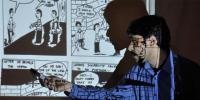
With World Comics India, the organization he started, Sharad has pioneered a cheap and easy medium for poor people to communicate meaningfully on issues that are neglected by the conventional media. While the urban elite dominates public media, the grinding day-to-day concerns of millions are rarely heard. Layers of discrimination and abuse heaped on huge numbers of people keep their problems out of sight and out of mind.