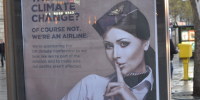
Brandalism, an organization out of the UK that aims to reclaim public spaces from advertisers, used Black Friday to protest "partner" brands to the COP21 Climate Conference.
Anonymous artists contributed subvertisements that criticized these brand for their hypocrisy in saying they are advocates for the environment when more often than not they are the worst contributors to the problem.
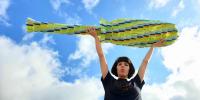
Environmental activist Ella Daish has created a giant tampon applicator as part of a protest against single-use plastic. The piece is made out of period plastic found polluting beaches, waterways, and local ecosystems in the UK. Daish sourced 1,200 applicators from 15 different locations across the United Kingdom. Of the plastic applicators collected for the project, 87.5 percent came from one brand, Tampax.
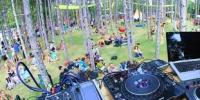
Festival “WakEUp!” (organized by “Heartefact”) happened at several locations, and included film and exhibition program. Festival originated from the need for a reaction to the present moment refugee crisis and the situation in the world, began on the 7 th of December at Gallery “G12 Hub” in Belgrade with two days performance that was dedicated to the current problem of refugees and their historical destinies.
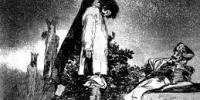
Francisco Goya created “The Disasters of War” from 1810-1820. These 80 etchings and aquatints show scenes from the Spanish struggle against the French army under Napolean Bonaparte, who invaded Spain in 1808. When Napolean tried to install his brother Joseph Bonaparte, as King of Spain, the Spanish fought back, eventually aided by the British and the Portugese.
The KLE - Kit de Libertad de Expresión (or Freedom of Speech Kit), is a portable digital device that allows people from all over the world to participate to remote protests by sending and displaying text messages in public space. The interactive banner is (unsurprisingly) inspired by the record number of social protests that took place in Spain in 2011. It is estimated that over 23.000 demonstrations have been organised that year around the country.
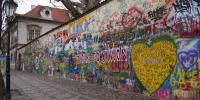
Prague's Lennon Wall is a tourist attraction to some, and a participatory street art haven for others. Directly opposite of the French embassy, the wall has been filled with evolving art and graffiti since the 80s. The wall received its first public inscription, a tribute to John Lennon, following Lennon's assassination in September 1980.
Michael Landy made an inventory of every single thing he owned: every item of furniture, every book, every work of art, every article of clothing and one Saab car. Cataloguing all his possessions took a year to complete and the final list comprised 7,227 items.
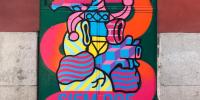
El Rey de la Ruina (The King of the Ruin) has become an act of powerful recognizable symbolism throughout Madrid. In terms of his popular heart symbolism, the artist chose the organ, a heart, as one of his favorite symbols because he was diagnosed when he was little with cardiomegaly, an abnormal increase in the volume of the heart, which is what inspired this organ as his prize art symbol.
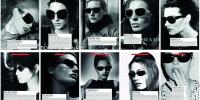
Croatian artist Sanja Iveković started Women’s House (Sunglasses) in 1998 in collaboration with a women’s shelter in Zagreb and later with women’s shelters elsewhere in Europe and Asia. Iveković organised workshops with women in these shelters to produce plaster casts of their faces, as well as to give them the space to write their life stories.
In 1994, the human rights and environmental activist KenSaro-Wiwa was arrested and accused of incitement to murder. Eighteen months later, following a show trial condemned by human rights organisations, he and eight other leaders of the Movement For the Survival of the Ogoni People were executed by hanging, an act that propelled the story on to the front pages of newspapers worldwide.