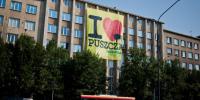
Greenpeace advocates displayed a banner outside of the Ministry of the Environment in Warsaw. The banner reads "I love primeval forests" to protest against tree felling in Bialowieza Forest.
Protesters dressed as construction workers wearing hard hats and scaling the Ministry of the Environment building on harnesses.
The government will introduce more rigorous vetting procedures for firearms licences and restrict access to semi-automatic weapons.
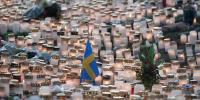
Sweden plans to toughen controls on gun ownership after its deadliest mass shooting in at least a century.
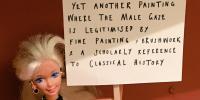
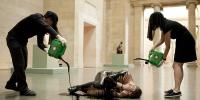
Museums and art galleries are not usually the sites of feminist political protest. Yet over the past couple of years, before the lockdown, gallery visitors all over the UK had noticed a small, determined activist whose modus operandi is “Small signs, big questions, fabulous wardrobe”.
This project was born a few days after a demonstrator lost an eye after being hit by a rubber bullet shot from police guns in Barcelona. Unfortunately, it was not the first time. "Cop d' ull" means a "a blow to the eye" and also "at a glance”, which is a perfect description of this project.
<br>Care2.com April 9, 2012 By Sarah Vrba
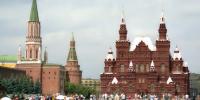
There have been regular protests in Moscow in the wake of Vladimir Putin’s re-election to the presidential seat in March. Early last month, thousands of protesters gathered in downtown Moscow in response to what they felt were rigged elections in favor of Putin. Over the last month, organizers have faced an uphill battle as they have attempted to keep protesters motivated.
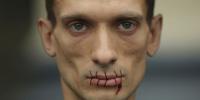
These two works on canvas were made with my own blood, using the severed distal phalanx of my index finger as the painting instrument. They are connected to my solo anti-war action in Copenhagen in September 2026.
Their central messages are “No to War!” and “Peace & Love!” The index finger—the finger used to pull a trigger—became the central symbol of my refusal to participate in aggression and the killing of other people.
Oh, to be a crow.
Maligned as scavengers that torment their dead brethren. Portrayed as aerial killers in the 1963 Alfred Hitchcock classic, “The Birds.”
In France, though, the wily crow is getting a makeover. Puy du Fou, a historical theme park in the Loire region about four hours from Paris, has trained six crows to pick up cigarette butts and bits of trash and dump them in a box.
Mon Dieu! Are the pigeons of Paris next?
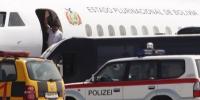
On July 2nd, 2013, after attending the Gas Exporting Countries Forum (GECF) conference, Bolivian President Evo Morales departed Russia from Vnukovo Airport in Moscow aboard his presidential plane. However, a "leak" suggested that Edward Snowden was aboard, which led Spain, France, and Portugal to close their airspace to the aircraft, to then be grounded in Austria.
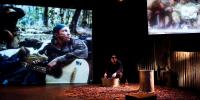
"On Friday, March 15, 2013, for the launch of the 20th edition of the Bayeux-Calvados Award for War Correspondents, the theatre company Map performed Jusqu’au bout, a play directed by David Ropars based on a text by the photojournalist Eric Bouvet. It was a great success! The monologue was given a magnificent interpretation by the actor Jean-Pierre Morice.
The Guardian:
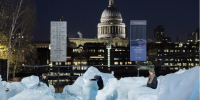
Olafur Eliasson is putting the chill into climate change. The revered Scandinavian artist has placed 24 large blocks of centuries-old ice, harvested from the Nuup Kangerlua fjord in Greenland, in a circle outside the Tate Modern in London, with another six on display in the City.
The Yayoflautas, or Iaioflautas is an organized group of senior citizens from different cities and regions of Spain. Like many others, the movement started during the first months of life of the 15-M movement, in Barcelona.
Zoo Portraits is a humorous photo series by Barcelona-based photographer Yago Partal that matches animal heads with human bodies. Partal amazingly matches animals to appropriate human bodies and even manages to match their personalities and styles.
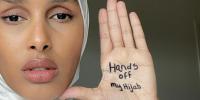
"Sixteen year-old Mariem Chourak is a devout Muslim who considers wearing a hijab an expression of her devotion to the Prophet Mohammad, but a proposal by French senators might soon deny her the freedom to do so in public spaces.
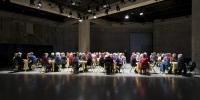
"Suzanne Lacy is an internationally known artist whose work includes installations, video, and large-scale performances on social themes and urban issues. One of her best-known works to date is The Crystal Quilt (Minneapolis, 1987) a performance with 430 older women, broadcast live on Public Television." (http://www.suzannelacy.com/)
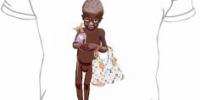
Danish 26-year-old art student Nadia Plesner designed this T-shirt depicting a Darfurian child holding a Louis Vuitton handbag as commentary on global disparity as it relates to war, developing nations, commercialism, and media.
In 2006, the fashion house sued Plesner for her appropriation of their trademark. The case was subsequently dismissed.
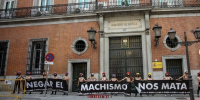
Today over 40 people gathered at the Ministry for Internal Affairs in the centre of Tirana, the capital of Albania. The issue is Tirana's drinking water, which is not clean, unreliable as it comes out of the tap only a few hours a day and that sewage systems continue to pollute the water sources.
FEMEN is an organization that is revolutionizing the feminist movement. Founded in Ukraine in 2008 and adopted in Spain in 2013, FEMEN protests gender-based issues such as inequalities, violence, patriarchy, etc. Since its creation, it has spread to several other countries, and there have been hundreds of organized protests.
When President Trump announced the US departure from the Paris Climate Accord on 1 June 2017, his enjoyment at walking over the efforts of national delegations and hundreds of pressure groups across the world who fought for that deal was palpable. I was in Paris in December 2015 during the negotiations, when the possibility of a global agreement was merely that, a fragile potential.
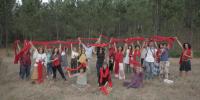
Linha Vermelha was created in 2016 by the non-profit organization Academia Cidadã (Citizenship Academy). At that time there were fifteen active contracts for oil and gas drilling and we were inspired by the “Red Line Action” in Paris, during COP21 and decided to create this campaign.
In 2008, Iceland was in turmoil. There was a systematic failure of its three main commercial banks. The Economist called the collapse the largest suffered by any country in history, relative to Iceland’s population size. In response to what was seen as government inertia, protests began to take place from around October of that year. However, the real fun began in January 2009.