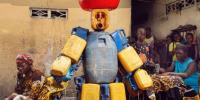
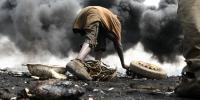
“So dramatic, so strong, so visual,” artist Stéphan Gladieu said of his first encounter with the revival of an ancestral folk art movement in Kinshasa, Democratic Republic of Congo. Kinshasa is the capital of Congo but also one of the many places American and European countries send their waste.
DOHA — In an interview with the Paris Review in 1993, the late Toni Morrison once said,
I think of beauty as an absolute necessity. I don’t think it’s a privilege or an indulgence. It’s not even a quest. I think it’s almost like knowledge, which is to say it’s what we were born for.
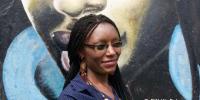
I am a visual activist. Most of what I have done over the years focuses on black LGBTQIA+ and gender-non-conforming individuals from South Africa and other neighbouring countries. It’s about making sure we exist in the visual archive. I call myself a visual activist — or, rather, a cultural activist, because this work is not only about the arts; I’m focusing on education, I’m dealing with culture in a way that confronts a number of issues.
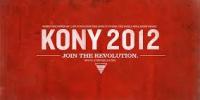
In 2004, the United Nations called the LRA crisis in northern Uganda the “most forgotten, neglected humanitarian emergency in the world.” Invisible Children was founded to change that and to fight against the false notion that our responsibility to each other stops at our own nations’ borders.
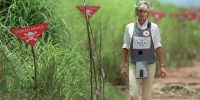
It's an evocative image — and it was intended to be: Diana, Princess of Wales, wearing a protective visor and flak jacket, walking through a live minefield in Huambo, Angola. The image of the princess, at the time one of most famous women in the world, surrounded by danger, made headlines across the world.
In February , two leaders of a guerrilla movement here traveled to the financial district carrying a wooden container that contained three pigs, each painted yellow from snout to tail.
Fespaco is a meeting place put to good use to promote the development of black cinematography. From 1973, topics of discussion are introduced at each edition.
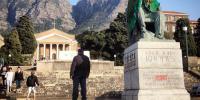
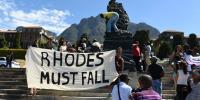
This series of protests began on the UCT campus in an effort to remove the bronze statute of Cecil Rhodes in the center of campus due to the belief that Rhodes represents the oppressive colonization of South Africa that eventually led to apartheid.
A beauty contest for landmine victims challenges normal concepts of beauty. The search for beauty takes many forms. The traditional beauty pageant might be thought to be one of the less acceptable, concentrating as it does on conventional ideas of female perfection. Miss Landmine is a challenge to normal concepts of beauty. It is a beauty pageant held in Angola, a country ravaged by war and its aftermath, for women who have lost limbs from landmines.
A TYPICAL EPISODE of Journal Rappé begins with Senegalese rapper Makhtar “Xuman” Fall dressed in a suit and seated behind a news desk. At first glance, the show looks like an ordinary newscast. But then Xuman (pronounced human) launches into his intro, rapping in French instead of talking. “Welcome! Make yourself comfortable. These are the news for you. Some good ones and bad ones too. But they’re all news for you.”
Joseline de Lima was wandering the dusty alleys of her working-class neighborhood in the capital of Togo one day last year, when a disturbing thought crossed her mind: Who would take care of her two boys if her depression worsened and she were no longer around to look after them?
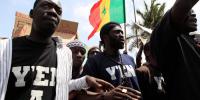
"Y’en a Marre (“We're Fed Up") first emerged in 2011 as a grassroots campaign against injustice and inequality in Senegal. Spearheaded by the hip hop group Keur Gui Crew in response to local power outages, the nascent protest movement went on to mobilize against the controversial bid by Senegalese president Abdoulaye Wade to remain in office for a third term.
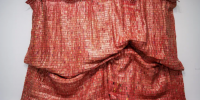
On August 14th 2014 several prominent statues within the city centre and the southern suburbs of Cape Town got redressed in green blankets, equipped with miner gear or carrying grocery bags. The statues – mainly of which represent colonial figures – were redressed in light of what has come to be known as the Marikana Massacre: the shooting of 34 miners by the local police force of Marikana, South Africa on August 16th, 2012.
By 2010, the Nigerian film industry, also referred to as “Nollywood,” had become the second-largest film industry in the world. Today, the accessibility of digital video technology continues to enable prolific amateur filmmakers to produce wildly popular low-budget and direct-to-DVD films, which deal with timely issues of religion, poverty, and corruption.
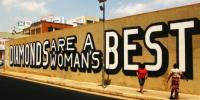
Africa has had a devastating history of blood diamond wars. Blood diamond refers to a diamond mined in a war zone and then sold to finance an invading army's war efforts, usually in Africa where more than two-thirds of the worlds diamonds are extracted.
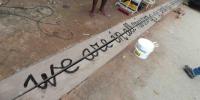
This site specific social / political word play was painted on the exterior wall of Johannesburg's largest diamond trader Jewel City.
The Green Belt Movement (GBM) was founded by Professor Wangari Maathai in 1977 under the auspices of the National Council of Women of Kenya (NCWK) to respond to the needs of rural Kenyan women who reported that their streams were drying up, their food supply was less secure, and they had to walk further and further to get firewood for fuel and fencing.
The term “Afrofuturism” was coined in the 1990s by the cultural critic Mark Dery, who recognized a preoccupation with the future in the work of a number of black artists. Ever since, it has remained a term that is retrospectively applied to seemingly disparate artists, from Missy Elliot to Toni Morrison. What unites the movement is a shared fascination with the black experience, particularly in America.
Driving along an ordinary dirt road, it's hard to miss the Goma Cultural Centre with its bright blue gate, emblazoned with the Congolese flag. "As you can see, we are proud to be Congolese around here," said Belamy Paluku, a volunteer manager at the youth centre.
The city of Douala in Cameroon had a huge problem associated with malfunctioning water drainage systems. This is due the fact that in many illegally constructed areas of the town, the sewers are without cover, and after heavy rainfall, this would generally lead to floods and related threats to public health.
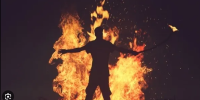
A video that was first posted on X (formerly Twitter) on November 8, of a Congolese man setting himself on fire has gone viral. The gruesome clip has started a discussion on whether a genocide is occurring in the DRC and is being ignored by both Africa and the rest of the world.
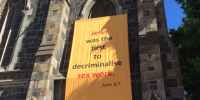
A big yellow banner hangs off the Central Methodist Church in Cape Town, South Africa proclaiming that *"Jesus was the first to decriminalise sex work - John 8:7"*
The Rwanda Film Institute dedicates a lot of its energy to the education of individuals in the field of filmmaking. Through our Kwetu Film School, we look to consistently breed the next generation of Rwandese filmmakers. This is an essential part of our overarching goal of the development of Rwanda culturally, economically, and communicatively through the growth of filmmaking as an industry.
In an endeavor to raise awareness at the local and international level, Razia organized the Mifohaza Masoala (Wake Up Masoala) music and environmental festival, which took place at the edge of the Masoala Rainforest in October 2011. The concert featured some of Madagascar’s most thrilling performers, and the festival was a tremendous success, with over 10,000 people in attendance.
Activist Boniface Mwangi on confronting corruption in his homeland, and director Sam Soko on recording his campaign
Kenyan director Sam Soko’s debut documentary feature, Softie, opens with the film’s protagonist, Boniface Mwangi, sourcing 1,000 litres of pigs’ blood. “I’ve found a van for you. When do you want it? When are you getting the blood?” Mwangi asks.