Students have accused university management of having a lack of concern about the issue.
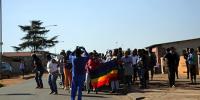
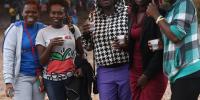
CAPE TOWN – University of Cape Town (UCT) students have stripped to their underwear to highlight their concerns over rape culture on campus.
Dozens of students have gathered outside the Bremner Building to discuss sexual assault and sexual harassment at the university.
The Rwanda Film Institute dedicates a lot of its energy to the education of individuals in the field of filmmaking. Through our Kwetu Film School, we look to consistently breed the next generation of Rwandese filmmakers. This is an essential part of our overarching goal of the development of Rwanda culturally, economically, and communicatively through the growth of filmmaking as an industry.
Photographer Thapelo Motsumi is one of many young South Africans who has worked with the Umuzi Photo Club to develop his artistic skills and engage his community. Now this “drop out” has had two exhibitions in London and has been entrusted with Mandela’s football jersey. By GREG NICOLSON.
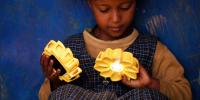
Olafur Eliasson's latest project Little Sun was first debuted at the World Economic Forum on Africa in 2012. The global initiative is bringing tiny, sunburst shaped, plastic solar powered LED lights to the most marginalized regions of the world. Elliasson calls Little Sun, "A work of art that works in life."The lights are also capable of self renewable energy, which makes them practical and portable to those without proper electricity.
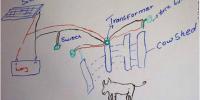
Richard Turere, 13, has devised an innovative system to protect his family's livestock from the wild beasts. He created "Lion Lights," which keeps the predators away from the family's enclosure. The Kenyan boy will speak about his invention at the TED 2013 conference.
Driving along an ordinary dirt road, it's hard to miss the Goma Cultural Centre with its bright blue gate, emblazoned with the Congolese flag. "As you can see, we are proud to be Congolese around here," said Belamy Paluku, a volunteer manager at the youth centre.
A beauty contest for landmine victims challenges normal concepts of beauty. The search for beauty takes many forms. The traditional beauty pageant might be thought to be one of the less acceptable, concentrating as it does on conventional ideas of female perfection. Miss Landmine is a challenge to normal concepts of beauty. It is a beauty pageant held in Angola, a country ravaged by war and its aftermath, for women who have lost limbs from landmines.
In 1978, while studying print-making in Hamburg, Gavin Jantjes was deemed a persona non grata by South Africa. His crime? Creating a series of prints that documented the violence and discrimination in the apartheid state, which he gathered together under the tongue-in-cheek name of a "colouring book".
In Women Are Heroes, JR introduces women who sometimes look death in the face, who go from laughter to tears, who are generous, have nothing and yet share, who have had a painful past and long to build a happy future.
The city of Douala in Cameroon had a huge problem associated with malfunctioning water drainage systems. This is due the fact that in many illegally constructed areas of the town, the sewers are without cover, and after heavy rainfall, this would generally lead to floods and related threats to public health.
In an endeavor to raise awareness at the local and international level, Razia organized the Mifohaza Masoala (Wake Up Masoala) music and environmental festival, which took place at the edge of the Masoala Rainforest in October 2011. The concert featured some of Madagascar’s most thrilling performers, and the festival was a tremendous success, with over 10,000 people in attendance.
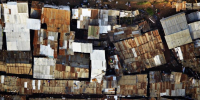
In a lively room in Kibera, Nairobi’s largest slum, a group of women have gathered to discuss how to keep the upcoming Kenyan election free from violence. The women are not politicians, election officials or campaigners – they are grassroots activists, working with their communities to keep the peace on August 8.
Drama Queens Ghana's “MoonGirls” is an Afrofuturistic graphic novel series. Through an Afrofuturistic lens, “MoonGirls follows the adventures of 4 African "supersheroes" with varying superpowers to save the world from a diverse range of forces; from patriarchy, rape culture to pollution and global warming.
ONGOING ORGANIZATION:
CALLED: Iranti [pronounced írantì] is the Yoruba word for ‘memory’. Largely found in South West Nigeria and parts of Benin Republic, the Yoruba people consider memory a prized form of intelligence which determines how often one remembers what they see and hear.
In her curatorial project Making Way, Ruth Simbao brought together works that complicated the idea of globalization’s effect on African nations, especially the idea that the new phase would usher in an almost frictionless movement of labor and capital across borders. Works by artists like Athi-Patra Ruga reflected on questions of how bodies moved through settler colonialist spaces.
The collective Ndaku Ya La Vie Est Belle, a group of Kinshasa street performers turn their bodies into living sculptures, and use them to political ends. Among the artists is Jared, who regularly takes to the streets dressed as Robot Annonce. The costume, made from broken radio parts, is designed to raise awareness of fake news. “People receive so much incorrect information and many inaccuracies are spread. I want to fight this,” says Jared.
By 2010, the Nigerian film industry, also referred to as “Nollywood,” had become the second-largest film industry in the world. Today, the accessibility of digital video technology continues to enable prolific amateur filmmakers to produce wildly popular low-budget and direct-to-DVD films, which deal with timely issues of religion, poverty, and corruption.
Djerbahood Project, which took place during the months of July and August on a small island called Djerba and is located in the Gulf of Gabes. Better known as the island of dreams, the tiny village of Djerba boasts a traditional and authentic Tunisian setting which acted as a blank canvas for hundred and fifty street artists from thirty different countries.
Our solution:
Fresh Direct Nigeria (Fresh Direct Produce and Agro-Allied Services) is “City Farming” using stackable container farms! Fresh DirectNigeria brings fresh premium organic produce closer to market with our Container Farm Technology.
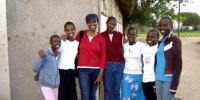
Mtendo MweMa Project's mission is to provide a safe house and educational opportunities to girls, especially those in danger of female circumcision, early marriage and pregnancy, whom otherwise have no alternative but to return to their villages during the holiday seasons in Kenya, East Africa.
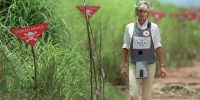
It's an evocative image — and it was intended to be: Diana, Princess of Wales, wearing a protective visor and flak jacket, walking through a live minefield in Huambo, Angola. The image of the princess, at the time one of most famous women in the world, surrounded by danger, made headlines across the world.
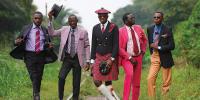
Their name, Sapeurs, comes from the French slang se saper, meaning to dress with class, but also from the acronym of their social group : La Société des Ambianceurs et des Personnes Élégantes (the Society of Ambianceurs and Elegant Persons). La Sape can be traced back to the early years of colonialism.
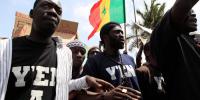
"Y’en a Marre (“We're Fed Up") first emerged in 2011 as a grassroots campaign against injustice and inequality in Senegal. Spearheaded by the hip hop group Keur Gui Crew in response to local power outages, the nascent protest movement went on to mobilize against the controversial bid by Senegalese president Abdoulaye Wade to remain in office for a third term.
Africa has had a devastating history of blood diamond wars. Blood diamond refers to a diamond mined in a war zone and then sold to finance an invading army's war efforts, usually in Africa where more than two-thirds of the worlds diamonds are extracted.
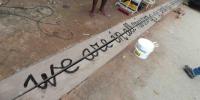
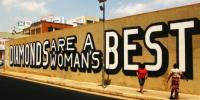
This site specific social / political word play was painted on the exterior wall of Johannesburg's largest diamond trader Jewel City.