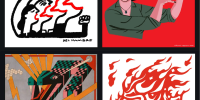
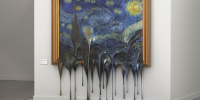
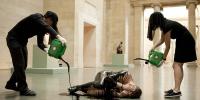
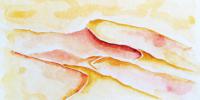
HOT ART EXHIBITION — is a series of visualizations following the question: What would happen if there would be no air conditioner during an extremely hot summer? This might be the result.
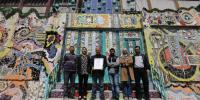
A group of Syrian artists in Damascus has created the world's biggest mural made of recycled materials, a rare work aimed at brightening public space in a city sapped by war and sanctions.
The brightly coloured, 720-sq metre work was constructed from aluminum cans, broken mirrors, bicycle wheels and other scrap objects and displayed on a street outside a primary school in the centre of the Syrian capital.
Yesterday, I procrastinated my way to watching the Savage X Fenty Show, and I was left in complete awe of Rihanna. She truly is a powerhouse, but on top of that, all her brands; Fenty Beauty, Savage X Fenty and Fenty have intentionally left no one behind.
Julie Dillon is a critically acclaimed illustrator, having been nominated and won multiple awards, including two Hugos and a Chesley. Her work often deals with science fiction and fantasy stories, and her work in the field has made her aware of the lack of diversity in this optimistic speculative fiction.
Sunaura Taylor is an artist, writer and activist. Through painting, printmaking, writing and other forms of political and artistic engagement her work intervenes with dominant historical narratives of disability and animal oppression. Taylor's artworks have been exhibited at venues across the country, including the CUE Art Foundation, the Smithsonian Institution and the Berkeley Art Museum.
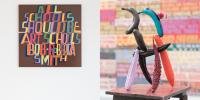
Bob and Roberta Smith has been at the forefront of activist art for 2 decades; so who better to ask about how art is responding to these politically bleak times?
When President Trump announced the US departure from the Paris Climate Accord on 1 June 2017, his enjoyment at walking over the efforts of national delegations and hundreds of pressure groups across the world who fought for that deal was palpable. I was in Paris in December 2015 during the negotiations, when the possibility of a global agreement was merely that, a fragile potential.
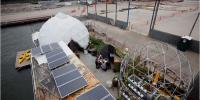
Waterpod™ was a floating, sculptural, eco-habitat designed for the rising tides. It launched in the summer of 2009, navigate down the East River, explore the waters of New York Harbor, and docked at several Manhattan piers on the Hudson River before continuing onward. The Waterpod™ demonstrated future pathways for water -based innovations.
❗❗PRIDE REQUIRES ACTION❗❗
Celebrating Pride?
What better way to uplift LGBTQ people’s lives than by joining our campaign to #EndTransDetention?
Honor the legacy of Pride by taking action until all of us are free.
Sign here & share with 3 friends:
https://www.endtransdetentions.org/petition
DOHA — In an interview with the Paris Review in 1993, the late Toni Morrison once said,
I think of beauty as an absolute necessity. I don’t think it’s a privilege or an indulgence. It’s not even a quest. I think it’s almost like knowledge, which is to say it’s what we were born for.
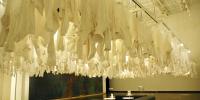
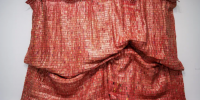
NORTHFIELD, Minn. — Exactly 1,281 white garments hang from the ceiling of the Perlman Teaching Museum’s Braucher Gallery. The collared shirts, knit sweaters, tights, and other items of clothing glow with an eerie luminosity.
By a pond inside one of the entrances to Beijing’s Chaoyang Park lies a cluster of one and two storey red pyramid-shaped buildings. Sculptures of Gandhi and Lincoln and other famous figures sit in the quiet woods nearby. This is Yuan Xikun’s Jin Tai Art Museum.
NAME OF PROJECT: ‘CHILDREN SHOULD BE SEEN AND HEARD’
TEAM MEMBERS: Caroline, Yasir, Sile, Audrey & Mary
GLOBAL CHALLENGE: To give children a voice and create empathy
among adults for children
♯childrenshouldbeseenandheard
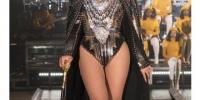
Beyoncé delivered an intensely, unapologetic celebration of Black and HBCU culture at the Coachella Festival 2 weekends in a row. Not only were her performances some of the best live performances to date but they sent a pretty significant message to the world.
Here are some assessments of this beautiful demonstration of Blackness and Black Girl Magic:
From BBC News:
David Černý has been called "l'enfant terrible" of Czech art. Since 1991, Černý continues to produce some of Czech Republic’s most famous political sculptures. His grand sculptures are almost always mocking the system through humor. Many of his well-known pieces remain as public art and have sparked much conversation. Examples of these can be found littered around Prague.
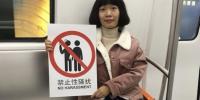
Zheng Xi 郑熹, a Ph.D. candidate with a focus on gender studies at Zhejiang University in Hangzhou. Zheng has launched a campaign asking city governments around China to display anti-sexual-harassment logos, complete with a groper’s “salty-pig hand” visual (etymological context here), alongside other commonly displayed public safety logos on places like subway trains and buses.
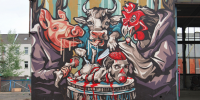
Creative Graffiti at the Urban Culture Festival in Germany
By Loredana Loy
A street art project by by KD Key Detail from Minsk, Belarus--created and featured at the IBUg 2013 Urban Culture Festival in Zwickau, Germany.
The project is entitled "Bon Appetit." Images speak louder than words. Links and photos below.
One in three women and one in four men are victims of sexual violence, the CDC reports. Martha Lluch is an artist and a survivor. Art is how she's taken control of her healing and of her life.
Platform ‘Iranian Women of Graphic Design’ share open-access protest posters to amplify #WomenLifeFreedom movement—triggered by the death of Mahsa Amini—in Iran and beyond.
Priya’s Shakti is an augmented reality comic blending Indian mythology with modern storytelling. It follows Priya, a rape survivor turned superhero, challenging cultural taboos around sexual violence and empowering women through art and technology.
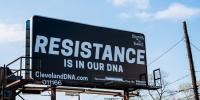
Shooting Without Bullets incubates young artist activists and eliminates systemic barriers in art and society for Black and Brown youth, all while spreading bold messages of justice and equity across Northeast Ohio and beyond. In Our DNA, their new public art initiative, uplifts Cleveland’s Black history to catalyze present and future racial equity, social justice, and civic engagement efforts across Cleveland communities.
I must first come clean, I studied fine arts in high school from years nine to 12. Since my studies were concluded, I had never held a paintbrush again.
Four months ago, I was in a multifaith brainstorm for the People’s Climate March when someone said, “What if we had a giant ark?” I think we all had the same reaction: Great … but how do you build an ark?
Without water, life would not exist. And yet, those of us in developed countries take it for granted; our shelves are stocked with hundreds of branded bottles, and it is freely given at restaurants, at schools, and even in parks. We seem to have an unslakable thirst for it; attained in excess, we throw it away like dirt—just as many developing countries liken its value to gold.