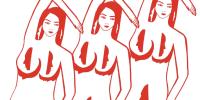
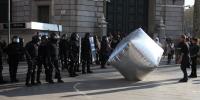
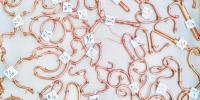
David Černý has been called "l'enfant terrible" of Czech art. Since 1991, Černý continues to produce some of Czech Republic’s most famous political sculptures. His grand sculptures are almost always mocking the system through humor. Many of his well-known pieces remain as public art and have sparked much conversation. Examples of these can be found littered around Prague.
The minaret of the Jara Mosque in Gabes towers over its surroundings. Formed of golden brick, it jolts up from the flat, sand-colored cityscape around it, all the better to broadcast the call to prayer across the coastal city.
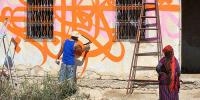
I went on a graffiti tour that went through NOHO, SOHO and the Lower East Side last weekend. We saw works by street artists - Space Invader and Roa - that were remarkable. Roa had created a commissioned mural of a bird on the side of a building, and the former artist derived his work from the unforgettable arcade game, Space Invader.
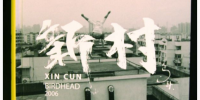
Song Tao and Ji Weiyu, established their collaborative named Birdhead in 2004. Both natives of Shanghai, their work is deeply rooted in their hometown and its evolution amid China’s growth into a global power. The duo takes diaristic snapshots, highlighting their everyday lives in the quickly changing city.
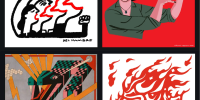
Platform ‘Iranian Women of Graphic Design’ share open-access protest posters to amplify #WomenLifeFreedom movement—triggered by the death of Mahsa Amini—in Iran and beyond.
Add Colour (Refugee Boat) begins as an all-white boat in an all-white room. Ono’s instruction for this collective, participatory work reads: ‘Just blue like the ocean.’ You are invited to contribute your hopes and beliefs in blue and white.
This article was published on the guardian website:
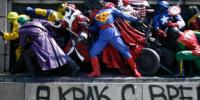
-Russia not amused at Red Army statue re-invented as Superman and friends-
Clenched teeth in Moscow over 1950s war memorial in Sofia given makeover by spray-painting street artist
By Tom Parfitt in Moscow
The Guardian, Wednesday 22 June 2011
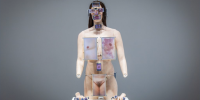
Filip Custic (Santa Cruz de Tenerife, Spain 1993) works across photography, performance and video to address themes around identity, body and our relationship with technology. Mirrors and screens are a recurring features, a reference to our age of image-obsession and selfies, and Custic also uses symbols, references to science, and art-historical borrowings in his art.
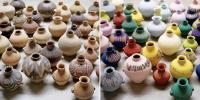
Exhibition visitors have expressed feelings of uneasiness or even pain and nostalgia when seeing Colored Vases by Ai Weiwei1. The 51 vases that make up the artwork are originally treasures from the Neolithic Age (5000–3000 BCE) and the artist has dunked them in common industrial paint.
Why did Ai Weiwei do it?
The Violence Against Women (VAW) Art Map was conceptualized in the fall of 2018, in the wake of the #MeToo movement by Dr. Lauren Stetz, as part of her doctoral research in Art Education with a minor in Women's, Gender, & Sexuality Studies at Penn State University.
In June of 1987, a small group of strangers gathered in a San Francisco storefront to document the lives they feared history would neglect. Their goal was to create a memorial for those who had died of AIDS, and to thereby help people understand the devastating impact of the disease.
Street activity to encourage small actions to help the bees at a local level that can impact on a global scale. By engaging the public in badge making we aimed to connect the head, hands and heart. We did this by providing a leaflet with information about the bees, badge making and encouraging people to take small actions. We did this as part of the Creativity and Change course, for more information on the course see below.
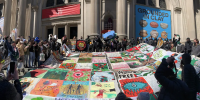
Hundreds of artists, cultural workers and activists gathered on the steps of the Metropolitan Museum of Art on Fifth Avenue in New York on Sunday (24 March), demanding that the most visited museum in the US publicly call for a ceasefire in the war in Gaza and commit to preserving Palestinian cultural heritage.
‘‘HAMILTON,’’ the new musical biography of Alexander Hamilton created by and starring Lin-Manuel Miranda, kicks off with a doozy of a question. The houselights rise on Aaron Burr, the third vice president of the United States and, infamously, the killer of Hamilton in a duel in 1804. Burr steps to center stage and reels off several lines of verse:
For Women’s History Month 2024, Hysterical Collective presented: Hysterical: Radical Creativity – the third instalment of the annual charity art exhibition and cultural programme taking place in March each year. Co-founded and curated by Eliza Hatch of Cheer Up Luv and Bee Illustrates, Hysterical is a queer and feminist-led exhibition and event showcase; centred around community, collaboration, and activism.
“My image was inspired by the #MeToo Revolution, my personal experiences with the male gaze and a healthy amount of frustration and repulsion. What I hope to convey in this image is the sense of verbal, physical and energetic male ownership that is placed on women in society.”
— Beata Kruszynski is a freelance illustrator and art teacher in Ontario, Canada.
For the past 20 years, Great Bend school district art teachers have been letting their students collaborate on an art project at the Barton County Historical Society Museum. This year, they will ground their efforts in working together to make a mural. Their teachers are trying to instill the fact that art builds community, as it has here for the past two decades.
If Not Now, When? is an ongoing exhibition that showcases the work of 31 female sculptors, employing diverse materials and forms to address social and environmental issues such as gender equality, nuclear disarmament, and electronic waste. The Hepworth Wakefield in England is hosting the exhibition from April 3 to July 4, 2023.
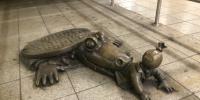
At the Eighth Avenue subway station, sewer alligators are not an urban legend.
Anyone who’s been through the 14th St./Eighth Ave. station has probably seen the bronze gator sculpture — and probably wondered what it means and why it’s there.
The underground gators — along with dozens of other whimsical creatures — are part of the permanent art installation housed at the intersection of the A,C,E, and L lines.
After artists learned that London's Design Museum was connected to Leonardo, a large arms dealing company, and hosted an event for them, many of the artists featured in their Hope to Nope: Graphics and Politics 2008-2018 asked the museum for their work to be removed. After receiving no response, one third of the show's artists removed their work from the show.
Indigenous people in Minneapolis supporting Black Lives Matter cite similar struggles
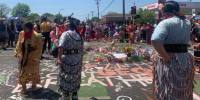
Jingle dress dancers held a ceremony at the intersection of 38th Street and Chicago Avenue in Minneapolis on Monday, the place where George Floyd was killed by police last week.
First: inflatables uplift a grim protest situation into a playful event. There is something magic about what inflatables induce in people. Their enormous size combined with the weightlessness and softness makes them irresistibly attractive and dreamlike. People have a natural tendency to touch the inflatable sculpture and to join the game of throwing inflatables in the air—changing a march into a poetic, joyful and participatory event.
According to the World Health Organization, China is home to two-thirds of the world's women who wear IUD devices. This is a form of contraception that was developed after World War II, and in essence, comes from discrimination against women. In 2014, artist Zhou Wenjing made a work of IEDs, which was recently exhibited in Beijing.
Alex King describes Project Ukko in detail for Huck Magazine (March 17, 2016):
"Moritz Stefaner’s Project Ukko turns climate and wind data into an immersive art installation that allows viewers to explore the future of the planet."