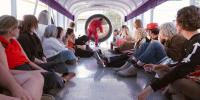
Glowing softly in the West Texas desert night, artist Guadalupe Maravilla’s Mariposa Relámpago, was once an ordinary school bus but is now a richly decorated, mobile site for remembrance and healing. Like much of the artist’s work, this piece commemorates and confronts the artist’s journey to the United States as an unaccompanied, undocumented minor fleeing civil war in El Salvador in the 1980s.
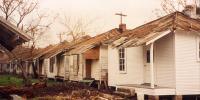
Project Row Houses (PRH) is a neighborhood-based nonprofit art and cultural organization in Houston’s Northern Third Ward, one of the city’s oldest African-American communities. PRH began in 1993 as a result of discussions among African-American artists who wanted to establish a positive, creative presence in their own community.
"Artbus is a non-profit organization devoted to the promotion and dissemination of contemporary art. Supported by contributions from individuals, foundations and corporations Artbus facilitates public access to current artistic expressions and fosters creativity and production by living artists.
Drama Queens Ghana's “MoonGirls” is an Afrofuturistic graphic novel series. Through an Afrofuturistic lens, “MoonGirls follows the adventures of 4 African "supersheroes" with varying superpowers to save the world from a diverse range of forces; from patriarchy, rape culture to pollution and global warming.
A young Black boy, wearing deep red livery with gold trimming, a gold earring, and red-and-white turban secured with a jeweled brooch, stares out at the viewer. Standing before a ship at sea, he hands a letter, addressed to “Monsieur le chevalier de Rohan, captain of the King’s ships at Rochefort,” to an older white man, dressed in regal-looking steel armor.
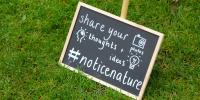
Notice Nature was a public engagement action undertaken by participants in the Erasmus+ funded training 'Creativity and Change: Empathy 2 Action - nurturing response-able global citizens' which took place in Cork from 8th - 13th April 2017. The team members were Marie-Michele Tessier, Aoife Dare, Ann Foulds, Zsofi Toth and Claire Faithorn.
Unveiling the Unseen
BlindWiki is a location-based audio network where citizens who are blind or partially sighted use smartphones to share their findings by posting sound recordings. The platform does not just contain information about difficulties and barriers but is also a repository for experiences, opinions and stories, generating a creative and collaborative cartography of the unseen.
In her curatorial project Making Way, Ruth Simbao brought together works that complicated the idea of globalization’s effect on African nations, especially the idea that the new phase would usher in an almost frictionless movement of labor and capital across borders. Works by artists like Athi-Patra Ruga reflected on questions of how bodies moved through settler colonialist spaces.
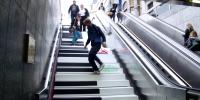
“Piano Stairs” is an interactive playful musical stairway installation created into the Odenplan underground station of Stockholm to make people use stairs more often than elevator. The project was part of a Wolkswagen initiative called “The fun theory” whose main objective and mission is to “change people’s behaviour for the better by making it fun to do.”
Conscious Lee is a public awareness project to help people value and protect their rivers. Rivers are rich sources of life and are vital for clean water. They are beautiful spaces to connect with nature. We all need to appreciate our rivers. We can all help river wildlife and protect this natural amenity for future generations.
El Sistema, also known as The National System of Youth and Children’s Orchestra and Choir, was established in Venezuela in 1975 by José Antonio Abreu, a Venezuelan educator, musician and activist. The music education program operates within the voluntary sector and is funded publicly.
At first, you don’t know what you’re looking at. A gray expanse of uneven geometry surrounded by undulating brown. Shift your perspective a bit and it might be a close-up of a distressed textile, with subtle hues and textures surfacing as your eyes adjust.
And then the horizon comes into focus. Now you know where you are. In the distance are the classic jutting buttes of Monument Valley, familiar to anyone who’s ever seen a John Ford Western.
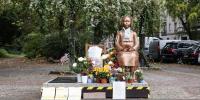
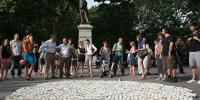
Photo taken on Oct. 15, 2020 shows a "comfort women" statue in Berlin, capital of Germany. The statue was built to commemorate the more than 200,000 girls and women from 14 countries and regions, so-called "comfort women," who were sexually enslaved by the Japanese military during World War II. (Xinhua/Shan Yuqi)
There is no embassy of Iran in Jerusalem.
We ask why.
We are a group of artists living and creating in Jerusalem, trying to create a new reality. one which we can identify with. A reality of dialogue between the people, not dominated by mass media and governments.
The Embassy as we imagine it will be functioning as a bridge for trading ideas, dreams and giving silent voices a sound through art.
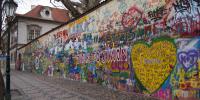
Prague's Lennon Wall is a tourist attraction to some, and a participatory street art haven for others. Directly opposite of the French embassy, the wall has been filled with evolving art and graffiti since the 80s. The wall received its first public inscription, a tribute to John Lennon, following Lennon's assassination in September 1980.
Promoted as a DIY festival with no corporate sponsorship, the 2015 Latino Punk festival in Brooklyn, NY featured bands from all over the Americas. With an emphasis on local bands supporting each other and nurturing local scenes, this festival functions in reference to the ideals of the punk and Riot Grrrl movements in the 1990s.
Empathy may be the cornerstone of any Global Justice movement, but how do we cultivate the conditions for empathy to thrive?
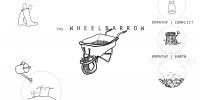
The wheelbarrow symbolises something universally useful, practical and pleasingly straightforward. A space to deliver things in an efficient and direct manner - no packaging and completely people powered.
During the Black Lives Matter protests in Richmond, VA, the two fourteen-year-olds posed in a powerful photo in front of Confederate General Robert E. Lee’s statue. Ava had originally arranged an appointment with photographer Marcus Ingram, but as she and Kennedy posed in front of the graffiti-covered monument with their fists firmly jutted in the air, several photographers began snapping pictures.
Founded by Bobby Gordon and Nayeli Adorador Knudsen, The Melrose Poetry Bureau is a public intervention involving a whole lot of typewriters, a public space, and the chaos that ensues. Once a location is picked for an intervention, Bobby and Nayeli pack up their collection of old and new, sleek and saggy typewriters and transport them to that place. They set up tables, distribute the typewriters, and invite people to come write poetry.
The veteran Malian master puppeteer Yaya Coulibali, born in 1959 in the village of Koula, around 100 kilometres north-east of Bamako, has more than half a century of experience in puppetry and has toured the world to perform his art.
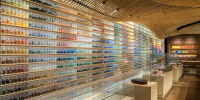
Established in 2015 in the Tennōzu neighborhood of Tokyo, and attracting industry professionals and art enthusiasts from both Japan and abroad, PIGMENT TOKYO has emerged as an art supply store specializing in the materials and tools used in traditional Japanese painting, such as mineral pigments, washi paper, and brushes. However, it’s more than just a store.
ŠTO TE NEMA is a public monument created as a response to Europe’s worst atrocity since World War II - the systematic killing of 8,372 Muslim men and boys in the UN-protected safe area of Srebrenica in Bosnia and Herzegovina in July of 1995.
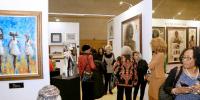
The International Harlem Fine Arts Show (HFAS) is the largest traveling African Diasporic art show in the United States. Inspired by the Harlem Renaissance, HFAS provides a platform for African Diasporic visionaries and American visual artists to exhibit and sell their artwork. The show also aims to create economic empowerment, educational opportunities and professional recognition within the multicultural community.
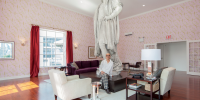
“Discovering Columbus,” by the Japanese artist Tatzu Nishi.
Nishi built a living room around the sculpture in Columbus Circle in New York City. The living room is mounted on scaffolding and turns the sculpture into a domestic center-piece.
"Send It On" is a song recorded by American recording artists Miley Cyrus, Jonas Brothers, Demi Lovato and Selena Gomez from charity project Disney's Friends for Change. The track's producers Adam Anders and Peer Åström co-wrote it with Nikki Hassman. The song was released on August 11, 2009 by Walt Disney and Hollywood Records as a charity single in order to benefit international environmental associations.