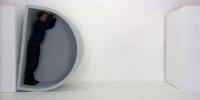
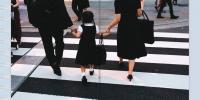
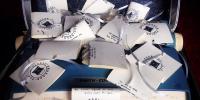
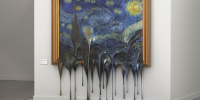
John Wood and Paul Harrison are renowned British artists whose collaboration has led to the merging of video art with performance and conceptual art. Their works usually reside on the relationship between human beings, objects, and the environment, with humor and wit attached to them. They are well in place to make the artworks thought-provoking and entertaining. One such has to be 'Device'.
WEST PALM BEACH, Fla. —
Supporters of the LGBTQ+ and arts communities in West Palm Beach are protesting the closure of two popular spots for creatives in the city.
The pro-democracy protests in Hong Kong have a new mascot: a roughly 12-foot-high figure of wood blocks holding a bright yellow umbrella in its outstretched right hand. The students call it Umbrella Man.
Umbrellas emerged as a symbol of the demonstrations after dozens of students wielded them on the night of Sept. 28 to fend off pepper spray as they jostled with the police.
This week, I got to make history. At 18 years of age, I received an honorary doctorate from the University of London for my work in climate justice, making me the current youngest holder of the award globally.
For his latest project, Mark Manzi found himself outside of his comfort zone. For the Amsterdam-based photographer and designer, People of Japan was an attempt to break from his photography-first portfolio. “In the past, my work was very image-focused, whereas with this book I wanted to scan objects, collect receipts, record noises, add copy, and really create something visually striking,” he says.
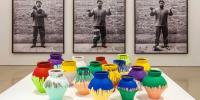
MIAMI — Officials at the recently inaugurated Pérez Art Museum Miami confirmed on Monday that a valuable vase by the Chinese dissident artist Ai Weiwei had been deliberately destroyed by a visitor in what appeared to be an act of protest.
For more than 30 years, the Guerrilla Girls have travelled the world exposing sexism and inequality in the art industry, and this week they proved Hong Kong was no exception.
Three members of the anonymous feminist collective—calling themselves Frida Kahlo, Käthe Kollwitz and Zubeida Agha—spoke at the University of Hong Kong on Monday, dressed in their signature black outfits and gorilla masks.
‘‘HAMILTON,’’ the new musical biography of Alexander Hamilton created by and starring Lin-Manuel Miranda, kicks off with a doozy of a question. The houselights rise on Aaron Burr, the third vice president of the United States and, infamously, the killer of Hamilton in a duel in 1804. Burr steps to center stage and reels off several lines of verse:
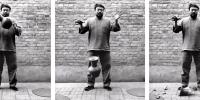
Dropping a Han Dynasty Urn (1995) by Ai Weiwei is a highly provocative work of art. This series of three black and white photographs portray the artist holding a 2,000-year-old Han dynasty urn that, frame by frame, he drops, it falls, and shatters. As much a work of photography as a work of performance art, in each still an unaffected Ai looks directly at the camera aware of his destructiveness.
Whose Chinatown? Examining Chinatown Gazes in Art, Archives, and Collections, brings together an art history of Chinatowns and their communities by historical and contemporary Canadian artists such Emily Carr, Unity Bainbridge, Yucho Chow, Fred Herzog, Paul Wong, Mary Sui Yee Wong, Morris Lum, and aiya哎呀, among others.
In her curatorial project Making Way, Ruth Simbao brought together works that complicated the idea of globalization’s effect on African nations, especially the idea that the new phase would usher in an almost frictionless movement of labor and capital across borders. Works by artists like Athi-Patra Ruga reflected on questions of how bodies moved through settler colonialist spaces.
As local rapper Naty says, a group of young people are intent on making their mark in Madagascar's cultural history. From gifted slam poet Caylah to inventive visual artist Temandrota and a crew of entrepreneurial skateboarders, a generation of young Madagascans are making space for creative projects.They are inspiring in their enthusiasm and hopeful for the future despite the poverty in their country and its colonial past.
"Myanmar has been engulfed in protest since February 1, when Burmese army general Min Aung Hlaing seized control of the government in a military coup, refusing to accept to the landslide election victory of the National League for Democracy and its leader, Aung San Suu Kyi.
Rokudenashiko is on a mission to free the vagina. In her native country of Japan, the vaginal slang word “manko” is considered taboo while the penis equivalent, “chinko,” is used freely. Rokudenashiko (the pseudonym of artist Megumi Igarashi) uses her manko art to destigmatize the vagina, using it as the basis for whimsical figurines, iPhone cases, dioramas, and, in her most infamous piece, a kayak.
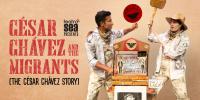
The play celebrates the life and legacy of the Mexican-American labor activist César Chávez. His early life as well as his partnership with Dolores Huerta, activism with the National Farm Workers Association, the 1968 grape boycott, and his ongoing commitment to nonviolent civil rights work.
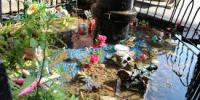
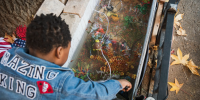
The Bed-Stuy Aquarium (also known as the Hancock Street Bed-Stuy Aquarium) is a makeshift goldfish pond located on a sidewalk in the Bedford-Stuyvesant, Brooklyn neighborhood of New York City. The pond, originally formed by a puddle from a leaky fire hydrant, garnered attention from locals and the press beginning at the time of its creation in August 2024.
The Bed-Stuy “aquarium” is back.
The neighborhood’s beloved sidewalk fish pond was resurrected this week — in an act of defiance that comes just five days after the city cemented over the original and left the neighborhood’s goldfish to die.
Founded by Bobby Gordon and Nayeli Adorador Knudsen, The Melrose Poetry Bureau is a public intervention involving a whole lot of typewriters, a public space, and the chaos that ensues. Once a location is picked for an intervention, Bobby and Nayeli pack up their collection of old and new, sleek and saggy typewriters and transport them to that place. They set up tables, distribute the typewriters, and invite people to come write poetry.
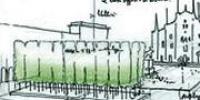
Claudio Abbado was an Italian orchestra director (1933 - 2014) who served as chief director at La Scala Theater in Milan from 1968 - 1985. After 18 years of absence, in 2009, he was invited to conduct a concert there. He accepted upon condition that, instead of paying him a monetary honorarium, the city would commit to the planing of 90.000 trees in the city of Milan.
The current cultural and political context in Macedonia marginalizes lesbians and women in general, and the dominant political party forces the traditional role of the woman, where she is a mother, a housewife, and of course, heterosexual. Furthermore, the major TV stations are flooded with Turkish soap operas, where traditional values are the leitmotif of the show.
HOT ART EXHIBITION — is a series of visualizations following the question: What would happen if there would be no air conditioner during an extremely hot summer? This might be the result.
The China Folk House project grew out of the Sidwell Friends School China Fieldwork Semester, a program which had ran for five years (2014 – 2018) that took students to Yunnan Province, China, for an integrated semester of experiential learning based at the Linden Center in Xizhou.
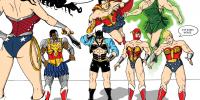
Submission for The Line is Drawn, theme "Male superheroes see how the other side lives".
Wonder Woman makes the rest of the JLA wear various costumes she's had over the years.
The video for “Borders,” a song off MIA's album Matahdatah, features images recalling all sorts of migrations from the developing world—there are people crossing deserts, fences, and bodies of water. Though much of M.I.A.’s work has been about women and children, this video is filled with brown men: the ultimate bogeyman for many in the West, stereotyped as terrorists, criminals, and job-takers.