In 1988, rap group the N.W.A from Compton, California released their second album, “Straight Outta Compton”. Without any radio play or media coverage, the album still managed to become an underground hit, and the notorious rap group successfully introduced socially conscious gangsta rap into the mainstream.
Rooted in Native American and indigenous practices,[11] restorative justice is a set of principles and practices that aims to help communities heal from conflict and harm by developing a common understanding of the root causes and effects.[12] Restorative justice can occur in a variety of different contexts: in the workplace, at schools and within, or instead of, the criminal justice system.
Many people were waiting for the release of the upcoming game Hogwarts Legacy based on the book series Harry Potter. The long antcipated game has been subject to alot of criticism since the game was first announced in September 2020, mostly due to J.K Rowling, the creator of Harry Potter, and her outspoken views on the transgender community.
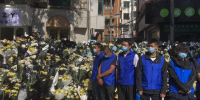
HEFEI, China (AP) — Hundreds, possibly thousands, of people gathered Thursday near a state funeral home in Beijing as China’s former second-ranking leader, Li Keqiang, was put to rest, while a steady stream of mourners showed their respects at the ex-premier’s childhood home in central China.
Li, who was China’s top economic official for a decade, died last Friday of a heart attack at age 68.
Lynn Neuman, director of New York City–based Artichoke Dance, became preoccupied with single-use disposability after she started wondering about waste and who was responsible for it. For some of her performances, she has collected massive quantities of discarded plastics, like bags and six-pack rings, and invited community members to contribute their own. “There’s a real aha moment when people see how quickly plastic amasses,” she says.
The International Harlem Fine Arts Show (HFAS) is the largest traveling African Diasporic art show in the United States. Inspired by the Harlem Renaissance, HFAS provides a platform for African Diasporic visionaries and American visual artists to exhibit and sell their artwork. The show also aims to create economic empowerment, educational opportunities and professional recognition within the multicultural community.
While meditating in front of a Nepalese Sarasvati statue on New Year's Day in 1991 at her California home, Mayumi received a calling that brought a sudden halt to painting. Having witnessed the horrors of atomic bombings as a child and later, watching her beloved Japan become a leader in nuclear-energy, and seeing the effects of depleted uranium, Mayumi had to pursue a global cause greater than her art or feminism.
When Jonathan D. Chang visits the 626, he often wears a black hoodie emblazoned with a colorful print of Guangong on the back. A military general from the Three Kingdoms era turned Taoist guardian deity, Guangong, or Guan Yu, is known throughout China and parts of Vietnam as a symbol of wealth and protection. Chang’s hoodie features his own design of the deity, which he drew in classic chibi fashion with a big head and smaller limbs.
SAO PAULO, May 16 (Reuters) - At one of Latin America's largest commuter bus terminals in Brazil's gritty downtown Sao Paulo, 84-year-old Rerizenil de Paula Santos waits on a bus decorated with neon lights and bright graffiti amid the hustle and bustle of rush hour.
Melissa is a down-to-earth, friendly woman in her 50s, and it seems that she has always met life with a certain amount of courage. She grew up on another continent, and after early motherhood, then divorce and a first career in business, she moved to the UK with her second husband. She then built another career working with survivors of domestic violence, before setting up a climate emergency centre in Abingdon, Oxfordshire.
The Islamic Republic has always frowned upon dance but recently even a simple choreographed or ‘synchronized movement’ – as the regime calls it – has become an act of protest.
Brian Larney is an AI.tivist or American Indian artist. He is also an Artivist where he performs Artivism, a concept that includes art as a form of activism.
Over the past few years, the public’s understanding of the issues that transgender people face has grown exponentially, but many people have never actually spoken to a transgender person.
From 1998 to 2004, pro-democracy activist Htein Lin was jailed for challenging the military dictatorship in his home country of Myanmar (formerly Burma) in Southeast Asia. Prior to his imprisonment, Lin acted in films and with a theater troupe. While behind bars, he continued to organize performance artworks with his fellow prisoners.
Through the use of mythical and archetypal iconography, Bourgeois translated her encounters into a very individualized symbolic imagery, employing things such as swirls, arachnids, cages, surgical equipment, and sewed appendages to represent the feminine mind, beauty, and mental agony.
The internet has reshaped the ways we learn and communicate. Information becomes heuristic, concomitantly - knowledge becomes protean. If you dedicate enough time to any particular platform, you are likely to acquire a community with congenial individuals. Social media’s proliferation has obfuscated the lines between reality and fiction. Embraced as a tool for many, these digital spaces typically have no monitoring process.
The Brat Summer movement can be directly traced back to the release of Charli XCX's album "Brat" in 2024. Known for her boundary-pushing pop sound and fierce persona, Charli XCX used "Brat" as a platform to explore themes of defiance, self-empowerment and the rejection of societal expectations.
"Las Carpetas looks at the bureaucratic residue of a 40-year-long secret surveillance program that aimed to destroy the Puerto Rican Independence Movement. Through still-lives, archival appropriation, and investigation, Christopher Gregory-Rivera provides a counter-history to the way many understand this period of time and its aftermath.
At first, you don’t know what you’re looking at. A gray expanse of uneven geometry surrounded by undulating brown. Shift your perspective a bit and it might be a close-up of a distressed textile, with subtle hues and textures surfacing as your eyes adjust.
And then the horizon comes into focus. Now you know where you are. In the distance are the classic jutting buttes of Monument Valley, familiar to anyone who’s ever seen a John Ford Western.
About us
"Path to Peace" - is a joint mosaic creation, by thousands of people, towards hope, love, and happiness among all people. The creation is placed upon the border wall that divides the Gaza Strip and Israel, adjacent to the homes of Moshav Netiv HaAsara.
The creation is seen from both sides of the wall, spreads on the gray security wall and completely changes the place's atmosphere.
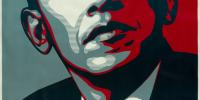
Street artist, graphic designer, and activist Shepard Fairey created this visionary portrait of then Senator Barack Obama in 2008 as a form of grassroots activism to support Obama’s first presidential campaign. Fairey based the work on an Associated Press photograph by Mannie Garcia, which he transformed with his signature high-contrast stencil technique, inspired by the political message and bold graphics of Soviet Socialist Realism.
The Xuzhou chained woman incident, also known as the Xuzhou eight-child mother incident, is a case of human trafficking, false imprisonment, sexual assault, severe mistreatment, and subsequent events that came to light in late January 2022 in Xuzhou's Feng County, Jiangsu, People's Republic of China.
The Georgian government’s attempt in March to impose a repressive Russian-style “foreign agent” law has galvanised the cultural community in the country. Museum workers and artists have been at the forefront of dramatic protests during which police fired water cannons at crowds waving European Union flags, and say they plan to continue the battle despite the government backing down from the legislation.
Concept
1. This is a participatory art action initiated by Action Office, aiming at questioning current democratic elections in Singapore and shaping an alternative possibility.
2. Design the pocards to resemble ballots, inviting people to fill out election results and mail them to the corresponding country’s polling stations or current government.
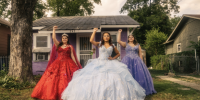
A group of young Latinas donned their quince gowns on Oct. 29 and led their families and friends along the streets of San Antonio, urging them to harness their electoral voice and vote in the upcoming midterm elections. The event was part of Ride to the Polls, a national campaign from the nonprofit organization Harness that aims to encourage young BIPOC voter turnout through cultural milestone celebrations.