Jameela Jamil has opened up about how she’s “not here to be liked” in a frank new interview with Meghan Markle.
In the latest episode of Archetypes, Meghan’s Spotify podcast, the Duchess speaks with both Jamil and Shohreh Aghdashloo about the “stereotypes and judgements women face in the world of activism”.
It’s been a historic year for women. There are more serving in Congress than ever before, and a record number are currently running for president in 2020. But even with these significant gains, women—both in the U.S. and around the world—can still find gender equality elusive.
Stream of Conscience is a site-specific, literary sculpture made out of torn pieces of cover-weight paper upon which people of all ages write their thoughts, feelings, and reflections about water. Prior to writing, participants engage in a dialogue about local water issues within a global context. The conversation is further distilled to include our personal relationship to water. Thousands of people have participated in this traveling exhibition.
Not far from the Burkina Faso capital of Ouagadougou, approximately 30 kilometers, lies Operndorf Afrika, a village that’s governed by art and a global exchange of culture.
On Tuesday night, Black-ish, one of the best shows on TV, returned for its fourth season. As expected, the premiere was outstanding.
The episode was a history lesson. The subject? June 19, 1865, better known as the Juneteenth, the official end of slavery.
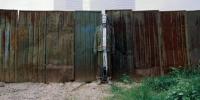
At the end of 2005, Liu Boln was living in Beijing and working as an artist’s assistant. Beijing’s art world at this time was thriving. On November 16, 2006 when Suo Jia Cun was forcibly demolished, Liu decided to use his works to make a stand against this atrocity. He wanted to show the state of artists in society, that their living and working places had not been protected.
The mischievous posters began appearing all over London in the past two months.
On the side of an East London bus stop, one of them shows Elon Musk, the world’s richest man, emerging from a Tesla’s roof with his hand pointing upward in a straight-armed salute. “Goes from 0 to 1939 in 3 seconds,” the ad reads. “Tesla. The Swasticar.”
The Norman Rockwell Museum is very unique. It attracts people of all ages from all around the world to visit. I’ve heard adults saying “I remember selling that copy of The Post door to door!” or seen children’s excited faces when they find something on the scavenger hunt list. The Rockwell Museum has something for everyone, and this summer I was lucky enough to receive an internship there.
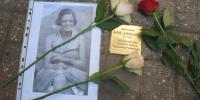
The late, late snow has finally disappeared from Berlin’s streets. Visible once again, here and there, are the “stumble stones” –Stolpersteine in German – with their brief, tragic messages.
Many Berlin tourists will enjoy the night life. They may also look upwards – at the giant TV tower, the Brandenburg Gate, at ancient and less ancient churches. There is a wide assortment of memorial monuments, some impressive, some uninspiring.
In the era of New Media, we share media content with a single click. We co-create the reality of our world, often without thinking how this reality is "real." Nevertheless, what if this reality is sometimes somewhat coloured?
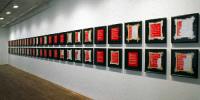
Indian Act speaks of the realities of colonization - the effects of contact, and its often-broken and untranslated contracts. The piece consists of all 56 pages of the Federal Government’s Indian Act mounted on stroud cloth and sewn over with red and white glass beads. Each word is replaced with white beads sewn into the document; the red beads replace the negative space.
Call it art, exhibited as an installation piece in the October 2014 show "Crossing Brooklyn," a collaboration of more than 100 artworks by 35 artists (or groups) who live or work in Brooklyn, presented at the Brooklyn Museum... or call it "A survey of Art from Brooklyn" as hyperallergic journalist Jillian Steinhauer wrote... it exists on the streets as a social practice, albeit using creative means for community-building.
In July and August 2013, O Teatrão, a Coimbra based theatre company, presented the project Arruinados, comprising three theatre performances in three abandoned spaces (‘ruins’), one in each of three cities in the Centre region of Portugal located along the Mondego River:Coimbra, Montemoro Velho, and Figueira da Foz.
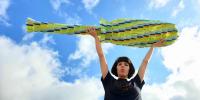
Environmental activist Ella Daish has created a giant tampon applicator as part of a protest against single-use plastic. The piece is made out of period plastic found polluting beaches, waterways, and local ecosystems in the UK. Daish sourced 1,200 applicators from 15 different locations across the United Kingdom. Of the plastic applicators collected for the project, 87.5 percent came from one brand, Tampax.
Now that the dust has settled from the Met Gala, with all the excitement over Kylie Jenner’s bathroom selfie and Rihanna’s body-swallowing Comme des Garçons florals, it is worth pausing to consider a red carpet moment most people missed: the entrance of Joe Gebbia, co-founder and chief product officer of Airbnb, with Yeonmi Park, a North Korean refugee and international refugee activist.
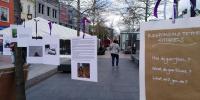
‘In Her Shoes’ was a street exhibition of stories from women and men affected by the 8th Amendment of the Irish Constitution. These stories were selected from the ‘In Her Shoes’ project Facebook page. We hung copies of the stories on ribbon between trees and provided pens, paper and a seating area for people to sit down and write a response to the stories if they chose.
Even if the idea of interactive theater gives you hives, you can still find amusement, and perhaps enlightenment, at Forum Theatre’s “The T Party,” a bold and inventive exploration of gender identity by local writer-director Natsu Onoda Power. The play begins as a progressive party you’ll be encouraged to join, but fear not. You can remain a mere observer.
In 2006, 25-year-old Jason DaSilva was on vacation at the beach with family when, suddenly, he fell down. He couldn’t get back up. His legs had stopped working; his disease could no longer be ignored. Just a few months earlier doctors had told him that he had multiple sclerosis, which could lead to loss of vision and muscle control, as well as a myriad of other complications. Jason tried exercise to help cope, but the problem only worsened.