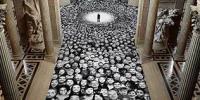
After winning the TED Prize on March 2, 2011, the French-artist JR launched the Inside Out Project, in his first TED Talk. Using his own artistic practice as inspiration, this participatory platform helps individuals and communities to make a statement by displaying large-scale black and white portraits in public spaces. Through their “Actions,” communities around the world have sparked collaborations and conversations.
La Casa Invisible project was started in 2007 in Malaga, Spain, when a group of socially involved participants squatted in a run-down building, aiming to eventually claim the legal rights to the property (Moor & Smart, 2016). The space was opened to local artists and creators, quickly becoming a hub for free local music, performances, and seminars as well as creating an important meeting space for social groups (Moor & Smart, 2016).
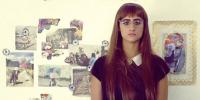
It was October 31st, 2012, when a new artist appeared on social media. In a series of video clips, she proposed with a soft and slow speech that Peru hide its poverty. Her project consisted of installing vinyl pieces to avoid what she called "the visual pollution." She titled the project Don't be poor, be fashion(able).
The Stanford Daily:
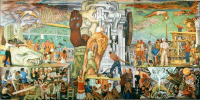
There is no word short of “spectacular” that better describes the experience of examining “Pan American Unity,” Diego Rivera’s 1940 mural, housed since 2021 at the San Francisco Museum of Modern Art (SFMOMA). The piece is the crux of SFMOMA’s soon-closing exhibition, “Diego Rivera’s America,” curated by James Oles and Maria Castro.
On October 6th, 2007, we beat a new world record. Thousands of people in cities all across Spain simultaneously shouted: “You won’t own a house IN YOUR WHOLE FUCKING LIFE!” The decibels radiating from this collective cry were registered by an interactive meter, baptized “The Fuck-o-meter” for the occasion.
Brian Larney is an AI.tivist or American Indian artist. He is also an Artivist where he performs Artivism, a concept that includes art as a form of activism.
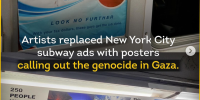
"Late last night, an autonomous group of activists placed posters throughout the subway system, blocking out advertisements with their own materials protesting Israel's bombing campaign in Gaza.
February 24, 2023 will mark one year since the Russian invasion and occupation of Ukraine began. Russia is attempting to take over Ukrainian territory and destroy its rich, vibrant culture. Ukrainians are fighting for their country and right to exist as free, independent people. For months, Ukrainians have endured relentless bombardment, destruction, and hardship.
Zhuang Huan invited more than 40 men - laborers, fishermen, construction workers––who had recently migrated to Beijing from other areas of China to participate. Zhang Huan said, “In order to find these workers, I visited many of the shacks where they live.”
This action was suggested in the workshop assembly by a neighbor of Arrayán street itself. At the end of this street giving the market there was a wall in a state of collapse that
concerned the neighborhood. On several occasions, either neighbors or from the same Peña Bética in front of them, they had
given by the City Council, but without results. And every day having to go all the way through that gorge with two
In response to white gentrifiers trying to silence go-go music on the corners of Florida Avenue and 7th Avenue, activists and D.C. residents poured into the streets by blasting go-go music and celebrating its rich history within the city. For those unfamiliar, go-go music is at the heart of D.C. culture and features live bands playing covers of, and sometimes original, music with all different types of drums and other percussion instruments.
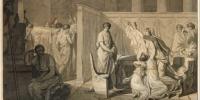
Jacques-Louis David was an active member of the French Revolution, and his works often depicted his political affiliations. David’s painting The Lictors Bring to Brutus the Bodies of His Sons portrays the scene of Brutus, an important figure of the Roman Republic, reacting to the death of his sons. Since they wanted to overthrow the government and restore the monarchy, Brutus ordered their death.
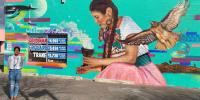
In a collaboration with fellow artist @vyalone on Instagram, Lucinda Hinojos or La Morena as the artist is known recently completed this mural in Phoenix which showcases the Native American culture of the people indigenous to the area. La Morena said in a post about the project on Facebook, "This mural is about reclaiming space, reclaiming our roots, our identity and finding our truth.
Benito Antonio Martínez Ocasio, better known to the world as Bad Bunny, has once again proven that his artistry goes far beyond reggaeton and trap. On January 5, 2025 — the eve of Puerto Rico’s cherished Three Kings Day — the Puerto Rican superstar released DeBÍ TiRAR MáS FOToS, an album that both celebrates his homeland and delivers a sobering message about its uncertain future.
National Public Radio (NPR):
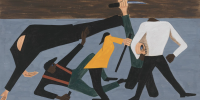
There's no historical marker outside Jacob Lawrence's childhood home in New York City's Harlem neighborhood.
But Khalil Gibran Muhammad, director of the Schomburg Center for Research in Black Culture, has an idea of what it might say: "Here lived one of the 20th century's most influential visual artists, a man named Jacob Lawrence, who was a child of southern migrants."
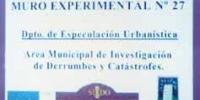
Bogus building inspection notices with the forged signature of city Building Inspection Director Frank Chiu appeared on buildings in San Francisco's South of Market area, prompting an investigation by exasperated city officials.
The ZAD (zone à défendre, or “zone to defend”) in Western France is 4000 acres of wetland, farmland and forest that was originally intended to be built into an airport in 1965 but is now an autonomous territory occupied by 40 different collectives looking to reclaim the land. There are around 200 people living permanently on the zone, in addition to some 2,000 people coming and going.
Collective Creativity in the Beginning
Project Row Houses (PRH) is, and has always been, a unique experiment in activating the intersections between art, cultural and historic preservation, affordable and innovative housing, community engagement and development, neighborhood revitalization, and human empowerment.
Urban Landscape as Canvas
A source of delicious egg creams and daily newspapers since at least the 1930s, an unassuming shop at the corner of St. Marks Place and 2nd Avenue was renamed Gem Spa in 1957 and swiftly transformed into a meeting ground for generations of downtown artists, musicians, poets, and activists.
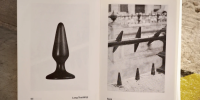
Hostile architecture—urban design features like ground spikes that deter the homeless from lying down or slanted benches that prevent lingering—inscribes exclusion into our streets. In response, a Chinese artist will launch the Free Butt Plug Catalogue, an art-activism project that documents fifteen such spikes and anti–loitering benches across London and pairs each with a commercially available butt plug of the same shape.
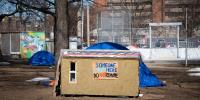
On his way to work on a construction site, Khaleel Seivwright surveyed the growing number of tents lining an intercity highway and in parks with increasing discomfort. How would these people survive Toronto’s damp, frigid winters, let alone the coronavirus, which had pushed so many out of overcrowded shelters?
He remembered the little shanty he had once built out of scrap wood while living on a commune in British Columbia.
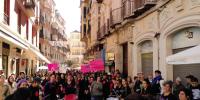
Just over a decade ago on May 15, 2011, a wave of social outrage began as the Spanish people collectively decided that they had had enough of the corruption, cuts, and inequalities affecting their country.
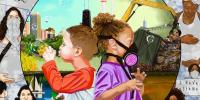
Two children stand back-to-back, but they are facing two very different Chicagos. One child blows bubbles in a park under blue skies. The other wears a gas mask against a backdrop of scrap metal and billowing smokestacks.
In May of 2011, tens of thousands of people crowded Puerta del Sol in the center of Madrid in the most visible manifestation of sit-in protests against austerity and corruption. 15-M was an expression of the devastating effects of the 2008 recession, which harshly affected the middle class and condemned millions of people to poverty because of the crash of the housing bubble (Altares, 2021).
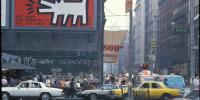
It’s the radiant baby, the barking dog and the dancing man; the badges and the t-shirts; the unmissable mural spelling out CRACK IS WACK. Keith Haring’s career was short but spectacular, and he leaves behind a lasting legacy. From his chalk drawings in city-wide subway stations, to his collaborations with the superstars of his day, Haring’s life was founded on a belief in the power of people to change the world.