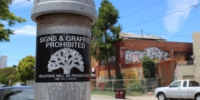
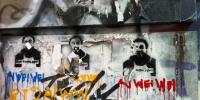
I went on a graffiti tour that went through NOHO, SOHO and the Lower East Side last weekend. We saw works by street artists - Space Invader and Roa - that were remarkable. Roa had created a commissioned mural of a bird on the side of a building, and the former artist derived his work from the unforgettable arcade game, Space Invader.
In 2016, Zhou Zhenfeng, who was a student at a college in Hebei at the time, discovered that there were a lot of waste tires in the streets and alleys. Zhou Zhenfeng learned that tires are made of infusible or refractory polymer elastic materials. It takes hundreds of years for these materials to decompose in the soil to the extent that they do not affect the growth of plants.
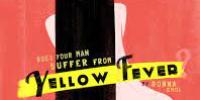
New York artist Donna Choi wanted to create a “weird, memorable way” to discuss fetishization of Asian women, so she put together a satirical series about how to diagnose Yellow Fever—the specific obsession many Western men have with Asian culture.
The over-the-top series is a discussion of race crafted for the attention span of the Internet.
I emailed with Choi about her thinking behind the Yellow Fever series.
Daniel Arzola, a digital artist and activist originally from Maracay, Venezuela, began his series, 'No Soy Tu Chiste' ('I Am Not A Joke') in 2013 intent on combating the stereotypes and cruelty so often facing LGBT identifiers; youth in particular. The project went viral in 2014, around the same time it teamed up with the It Gets Better Project based in the United States.
Delhi- based graffiti artist who goes by the name Daku went around South Delhi, one of the poshest places in the city, and painted on overflowing garbage cans.
RACC Satellite Space in Garden City
1205 Franklin Avenue, 3rd Floor, Garden City, NY 11530
June 26, 10 am – July 28, 7 pm
Monday – Friday, 10 am – 7 pm, free admission
Please write to racc.ny@mail.ru or call (347) 662 1456
The artist is available for interviews
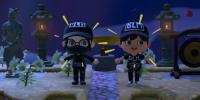
s street protests against anti-black racism erupted across the globe, Animal Crossing: New Horizons players were taking their own stand. Adelle, a software engineer from New York, decided to create a memorial on her in-game island, decorated with flowers and pixel art portraits of George Floyd, Breonna Taylor and other black victims of police brutality.
Is it possible that through affective design we can change our consumer behavior? Yan Lu and his "Little Fish Project" offer a design inspired solution to excess use of water. "As consumption is incalculable, saving is often neglected through daily consumption.
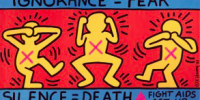
Keith Haring was an American artist and activist in 1980s New York, whose artwork raised awareness on social issues at the time. One the main awareness campaigns Haring participated on was AIDS awareness and activism.
Jeff is an animation storyboard artist from Los Angeles, previously working as an animation artist on several famous Disney movies. He uses his talent to produce work highlighting environmental and social issues worldwide with Disney characters, called Unhappily Ever After. His work includes images of Elsa from Frozen on melting ice caps and Alice from Alice & Wonderland taking drugs down a dark alley.
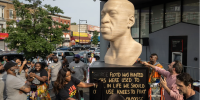
It was a quick turnaround for federal employers to recognize Juneteenth as a new federal holiday. But some cities were ready with new statues honoring George Floyd, whose killing by police in Minneapolis last year sparked a nationwide racial justice movement.
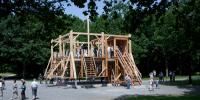
Sam Durant is an LA based artist who engages in social, cultural and political issues through his interactive public sculptures. Durant is interested in investigating historical narratives and their contemporary communities. From 2005-2010 Durant was part of the collective Transforma Projects, a grassroots cultural rebuilding initiative in New Orleans. One of his most recent interactive public sculptures Scaffold is on view at the Hague.
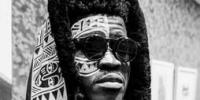
The story of an artist. Laolu Senbanjo grew up surrounded by the culture and mythology of the Yoruba, an ethnic group from the southwest of Nigeria, but he never imagined how it would influence the artist he is today. After a career as a human rights attorney, Senbanjo moved to New York City to pursue art full time. “With my art, I like to tell stories, I like to start a conversation,” says Senbanjo, but life as an artist in New York was tough.
With more than 48,000 panels and 94,000 names, the AIDS quilt is a constantly growing testament to the deadly toll the disease has taken on the world. At roughly 1.3 million square feet, it is so large that it can’t be displayed in its entirety in one place. Parts of it are currently on display at the National Mall, with volunteers constantly switching sections in and out.
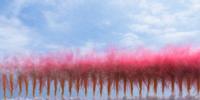
On June 26, contemporary artist Cai Guo-Qiang released the daytime firework display ‘When the Sky Blooms with Sakura’ at Yotsukura Beach in Iwaki City, as commissioned by Saint Laurent’s creative director Anthony Vaccarello.
The Eye that Cries (El Ojo que Llora, in Spanish) is a memorial that was born as a private initiative designed to honor the thousands of victims as a result of terrorism in Peru, to strengthen the collective memory of all Peruvians and to promote peace and reconciliation in the country.
"MASK" is an art exhibition that explores the uses and meanings of masks, and ones feelings about them. Masks throughout history have taken many forms and have served many purposes. They have been used in construction, scientific research, technical manufacturing, medicine, the theater, and warfare.
Thrive Collective mobilizes students, parents, artists, and community stakeholders to partner with public schools for transformational change. They function both as a matchmaker and direct service provider of arts and mentoring programs that cultivate the character and competencies necessary for students to thrive in today’s world.
Charged with participating in demonstrations against the Islamic Republic of Iran, Soudabeh Ardavan was held for eight years (1981-1989) in Iran’s notorious Evin Prison. She found sanity and solace through the forbidden activities of drawing and painting, secretly producing paint from flower petals and tea, using brushes made from toothpicks and human hair.
In this article, author Caroline Choi highlights different grafiti artists and their stories. These artists use their talent to tell their stories, ones that might not get to be told otherwise. She goes into the history of grafiti, and how it ties into how rich and white the art world has become.
The American rapper’s performance of 'Stand Up for Something' with singer Andra Day has gone down as one of the highlights of this year’s Academy Awards.
Common used his Oscars performance to condemn Donald Trump’s “hate” and the National Rifle Association.
The American rapper’s performance of “Stand Up for Something” with singer Andra Day has been held up by many as one of the highlights of this year’s Academy Awards.
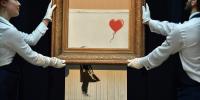
On Friday night, a painting by the anonymous street artist known as Banksy sold at Sotheby’s auction house in London for $1.4 million. But as soon as the auctioneer dropped the gavel, something unexpected happened: a beeping alarm went off and the frame began eating the painting, spitting half of it out the bottom in what may be the first instance of a self-destructing painting, reports Scott Reyburn at The New York Times.
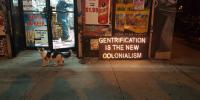
Since Christmas Eve, some lights along the streets and in the houses of Bushwick have spelled out a number of messages quite different from the festive wishes one usually finds during the holiday season. “GENTRIFICATION IS THE NEW COLONIALISM,” “NOT 4 SALE,” and “NO EVICTION ZONE,” some read.
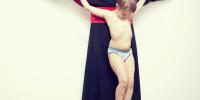
A CUBAN artist's controversial photographs of children being hung from crosses has landed him in hot water.
Erik Ravelo took a series of photos of children hung like Jesus from a cross, but in the place of the cross were soldiers, surgeons, priests and Ronald McDonald.