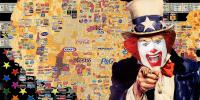
Ever get to thinking about how a food desert can pop up in the middle of a major city? One major reason is corporate fast food and manufactured goods. Food deserts are defined as urban neighborhoods and rural towns without ready access to fresh, healthy, and affordable food.
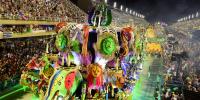
"A week-long party characterizes Brazil’s Carnival, the Mardi Gras of the southern hemisphere. Celebrations and parades are held throughout the country, most notably in the city of Rio de Janeiro and the Brazilian states of Bahia and Pernambuco. Carnival celebrations vary in length and content, depending on the area.
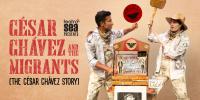
The play celebrates the life and legacy of the Mexican-American labor activist César Chávez. His early life as well as his partnership with Dolores Huerta, activism with the National Farm Workers Association, the 1968 grape boycott, and his ongoing commitment to nonviolent civil rights work.
The image is stark. And shocking.
A black man, his ankles shackled, his head hanging away from the viewer, stands in relief on a field of white. Chains stretching to the image's borders on the left and right pull his arms taut. Fourteen crimson marks crosshatch his back. Within the dark fabric that frames "86 Lashes to Go," a small rectangle is labeled simply "salt."
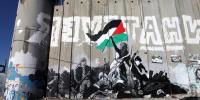
In June 2002, the Israeli Government decided to construct a physical barrier separating Israel and the West Bank. The declared purpose of this (as yet unfinished) 709 kilometers long barrier—which came to be known as Gader Ha’hafrada (The Separation Wall)—was to prevent the entry of Palestinian terrorists from the occupied territories into Israel in order to protect Israeli citizens.
ONGOING ORGANIZATION:
CALLED: Iranti [pronounced írantì] is the Yoruba word for ‘memory’. Largely found in South West Nigeria and parts of Benin Republic, the Yoruba people consider memory a prized form of intelligence which determines how often one remembers what they see and hear.
The Shifting View on Anthropofagia
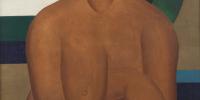
Tarsila is closely associated with the establishment of the Brazilian art movement known as cultural “cannibalism,” or “Anthropofagia”: the then-radical idea that a truly Brazilian art would emerge by ingesting all the different cultures that intermingled within the country, rather than simply copying European styles.
By Andrea Long-Chavez
The recognizable figure of a Latino gardener is a common sight for most Southern California locals. But if you happen to see the cardboard painting of a gardener propped up against a chain link fence or hedge, chances are you’ve just seen the public art of Los Angeles-based artist Rarmio Gomez, Jr.
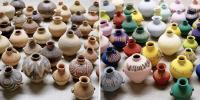
Exhibition visitors have expressed feelings of uneasiness or even pain and nostalgia when seeing Colored Vases by Ai Weiwei1. The 51 vases that make up the artwork are originally treasures from the Neolithic Age (5000–3000 BCE) and the artist has dunked them in common industrial paint.
Why did Ai Weiwei do it?
“Girl’s Day” in China was supposed to be a way for boys on college campuses to show the girls how much they care. This year it went too far.
Have you heard about “Girl’s Day?” It’s a big holiday for Chinese college students. Every year on March 7, students throughout the country celebrate the day as a campus version of International Women’s Day.
Graffiti art is particularly viewed as a powerful form of social protest, and the (illegal) act of defacing can be as important as the message itself. Artist Void One has been arrested on numerous occasions for his politically-charged interventions.
“I didn’t set out to make political art but art is a platform where I can vent my frustrations” – Void One.
"Turkish past, Ottoman present" and "Spengler in Turkey"
105 NY-110, Melville, NY 11747
August 5, 11 am – August 30, 7 pm
Monday – Friday, 11 am – 7 pm, free admission
Please write to racc.ny@mail.ru or call (347) 662 1456
The artist is available for interviews
Now What? project has just finished a series of interactive workshops, where global citizens came together to reflect on the global sustainability issues, got inspired and empowered to imagine the world anew through poetry and imagery.
With the focus on the community and climate action, the project is live on social platforms and soon to be a collective street art too.
Forensic Architecture's Cloud Studies is a project that investigates the impact of toxic clouds on colonised and oppressed communities. The clouds, originating from sources like tear gas, industrial emissions, chemical weapons, and forest fires, often go unaddressed due to doubt and denialism.
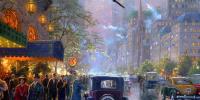
There are few artists more innocuous, more neutered, more universally loved and reviled than Thomas Kinkade. His soft-focus images present an idyllic vision of America and of Christianity, like Norman Rockwell without the blue-collar populism, where everything is beautiful, nothing hurts, and there’s always a warm fire going in the Lincoln-Log cabin just down the trail.
"Iconography"
1235 Ocean Parkway
Brooklyn, NY 11230
May 27, 11 am – June 24, 7 pm
Tuesday – Saturday, 11 am – 7 pm
Please write to racc.ny@mail.ru or call (347) 662 1456
The artist is available for interviews
*We would like to thank everyone who who participated in a very successful first Butterflies for Bealtaine*
For the month of May, we invited all ages to creatively respond to the theme of The Butterfly and to share a change they wish for on a personal, community or global level.
In Ireland as in many parts of the world we have been in a quarantine situation because of the global pandemic. This environment informed our project.
Early Sunday morning, the Dallas Police Department's Twitter account tweeted for followers to download its iWatch Dallas app and share videos "of illegal activity from the protests." The police are looking to arrest lawbreakers at weekend demonstrations decrying police violence against black people. The benefit of the app, according to the tweet, was the ability for informants to stay anonymous.
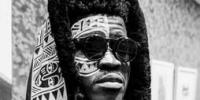
The story of an artist. Laolu Senbanjo grew up surrounded by the culture and mythology of the Yoruba, an ethnic group from the southwest of Nigeria, but he never imagined how it would influence the artist he is today. After a career as a human rights attorney, Senbanjo moved to New York City to pursue art full time. “With my art, I like to tell stories, I like to start a conversation,” says Senbanjo, but life as an artist in New York was tough.
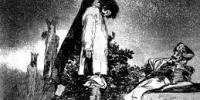
Francisco Goya created “The Disasters of War” from 1810-1820. These 80 etchings and aquatints show scenes from the Spanish struggle against the French army under Napolean Bonaparte, who invaded Spain in 1808. When Napolean tried to install his brother Joseph Bonaparte, as King of Spain, the Spanish fought back, eventually aided by the British and the Portugese.
New York Times, DAVID FIRESTONE, Published: December 31, 1993
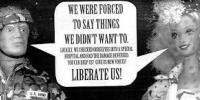
Your son tears the wrapping paper off his fierce new "Talking Duke" G. I. Joe doll and eagerly presses the talk button. Out comes a painfully chirpy voice that sounds astonishingly like Barbie's saying, "Let's go shopping!"
Does your son:
A) Furiously vaporize the doll with his own phaser rifle?
B) Go shopping with Joe?
Text taken from website:
By appropriating mementos of other people’s lives and placing them in an art context, Boltanski explores the power of photography to transcend individual identity and to function instead as a witness to collective rituals and shared cultural memories.