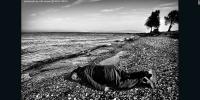
Chinese artist and activist Ai Weiwei has recreated the image of drowned infant Alan Kurdi that in 2015 became the defining symbol of the plight of Syria’s refugees.
For the recreation, Ai lay on a pebbled beach on the Greek island of Lesbos. His pose was similar to that of Kurdi’s lifeless body, which washed up on a beach near the Turkish town of Bodrum and was captured in a September 2015 photo.
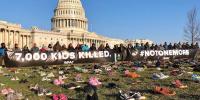
Protesters left 7,000 pairs of shoes in front of the Capitol building Tuesday to symbolize the number of children killed by gun violence in the United States since the Sandy Hook Elementary School shooting in December 2012.
From 8:30 am to 2 pm, the shoes were displayed on the southeast lawn in the hope of sending a clear message to Congress: Reform gun control legislation or more children will be killed by gun violence.
The Stanford Daily:
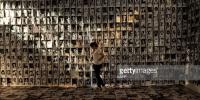
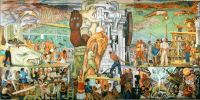
There is no word short of “spectacular” that better describes the experience of examining “Pan American Unity,” Diego Rivera’s 1940 mural, housed since 2021 at the San Francisco Museum of Modern Art (SFMOMA). The piece is the crux of SFMOMA’s soon-closing exhibition, “Diego Rivera’s America,” curated by James Oles and Maria Castro.
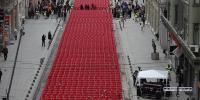
Empty chairs were laid out in Sarajevo today in honour of the 11,541 people killed in the city during the Bosnian war which began exactly 20 years ago.
The seats - lined up along the city's main street - were left empty in memory of the victims of the 44-month Serb siege of the city.
Hundreds of the chairs are small representing the children slain in the conflict.
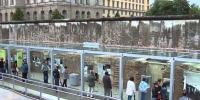
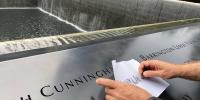
It was once the most feared address in Berlin, a place easy to enter but very hard to leave. Now the ruins of the former engine room of Nazi terror at Prinz Albrecht Strasse in Berlin have been preserved in a new exhibition space open to the public from tomorrow.
Presaged by shimmering spin-off hits “Dreams” and “Linger,” The Cranberries’ landmark debut album, Everybody Else Is Doing It, So Why Can’t We?, suggested its creators had taken up the baton handed down by jangly indie-pop classicists The Smiths and The Sundays.
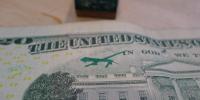
In Drones We Trust, 2014 - Joseph DeLappe
Crowd Sourced, Participatory Rubber Stamp Currency Intervention
FOR FULL PROJECT DOCUMENTATION VISIT: http://indroneswetrust.tumblr.com/
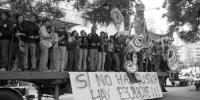
Faced with a lack of prosecution of those accused of crimes against humanity committed during Argentina’s military dictatorship, family members and descendants of the country’s estimated 30,000 disappeared took action.
In time for the 30th Anniversary of the famed EDSA People People Revolution, a two-day pop-up museum in Camp Aguinaldo serves as a vivid reminder of a significant period in Philippine History.
The interactive museum, which is composed of nine halls, recreates the martial law victims’ struggle for democracy, including the events that led to the bloodless revolution in 1986.
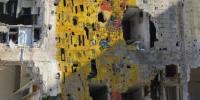
"A new photographic work created by Ayyam Gallery artist Tammam Azzam has captured the imaginations of the world, going viral and being shared across social media as a symbol of the power of love and human spirit in times of war. The Syrian artist has superimposed Gustav Klimt’s iconic work, The Kiss (1907 – 1908), over the walls of a war-torn building in his native country in a powerful juxtaposition of beauty and devastation.
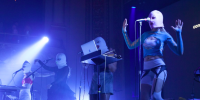
Pussy Riot are spreading their protests and activism beyond Russia. Away from Vladimir Putin’s censorship, they’re bringing their voices to Canada – a place where their message of resistance is resonating. On Nov. 1, as a chilling cold filled the streets of Montreal, Pussy Riot kicked off the North American leg of their Riot Days tour with a sold out show at the Rialto Theatre. The tension in the room was palpable.
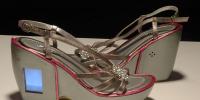
In the past, prostitution was intrinsically tied to religion ritual and public policy, and it wasn't considered a taboo. Taking up from the idea of ancient sandals worn by prostitutes, the artist has created platform shoes that specifically focused on their protection and safety nowadays, with a GPS tracker that can send emergency signals to 911 or a sex workers' rights group.
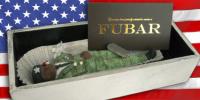
This past Valentine's Day the Fresh Juice Party pulled another "art prank;" this time sending chocolate shaped as dead American soldiers and sent them to U.S. government officials, especially to the previous Bush administration. This prank while very effective in its message, is not so effective in terms of timing.
If Not Now, When? is an ongoing exhibition that showcases the work of 31 female sculptors, employing diverse materials and forms to address social and environmental issues such as gender equality, nuclear disarmament, and electronic waste. The Hepworth Wakefield in England is hosting the exhibition from April 3 to July 4, 2023.
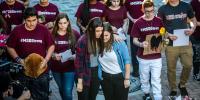
Shine, written by Stoneman Douglas students Sawyer Garrity and Andrea Peña in response to the tragic shooting at their school on February 14, 2018 to inspire unity, hope, and change. MSD alum Brittani Kagan collaborated with students and faculty to create this music video to honor the victims and the school.
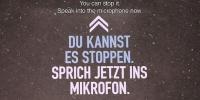
Neighbors in modern cities have less and less communication, and they all go about their business as soon as they close the door. In Switzerland, a woman dies every week as a result of domestic violence, so in an effort to get everyone to act, the charity has put up an interactive billboard in a shopping mall that shows a man in a family doing violence to a woman.
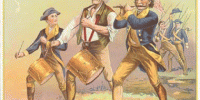
The Fourth of July is upon us, so it’s time once again to sing what is arguably our most baffling national ditty, “Yankee Doodle Dandy.” Maybe you’ve noticed: Some of the lyrics seem like the work of a prankster on acid. Who else could have conceived a vignette as bizarre as a man riding a pony into town, then sticking a feather in his cap that, for unknown reasons, he insists on calling “macaroni”?
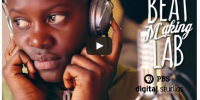
It started as an experiment: what happens when you equip a vibrant youth community with the resources to express themselves through hip hop and electronic music? Last summer I traveled to Goma, Democratic Republic of Congo to find out and the results were more beautiful than I could have imagined.
With delicate composition, striking details and strong emotion, five editorial posters drawn by Wuheqilin have attracted some half million followers to his account on Sina Weibo, China's Twitter-like social media platform. His political views expressed in his art have led to some netizens dubbing him the "Wolf Worrier artist."
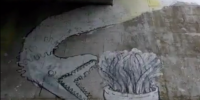
"For those who haven’t seen it, Big Bang Big Boom (2010) is yet another fabulous animated graffiti parable from the Blu
art collective. Their work is endlessly fascinating — animated
creatures sliding seamlessly from walls, through sand, along pipes and
under bridges into stop-motion interaction with beach garbage and
This project was born a few days after a demonstrator lost an eye after being hit by a rubber bullet shot from police guns in Barcelona. Unfortunately, it was not the first time. "Cop d' ull" means a "a blow to the eye" and also "at a glance”, which is a perfect description of this project.
While meditating in front of a Nepalese Sarasvati statue on New Year's Day in 1991 at her California home, Mayumi received a calling that brought a sudden halt to painting. Having witnessed the horrors of atomic bombings as a child and later, watching her beloved Japan become a leader in nuclear-energy, and seeing the effects of depleted uranium, Mayumi had to pursue a global cause greater than her art or feminism.
By Nora Fakim, BBC News
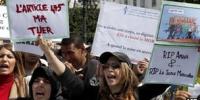
Several hundred women's rights activists have demonstrated outside Morocco's parliament to demand the repeal of a law on sexual violence.
Morocco's penal code allows a rapist to marry his victim if she is a minor as a way of avoiding prosecution.
A 16-year-old girl, Amina Filali, killed herself a week ago after being severely beaten during a forced marriage to her rapist.
Mtendo MweMa Project's mission is to provide a safe house and educational opportunities to girls, especially those in danger of female circumcision, early marriage and pregnancy, whom otherwise have no alternative but to return to their villages during the holiday seasons in Kenya, East Africa.