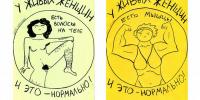
It's My Body! was initially a project for Stephen Duncombe's Media Activism class during Spring 2012. We designed and developed the concept for the class, but have yet to set up the actual website. The images below show the site's layout.
The group of students from NYU took to the streets of Manhattan to shout back against sexual harassment and bring awareness to the Everyday Sexism project. Armed with business cards that said "#shoutingback" on one side, and "Real men don't catcall" on the other side, the group waited for men to yell at the women while they walked down the street.
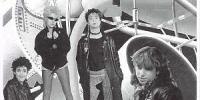
Las Vulpes was the first spanish punk rock band formed only by women. It was founded in Baracaldo (Vizcaya, Basque Country) in the summer of 1982, as a result of the guitarist´s desire on creating an all women punk band. After a few changes, the final formation consisted on: Loles Vázquez (guitar), Mamen Rodrigo (voice), Begoña Astigarraga (bass) and Lupe Vázquez (drums), all between 17 and 22 years of age.
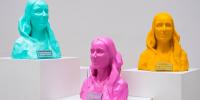
MONUMENT #1 is a series of sculptures by the Bulgarian artist and designer Erka, created in collaboration with Fine Acts. The work seeks to raise awareness about the lack of monuments honoring notable women in Sofia, the capital of Bulgaria - a EU member state.
The brightly-coloured busts were placed at some of the most central locations across Sofia during a covert early-morning action on Wednesday, March 22.
A widespread but illegal campaign by a group calling itself “the Gluers” uses posters to denounce violence against women. It has become an effective — and ubiquitous — tool to raise awareness.
On a recent mild night, a squad of four young women wandered through a peaceful neighborhood in eastern Paris, armed with a bucket of glue, a paintbrush and backpacks loaded with posters.
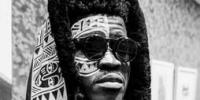
The story of an artist. Laolu Senbanjo grew up surrounded by the culture and mythology of the Yoruba, an ethnic group from the southwest of Nigeria, but he never imagined how it would influence the artist he is today. After a career as a human rights attorney, Senbanjo moved to New York City to pursue art full time. “With my art, I like to tell stories, I like to start a conversation,” says Senbanjo, but life as an artist in New York was tough.
The satirical website was launched at noon on Monday, December 3. According to the site, “PINK loves CONSENT is our newest collection of flirty, sexy and powerful statements that remind people to practice CONSENT. CONSENT is a verbal agreement about how and when people are comfortable having sex.”
The pink "pussy hats" in The Women's March were created by a group of activists and knitters, including Krista Suh and Jayna Zweiman. The hats were designed as a form of protest and a symbol of resistance to the new administration and its policies.
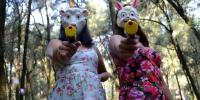
Born as a side project Las hijas de Violencia approaches the subject of street harassment and gender based violence through performance art, punk and video that is addressing socially legitimized male violence. "As actresses and as women we feel directly affected and consider it urgent to address the real cause of the problem: its ideological nature.
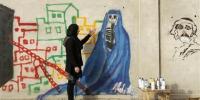
Meet Shamsia Hassani. At age 24, she is one of Afghanistan's first female graffiti artists.
An associate professor of sculpture at Kabul University, she was first introduced to graffiti in 2010 by British artist, Chu, during a week-long course in street art.
Meet also Malina Suliman, 23, who has been receiving threats from extremists due to her work in graffiti.
Under the moniker BomBaebs, Pankhuri Awasthi and Uppekha Jain rap about rape, cultural stereotypes, religious biases, and hypocrisy surrounding sexism and gender biases in India. They open the video with a disclaimer, warning that “This video doesn’t have any explicit or bannable content. It is just that the reality for women in India is Explicit.”
The problem with feminism is that it’s just too familiar. The attention of a jaded public and neophiliac media may have been aroused by #MeToo, with its connotations of youth, sex and celebrity, but for the most part it has drifted recently towards other forms of prejudice, such as transphobia. Unfortunately for women, though, the hoary old problems of discrimination, violence and unpaid labour are still very much with us.
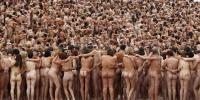
Calling all feminist activists, nudists, Cleveland-based Democrats, and people overdue for a laundry day. Photographer Spencer Tunick is looking for 100 bold women to pose nude for a Cleveland-based photo shoot on July 17, 2016.
Also — you’ll be baring all at the Republican National Convention.
"My body is not pornography" — that is the slogan written under many of the social media posts inspired by Yulia Tsvetkova. Women are posting pictures of themselves showing off their curves, body hair and scars, along with feminist art and pictures of everyday objects that look like vaginas — like fruits or flowers.
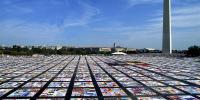
Cleve Jones's powerful vision for memorializing those lost to AIDS was realized in October 1987 in Washington D.C. It showcased the artistic contributions of people who'd lost loved ones to the virus from a number of US metropolitan centers. The quilt has continued to grow for the nearly 40 years since. By 1992, the AIDS Memorial Quilt included panels from every state and 28 countries.
Gender equality charity Women of the World (WOW) is launching a one-day festival of activism that invites people from all generations, genders and backgrounds to take part in conversations around sexual violence.
Adrian Piper disguised her identity, changing her race, sex, and social class in order to experiment in public situations and gauge people’s reactions. She investigated how outwardly visible identity markers (like skin color) impacted others’ perceptions of her character. By manipulating her (apparent) identity to produce reactions, she demonstrated the power and influence of stereotypes (Piper, 1996).
Daniel Arzola, a digital artist and activist originally from Maracay, Venezuela, began his series, 'No Soy Tu Chiste' ('I Am Not A Joke') in 2013 intent on combating the stereotypes and cruelty so often facing LGBT identifiers; youth in particular. The project went viral in 2014, around the same time it teamed up with the It Gets Better Project based in the United States.
How would you describe Mixer?
Anis Bennaceur: It’s a professional network for creatives—people working in arts, fashion, film and media, and music. You can showcase your work, past projects to everyone else on the platform, and you can search, discover, connect, and collaborate with a lot of other incredible and talented people working in those industries. Also, every member is vetted by our team, so we ensure the quality of the userbase.
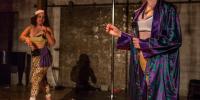
“Cabaret Con-Sensual is an effort comprised of actors, dancers, comedians, producers, writers, and other artists who strive to champion consent and discuss rape-culture through the subversive, yet expressive medium of the performing arts.”
The show was created by Bitsy La Bourbon, founder of the anti rape campaign and non profit organization More Than No.
Photography has long been associated with acts of resistance. It is used to document action, share ideas, inspire change, tell stories, gather evidence and fight against injustice.
This group exhibition at the SLG, organised in collaboration with the V&A, brings together works by international artists and collectives who are using the camera to challenge and move beyond traditional protest photography.
In order to raise awareness about the global issue of arranged child marriages, 21-year-old YouTube star Coby Persin decided to push the envelope by asking a 12-year-old 'bride' to pose with a 65-year-old 'groom' in the middle of Times Square. Child marriage is not only legal in 91 countries around the world, but even continues to be legal in the United States - with some having a cut off as low as 12 years of age.
Homeworkers 1977 is the central piece of a multidisciplinary project that comprised photographs, interviews, news clippings and a large canvas documenting the situation of non-unionised women doing manual work at home.