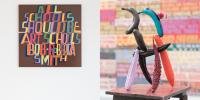
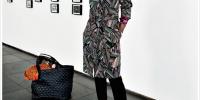
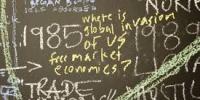
Bob and Roberta Smith has been at the forefront of activist art for 2 decades; so who better to ask about how art is responding to these politically bleak times?
At the same site where Dr. Martin Luther King, Jr. delivered his "I Have a Dream" speech, we lit thousands of candles - one for each signature on our petition - to commemorate the legacy of brave freedom fighters Andrew Goodman, James Chaney, and Michael Schwerner and to stand up for the rights that are once again in peril.
It started as an experiment: what happens when you equip a vibrant youth community with the resources to express themselves through hip hop and electronic music? Last summer I traveled to Goma, Democratic Republic of Congo to find out and the results were more beautiful than I could have imagined.
Two weeks ago, the University released the final version of its diversity and inclusion action plan, which could not have been compiled without the exhaustive efforts of students throughout last semester.
Fashion designer and former head designer of Dior, John Galliano, in the past few years has failed to rise to his former glory in fashion. In 2011, a videotape of John Galliano shouting anti-semitic statements went viral, thus leading to his dismissal at Dior and the irreparable defamation of his fashion career.
Comusitària is a Community Cultural Development agency based in Barcelona run by Noemi Rubio and Laia Serra. They work in the production, management, research and dissemination of artistic projects that build social capital and enable citizens to live more active, critical and creative lives.
"SOA Cycle, and what it later became, which is called the Democracy Cycle, is a group of seven large works that approach the question of democracy. What is democracy? How is it constructed? How is it implemented? Is it something that is to be thought of in relation to its political influence? Or is it something that plays out in terms of cultural and social, and even emotional terms, for instance?
This week, I got to make history. At 18 years of age, I received an honorary doctorate from the University of London for my work in climate justice, making me the current youngest holder of the award globally.
As an add-on to my 2010 book, Representing Disability in an Ableist World. Essays on Mass Media, I have created this online resource site.
https://www.facebook.com/pages/Representing-Disability-in-an-Ableist-Wor...
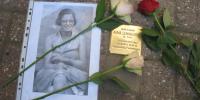
The late, late snow has finally disappeared from Berlin’s streets. Visible once again, here and there, are the “stumble stones” –Stolpersteine in German – with their brief, tragic messages.
Many Berlin tourists will enjoy the night life. They may also look upwards – at the giant TV tower, the Brandenburg Gate, at ancient and less ancient churches. There is a wide assortment of memorial monuments, some impressive, some uninspiring.
"A Night of Philosophy and Ideas is a thinker’s lollapalooza. The free, 12-hour weekend lyceum at the Brooklyn Public Library includes spirited debate, live music, theater, performance art pieces, and film screenings. At any given hour, five or six different events will be taking place simultaneously. Visitors are encouraged to come and go as the spirit moves them.
Despite the pushes to motivate more young girls into STEM (science, technology, engineering, and math) fields, women are still very underrepresented in almost every scientific field. Part of this motivation is because a lot of young girls would rather do something else.
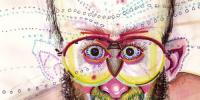
Artist Bryan Lewis Saunders took it upon himself to draw a self portrait every time he took a psychoactive substance. These ranged from zoloft to morphine to marijuana and it is an amazing subjective experience to witness. We can almost get a taste of what each drug must feel like on the inside, at least to Saunders, and an experiment like this raises some important questions like what are drugs and what place do they have in society?
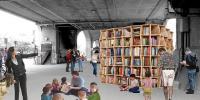
"The Uni Project aims to do one thing and do it well: temporarily
transform almost any available urban space into a public reading room
and venue for learning. We start with the conviction that books and
learning should be prominent, accessible, and part of what we expect at
street-level in our cities." (From site.)
Mind Over Media is a crowdsourced educational platform that contains diverse examples of contemporary propaganda on a wide range of social, political, economic and environmental topics.
Now What? project has just finished a series of interactive workshops, where global citizens came together to reflect on the global sustainability issues, got inspired and empowered to imagine the world anew through poetry and imagery.
With the focus on the community and climate action, the project is live on social platforms and soon to be a collective street art too.
The Spanish 15M/Indignados movement represents a citizen break-up with the current political system while proposing an alternative one, changing the prevailing participation patterns while transforming the cultural, social and political structures in the country.
Nobody expected the Spanish r-Evolution and there it goes; still advancing and strong.
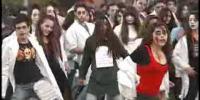
The following is a description of the action that Huffington post published online on 6/25/2011:
"Student demonstrators took to the streets of Santiago dressed as goblins and ghouls from Michael Jackson’s 'Thriller' video in their latest spirited pursuit of higher education reforms."
Is there a way to make sex ed, big, scary, nasty, icky, sex ed, fun again? In the Spring Quarter of of 2013, UCLA students in the Sex Squad, a performance troupe dedicated to injecting a dose of humor into high school sex education, set out to answer that question through a series of short videos.
Play Safe is a documentary film series created and directed by NYU alum Eddie Einbinder. The film, much of which now appears for free on YouTube, was originally released in 2013 after being filmed between 2011 and 2012. It debuted at the International Harm Reduction conference in Vilnius, Lithuania in 2013.
Thelma Golden, curator at the Studio Museum in Harlem, talks through three recent shows that explore how art examines and redefines culture. The "post-black" artists she works with are using their art to provoke a new dialogue about race and culture -- and about the meaning of art itself.