#SaveNYC is a grassroots, crowd-sourced, DIY movement
to protect and preserve the diversity and uniqueness
of the urban fabric in New York City.
As our vibrant streetscapes and neighborhoods are turned into bland, suburban-style shopping malls, filled with chain stores and glossy luxury retail, #SaveNYC is fighting for small businesses and cultural institutions to remain in place.
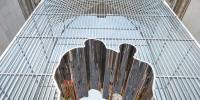
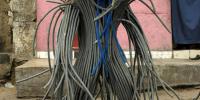
The artist has assembled a set of 300 installations around New York City, based around the concept of fences and borders, to showcase the ‘narrow-minded’ attempts used to ‘create some kind of hatred between people’
Back after a five year hiatus, V-Day Sedona joins with hundreds of other productions across the globe in celebrating V-Day’s 20th anniversary with an act of artistic activism. For its 20th anniversary, V-Day is calling on activists around the world to Rise, Resist and Unite.
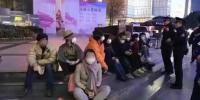
In the south-western city of Chengdu, by all accounts a city on the edge coping with heavy pollution but also with authorities scrambling to put a lid on simmering discontent. That night police detained a number of artists who managed to stage a silent demonstration, while wearing face masks.
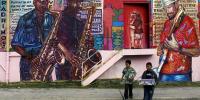
CENTRO San Antonio's Art Everywhere Project will celebrate its 5th anniversary in May.
As of May 2024, the project had seen numerous artists from the city's urbancore decorate areas of the city with elaborate murals reflecting the city's history and the diversity of cultures in the city.
In São Paulo, just like in many other metropolitan regions, public transport is not as effective as it could be. Buses and trains usually run overcrowded, late and on limited hours, so that owning a car increases a lot one’s comfort. But not everybody can afford to have one, so a clear and recurrent class distinction occurs: public transport is mostly used by poor people.
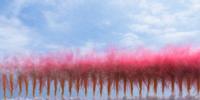
On June 26, contemporary artist Cai Guo-Qiang released the daytime firework display ‘When the Sky Blooms with Sakura’ at Yotsukura Beach in Iwaki City, as commissioned by Saint Laurent’s creative director Anthony Vaccarello.
Asian Americans standing up for themselves, the Black Lives Matter movement, and their home: New York City
In 2020, as COVID-19 flared through New York City and NYC hospitals saw a spike of nearly 200,000 patients, Asian and Pacific Islanders (APIs) faced an added threat: blame, racism, and xenophobia.
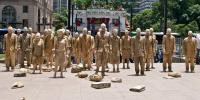
A troupe of approximately thirty women and men of various ages, sizes, ethnicities and performance backgrounds marched through the performance art space of SESC-Vila Mariana in Sao Paulo and then through the streets of downtown Sao Paulo, silent, blind folded, dressed in business attire, and covered completely with a gray mud. The performances walked slowly in unison at turtle's pace.
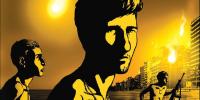
He had served in the army, either as a full-time soldier or as a reservist, for 22 years when he finally decided he wanted out. In 2003, Ari Folman, who had just turned 40, asked his commanders in the Israel Defence Forces to release him from the obligation to do a month's military service every year. They agreed - "so long as you go to the army therapist and talk about everything you went through".
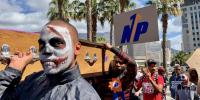
The collective Ndaku Ya La Vie Est Belle, a group of Kinshasa street performers turn their bodies into living sculptures, and use them to political ends. Among the artists is Jared, who regularly takes to the streets dressed as Robot Annonce. The costume, made from broken radio parts, is designed to raise awareness of fake news. “People receive so much incorrect information and many inaccuracies are spread. I want to fight this,” says Jared.
MADE HERE is a documentary series and website focusing on performing artists based in New York City. A collage of intimate interviews, performances and behind-the-scenes footage, MADE HERE mirrors the rich diversity of the artists and communities they serve. It reflects on Performance Artists battle to balance work and art in New York City.
During the economic crisis of 2008, bankers in Spain took advantage of the economically disadvantaged, and the artwork La Fiera en Sevilla, or the Wild Animal in Sevilla in English, brings attention to this money-centric act from the bankers. La Fiera refers to the bankers at the time that used predatory methods in their actions to forcibly evict poor people from their houses.
The Yes Men join Reclaim the City in their fight against unjust housing policy. On September 30, 2019, a horde of zombies attended a "#natsneverdie rally" at the Cape Town Civic Centre in order to celebrate Mayor Dan Plato and the Mayoral Committee and to support their policies, which are increasingly similar to those of the National Party under Apartheid.
The odd spaces exiting under bridges and viaducts around the world are often left aside, urban spatial residues mostly abandoned or occupied informally by homeless people drug users etc. The former pro boxer Nilson Garrido saw the space under the Alcantara Machado viaduct (in the Mooca neighborhood of Sao Paulo) as an opportunity to create a Boxing Academy.
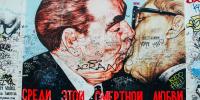
Since the fall of the Berlin Wall on November 9th, 1989, the cement segments that remain have stood as something more symbolic than just a wall. With installations in every continent, except for Antarctica, the East Side Gallery is the most authentic existing part of the Berlin Wall.
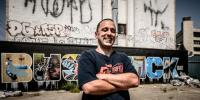
Conceived and curated by Bushwick native Joe Ficalora, the Bushwick Collective has evolved into an extraordinary open-air gallery since its first mural surfaced in 2011.
Attracting a wondrous array of local, national and international artists, it showcases first-rate street art -- from legendary Blek Le Rat stencils to huge collaborative walls by such world-renowned artists as Case Ma'Claim and Pixel Pancho.
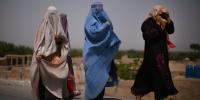
In December – as many around the globe were preparing for the holidays – Sama, a former attorney, remained hunkered down in her house in Kabul, Afghanistan, trying to comprehend how her world had changed.
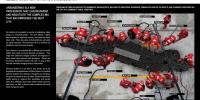
Whose job is it to create a city? Our intention is to jumpstart a new profession that can re-invent and negotiate the complex mix that encompasses a city. We have defined a radical new occupation to regenerate, pioneer, and sustain the future urban realm. These innovative multi-disciplinarian advocates are called Urbaneers. Their immense task is to manifest and facilitate the next expression of city across the globe.
In April, 2011, Food and Water Watch partnered with Yes Lab to raise questions regarding drinking water around New York City. Yes Lab, an organization that collaborates with activist groups, aims to create successful media-related creative actions that help raise awareness regarding pertinent causes and create desirable action, often by staging interventions for the existing status quo by imitation and alteration.
Unveiling the Unseen
BlindWiki is a location-based audio network where citizens who are blind or partially sighted use smartphones to share their findings by posting sound recordings. The platform does not just contain information about difficulties and barriers but is also a repository for experiences, opinions and stories, generating a creative and collaborative cartography of the unseen.
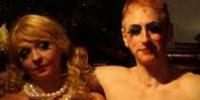
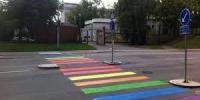
Swedish lesbian, gay, bisexual and transgender (LGBT) rights advocates offered their colorful stance on Russia's controversial anti-gay legislation over the weekend.
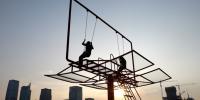
Architect Didier Faustino strips a billboard down to its skeleton, repurposes it as a swing set, and names it Double Happiness. This "urban reactivation device" needs to become a world wide phenomenon. Imagine billboard swing sets waiting at every destination. The climb looks worth the view.
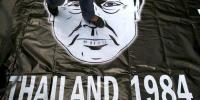
There are no whistles, no loud speakers, and no placards held up high in this quiet act of subversion. Pimsiri Petchnamrob stands silently in a mass of sharply dressed Bangkok commuters, her hands clutched around a copy of George Orwell's 1984.
Next to her a small group of young men and women, their faces sombre and their heads bowed low, also read books about fictional and real totalitarian worlds in silence.
La Casa Negra is a moving artist squat that occupies houses destined for demolition as temporary venues for site specific performance art in Barranco (Lima, Peru). Artists use all of the available rooms (kitchen, bathrooms, stairs, backyard) to enact a series of critical art pieces, while using the space as a demonstration of artist resilience in an increasingly gentrifying neighborhood.