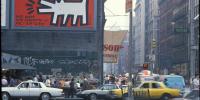
It’s the radiant baby, the barking dog and the dancing man; the badges and the t-shirts; the unmissable mural spelling out CRACK IS WACK. Keith Haring’s career was short but spectacular, and he leaves behind a lasting legacy. From his chalk drawings in city-wide subway stations, to his collaborations with the superstars of his day, Haring’s life was founded on a belief in the power of people to change the world.
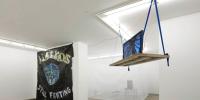
Brief History is part of a series produced by Carlos Motta between 2005 and 2009 that presents two chronologies of events in Latin America: one of U.S. interventions in the region since 1946, and one of the area’s leftist guerrilla movements. One side of the print outlines the interventions’ interconnected narratives in text; the other depicts two bloody handprints and the symbol of the Mano Blanco death squads from 1980s El Salvador.
“Artist Andrea Bowers creates powerful works addressing immigration, gender violence, and environmental justice. Her large-scale drawing ‘No Olvidado’ memorializes migrants who died crossing the U.S.-Mexico border, calling attention to the human cost of border policies.”
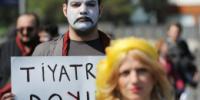
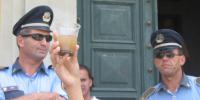
Today over 40 people gathered at the Ministry for Internal Affairs in the centre of Tirana, the capital of Albania. The issue is Tirana's drinking water, which is not clean, unreliable as it comes out of the tap only a few hours a day and that sewage systems continue to pollute the water sources.
Sewing and textiles have always been a part of the artist Aram Han Sifuentes’ life. Her South Korean immigrant parents operated a dry cleaning business, and she mended her own clothing from a young age.
Cheril Linett is a female artist from Chile, with a background in performance art and stage performance, who primarily focuses her artwork on feminist issues in Chile, especially ones involving violence, murder, hate crime and different kinds of oppression and assault, but also creates artwork reflecting issues in other parts of Latin America.
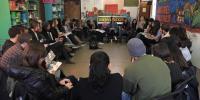
Close to 100 artists and activists staged a protest at the Brooklyn Museum yesterday afternoon in response to displacement — both in Brooklyn and Palestine.
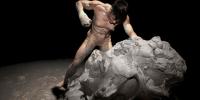
Cassils' Becoming an Image confronts issues of queer and trans visibility, bodily violence, and the politics of witnessing. The performance uses a powerful blend of media—including live action in darkness, flash photography, clay sculpture, and sound—to explore how trauma and resilience are physically and symbolically inscribed onto the queer body.
Members of this organization begin the narrative process by examining city neighborhoods and commercial districts for compelling structures that appear to have fallen into disuse —“hidden gems” of the built environment. In varying states of repair, these buildings suggest only stories about the past, not the future.
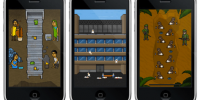
Phone Story is an educational game about the hidden social costs of smartphone manufacturing. Follow your phone's journey from the Coltan mines of the Congo to the electronic waste dumps in Pakistan through four colorful mini-games. Compete with market forces in an endless spiral of technological obsolescence. You can keep Phone Story in your favorite device as a reminder of your impact on this world.
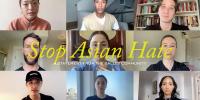
"Amid a rise in anti-Asian hate crimes around the world, Singapore-based dancewear company Cloud & Victory posted a video on March 18 calling for a stop to the hate against the Asian and Pacific Islander (AAPI) community. It features prominent Asian dancers and allies, including former professional dancer Miko Fogarty, The Joffrey Ballet's Jeraldine Mendoza and Boston Ballet's Lia Cirio and Paulina Waski.
Fanfiction is political, subversive, radical. Writing Harry Potter as a girl, Hermione as black, or Ron as transgender exposes people to narratives written from the perspective of marginalized communities. But is writing fanfiction a type of activism?
This piece is about multiple layered “creative activism”. There is art, activism, and community building.
According to the Merriam Webster dictionary, a zine is a “noncommercial often homemade or online publication usually devoted to specialized and often unconventional subject matter.”
While adult coloring books are hitting a high note right now in 2016, this isn't the first time this has happened. Back in the 1960s, coloring books were so popular that one of them even made it to the New York Times bestseller list.
However, while modern adult coloring books are very geometric and abstract, intended to help adults destress and relax, adult coloring books from the 1960s were much more political.
Anonymous (used as a mass noun) is a loosely associated hacktivist group. It originated in 2003 on the imageboard 4chan, representing the concept of many online and offline community users simultaneously existing as an anarchic, digitized global brain.
In the late 1960s, in the aftermath of the Watts Uprising and against the backdrop of the continuing Civil Rights Movement and the escalating Vietnam War, a group of African and African American students entered the UCLA School of Theater, Film and Television, as part of an “Ethno-Communications” initiative designed to be responsive to communities of color (also including Asian, Chicano and Native American communities). Now referred to as the L.A.
Mayday is a neighborhood resource and a citywide destination for engaging programming, a home for radical thought and debate, and a welcoming gathering place for people to work, learn, drink, dance and build together.
Lady Gaga said something interesting about her song “Born This Way” during a March 2011 interview at Google headquarters. “What's so funny [is] when I put that song out, everybody was like, ‘Oh, the lyrics are so literal,’ and I'm like, ‘Yeah,’” she shared, almost with a fuck-you cadence. She wasn't angry—but you could tell how important the track was to her, and how she didn't want its message muddled.