The SlutWalk protest marches began on April 3, 2011, in Toronto, Ontario, Canada, and became a movement of rallies across the world. Participants protest against explaining or excusing rape by referring to any aspect of a woman's appearance.
Carlos Hernández Chávez is a Mexican-American muralist who brings the spirit of 20th-century Mexican muralism into modern New England. Chávez’s murals address key social justice themes, including immigration, workers’ rights, and cultural identity, challenging viewers to acknowledge and reflect on pressing societal issues.
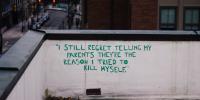
"What I Couldn't Say in Public" transforms individual secrets into a public, anonymous spectacle.
While origins and exact location of the "What I Couldn't Say in Public" project are unknown, awareness about the project has grown over the micro-blogging platform of Tumblr. Amassing over 132,480 notes on the website, this practice may have possibly inspired others to imitate the same or similar projects in different locations.
In March 2013 we started a grassroots boycott movement against Coca-Cola for exploiting legal loopholes to kill off container deposit recycling in the Northern Territory. We simply used the same successful strategy as the ANZ Out of Order action, putting out of order signs on Coca Cola vending machines and posting the photos on social media.
Northeast Minneapolis is going to have the first full-fledged water bar of its kind, an establishment where you can sit and drink a variety of local tap waters to your heart’s content. Their delightful motto: “Water is all we have.”
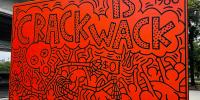
Without having been commissioned—or even given legal permission at all—Haring set out to create Crack Is Wack on the wall of an abandoned handball court in a park at 2nd Avenue and East 128th Street on June 27, 1986. Upon the completion of the mural, Haring was arrested by the New York City Police Department for vandalism of city property and faced potential jail time in addition to heavy fines.
Maria was psyched to travel to the Philippines where her hand-made basketball nets were well received. Invited with the Institute for Infinitely Small Things (Boston/Mass based) by Clara Balaguer and the Office of Culture and Design (Manila) she worked in Zamboanga City with students of Western Mindanao State University to carry out a 6 day arts and activism workshop.
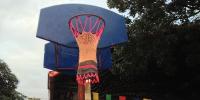
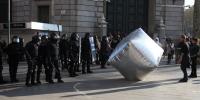
First: inflatables uplift a grim protest situation into a playful event. There is something magic about what inflatables induce in people. Their enormous size combined with the weightlessness and softness makes them irresistibly attractive and dreamlike. People have a natural tendency to touch the inflatable sculpture and to join the game of throwing inflatables in the air—changing a march into a poetic, joyful and participatory event.
Trampoline House is a user-driven refugee justice community center located in the center of Copenhagen, where refugees, asylum seekers, and migrants can meet with Danish citizens and other residents of Denmark and share experiences, learn from one another, and work to create a more just and sustainable refugee and asylum policy.
From Black Power to Migrants’ Power
BY Robin Cembalest POSTED 01/22/13
As ’60s activist art enters museums, a new generation is creating an iconography of protest for today
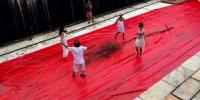
A site-specific art intervention intended as a call to action in response to Brazil's water crisis. Strategically planned to coincide with UN World Water Day, Gota D'Agua gathered onlookers around an abandoned Olympic size swimming pool at the foot of Edificio Raposo Lopes, a towering luxury condominium building situated on a steep incline overlooking Rio de Janeiro.
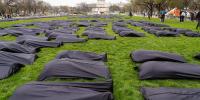
Over 1100 black “body bags” fanned out over a section of grass on the National Mall in Washington D.C. on March 24 in a plea for sanity. Each represented roughly 150 individuals who have died from gun violence since the mass shooting at Marjory Stoneman Douglas High School in Parkland, Florida on Feb. 14, 2018 which left 17 people dead and 17 more injured – most of the victims in their teens.
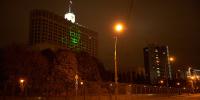
Voina art collective members covertly brought a large laser projector into the attic room of a hotel located across the street from the Russian White house (also called the Russian Parliament Building). From there they projected a large image of a skull and bross bones across the front of the white house building. Other group members on the ground then stormed the building gates and successfully entered the secure zone in front of the building.
This piece is fascinating because of its use of just a few words and country names, muted colors, and the recreation of famous art. The artist used this canvas to depict a concern about events happening in the Gaza strip.
For more than 30 years, the Guerrilla Girls have travelled the world exposing sexism and inequality in the art industry, and this week they proved Hong Kong was no exception.
Three members of the anonymous feminist collective—calling themselves Frida Kahlo, Käthe Kollwitz and Zubeida Agha—spoke at the University of Hong Kong on Monday, dressed in their signature black outfits and gorilla masks.
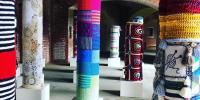
The Immigrant Yarn Project (IYP), organized and created by Cindy Weil was a massive work of public and democratic (crowd-sourced), yarn-based art honoring our immigrant heritage and promoting tolerance, difference, and community. Weil reached out across the state and beyond to collect yarn-based creations by immigrants and their descendants.
I get catcalled on the street by a construction worker. He says that he can see I’m smart because I have enormous books. He tells me he’s reading the latest Zadie Smith novel. I invite him to join my book club, and spend all night fantasizing about his insightful commentary around non-linear plot structure.