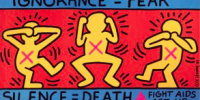
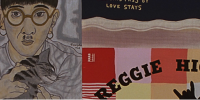
Keith Haring was an American artist and activist in 1980s New York, whose artwork raised awareness on social issues at the time. One the main awareness campaigns Haring participated on was AIDS awareness and activism.
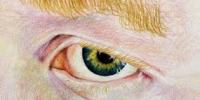
Through her work, South African art activist Athenkosi Kwinana aspires to deepen the understanding of Albinism in her native country, where she has faced discrimination in most aspects of her life from childhood days on. Working with both drawing and printmaking, Kwinana creates large self-portraits that aim to constructively reimagine the representation of Albinism in the country’s black communities and African contemporary art as whole.
Our solution:
Fresh Direct Nigeria (Fresh Direct Produce and Agro-Allied Services) is “City Farming” using stackable container farms! Fresh DirectNigeria brings fresh premium organic produce closer to market with our Container Farm Technology.
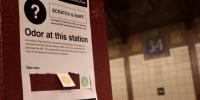
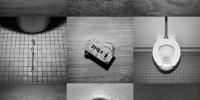
The New York City subway is many things, but clean isn’t necessarily one of them.
It doesn’t exactly smell great, either.
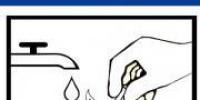
While the MTA hedges on solutions (and continues to debate whether eliminating trash cans from the stations actually solves sanitary issues), the artist and School of Visual Arts student Angela H. Kim is waging a personal guerilla war against the olfactory offensiveness of it all.
Animal Collective, Mumford and Sons and Duran Duran among performers who have turned concerts in state into fundraisers as part of NC Needs You movement
Even as North Carolina’s governor, Pat McCrory, refused to comply with federal officials over his state’s so-called “bathroom bill”, experimental pop group Animal Collective went forward with its scheduled show in the state over the weekend.
On Thursday 18th December 2014, dozens of leading international health activists staged a colorful protest in front of Hospital del Mar in Barcelona, Spain - highlighting the high prices of Gilead's new hepatitis C treatment, Sovaldi. The medicine costs approximately 40,000 euros in Spain, and $84,000 in the United States, leading to the exclusion from treatment of the majority of patients.
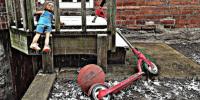
A mainland couple allowed their 2-year-old son to relieve himself by the road at Mangkok, Hong Kong and conflicted with local pedestrians who took photos of the child caused quite a stir among Chinese netizens. While the majority of mainland netizens show understanding for the couple, HongKongers think differently.
We demand that AATA respond to Karen Pence's stated commitment to our field by asking her to publicly take action for the rights of LGBTQIA people, Native people, Black and Brown people, Muslims, survivors of sexual assault, people with disabilities, immigrants, refugees and all people who are in danger as a result of the policies of the current administration.
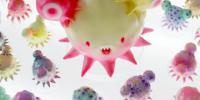
Lu Yang attempts to bring the negative notion of Cancer cell into a “Kimo Kawa” object of love and/or pain and hopes to open a dialogue that brings awareness to the acceptance and tolerance of living with cancer cells.
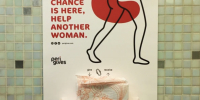
The public bathrooms at Penn Station in New York City are a dirty, depressing place. But now, there’s a bright spot: a poster that encourages women to donate menstrual products, like pads or tampon, to help the many homeless women who frequent the bathroom.
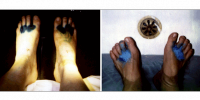
Tina Takemoto is an artist and associate professor of visual studies at California College of the Arts in San Francisco. Her work examines issues of race, queer identity, memory, and grief. Her current project explores the hidden dimensions of same-sex intimacy and queer sexuality for Japanese Americans incarcerated by the US government during World War II.
In April, 2011, Food and Water Watch partnered with Yes Lab to raise questions regarding drinking water around New York City. Yes Lab, an organization that collaborates with activist groups, aims to create successful media-related creative actions that help raise awareness regarding pertinent causes and create desirable action, often by staging interventions for the existing status quo by imitation and alteration.
The link between early trauma and ill health later was untilled soil in the world of medicine. But the possibility of a connection captured the interest of the Centres for Disease Control and Prevention. And it was the beginning of a 25-year odyssey for Vincent Felitti when he teamed up with researchers to study the health of 17,000 members of a preventive care program at Kaiser Permanente, a private insurer.
Pneumoconiosis has become the most serious occupational disease in China, and the vast majority of sufferers, nearly 6 million, are migrant workers. Because of the long-term inhalation of dust caused by pulmonary fibrosis, they usually breathing if not oxygen machine help, easy to suffocate.
The author behind ‘The First Paradise of Fang Siqi,’ a novel that Han described as ‘a young girl falling in love with her rapist,’ has sent shockwaves through Taiwanese society.
On April 27, aspiring Taiwanese author Lin Yi Han committed suicide, leaving behind only her first, and sadly last, novel. The story, entitled “The First Love Paradise of Fang Siqi,” concerns the mental struggles of a young girl who is raped by her teacher.
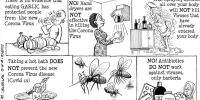
Godfrey Mwampembwa, popularly known as Gado, has been holding politicians accountable for nearly 30 years. Now, his concern has shifted to the coronavirus.
In a quiet office on the third floor of a building in Nairobi’s central business district, the cartoonist known by his pen name, Gado, was sketching a satire about the coronavirus.
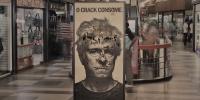
To show the harmful effects of cocaine on a drug addict, Brazilian advertising agency Talent created ‘living’ poster ads that are consumed by live mealworms over time.
Printed on dough, the ads initially show the faces of drug addicts.
However, as time passes, the mealworms slowly eat away at the posters, causing holes to form on the printed faces—highlighting the harmful effects of the drug.
The AIDS pandemic began in the early 1980s and brought with it a surge of emotions from the public: they were afraid, angry, fearful and defiant. The arrival of AIDS also brought with it a condemnation of the LGBT community. These emotions, along with the view on the LGBT community, paved the way for a new generation of artists.
In June of 1987, a small group of strangers gathered in a San Francisco storefront to document the lives they feared history would neglect. Their goal was to create a memorial for those who had died of AIDS, and to thereby help people understand the devastating impact of the disease.
Working in a grocery store has earned me and my co-workers a temporary status. After years of being overlooked, we suddenly feel a sense of responsibility, solidarity, and pride. On a private Facebook group page for my company, Trader Joe’s, one employee from Washington State posted a picture of a company-issued work shirt hanging from the ceiling of the store. A sign attached to the shirt read not all heroes wear scrubs.
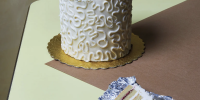
LONG BEFORE WOMEN finally — though incompletely — won the right to vote in the United States in 1920, they were finding ways to influence politics. In late 18th-century New England, colonial women would make muster cakes — spiced, doorstop-heavy confections flecked with candied fruit and soaked in alcohol — for soldiers being gathered (or “mustered”) to fight in the Revolutionary War.
Through the Market Token program, wooden tokens are used as market currency, making it possible for customers with SNAP (Supplemental Nutrition Assistance Program) food-stamp benefits to get fresh, healthy, affordable foods at the Market. Customers stop at the Market office to swipe their Electronic Benefits Transfer (EBT) card and purchase $1 and $5 tokens that function as cash and are accepted by dozens of Market vendors.
Exposing Disordered Eating is a photographic exhibition intended to show us the images we rarely see. In American media, representations of disordered eating are conditioned and controlled; all we are shown is the crumpled, emaciated anorexic figure with sunken eyes and cheekbones. This image is both unrelatable and othered, and it fails to capture the reality of modern eating disorders: they are omnipresent, multifaceted, and sneaky.
We set up a gazebo and table in a public park. The gazebo had two notice boards in the shape of trees where reflections were encouraged. We had a sign with the name of the action "Fall in Love With Nature" painted upon it. On the table were resource lists for the public to take away with links to books and websites on the topic of forest bathing and connecting with nature.
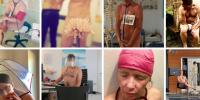
A group of German doctors have posed naked in an attempt to draw attention to shortages of protective clothing and equipment.
Calling their protest Blanke Bedenken, or Naked Qualms, members of the group said they felt at risk from coronavirus and claimed their calls for help over several months had gone unheeded.