The coronavirus outbreak has prompted climate activists to abandon public demonstrations, one of their most powerful tools for raising public awareness, and shift to online protests.
This week, for example, organizers of the Fridays for Future protests are advising people to stay off the streets and post photos and messages on social media in a wave of digital strikes.
Sometimes justice requires a little imagination. On Saturday, when
much of the Occupy Wall Street movement in New York was loudly
denouncing police violence against minorities and protesters, a small
group of environmentalists dreamed up a way to get the police to focus
on the crimes of the 1 percent, to the point of arresting five corporate
suits on United Nations property.
On this International Women’s Day, we wanted to celebrate the commitment of a very special human being. Her name is Zaria Forman, a leading artist in contemporary art with a cause. She is not only an exceptional human being; she is also an incredible American drawer who uses art to convey the emergency of climate change.
Many artists are inspired to bring climate change into their work after a direct experience with it. Catherine Sarah Young hopes her work helps people understand and talk about their experiences with climate change.
Environmental activist Franny Armstrong's brainwave came as she was walking to a debate with the then Secretary of State for Energy and Climate Change Ed Miliband. She had read a report saying that the developed world must cut its carbon emissions by 10% by the end of 2010 to avoid passing the tipping point. Armstrong, 39, dropped her idea to start a campaign into the debate. 10:10 was born.
"This is the video that Coca-Cola, PepsiCo, and Nestlé don’t want you to see.
The big brands want you to believe they are taking steps to reduce single-use plastic BUT they are actually working hand in hand with the fossil fuel industry to produce even MORE!
Watch now to learn that the actual “Story of the Bottle” has devastating effects on our health, planet, and communities!
The work of Marcela Cantuária (b. 1991, Rio de Janeiro; lives in Rio de Janeiro) often portrays female figures who navigate regional, international, and social boundaries. Often highlighting symbols from tarot and astrology as well as themes that reflect political and environmental activism in Latin America, she weaves narratives of social spheres, political associations, and ethereal wishes.
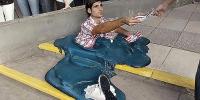
A young man melting into a puddle of himself is something you don’t see everyday, much less in a busy public square. Yet this humourous but surprisingly effective spectacle is the latest effort by the Red Cross of Argentina to raise awareness about climate change.
From Public Delivery:
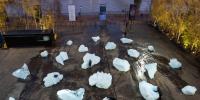
For Ice Watch (2014), he extracted 30 blocks of glacial ice from the waters of Greenland and in 2018 strategically placed them in front of Tate Modern in London . The ice was left here to melt. Ice Watch was to inspire public action against climate change, advocating for a rapid public response.
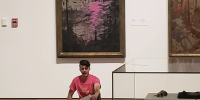
A climate activist smeared pink paint on a Tom Thomson artwork at the National Gallery of Canada as part of activities this week drawing attention to demands for a national firefighting service.
A video uploaded to Facebook by the group On2Ottawa appears to show Kaleb Suedfeld, 28, splashing paint onto Thomson’s 1915 landscape Northern River, kneeling and gluing his hand onto the floor before pulling a written speech from his pocket.
A series of three animations and posters to support the campaign titled: Stop the Coal Monster.
Our demands of Nelson City Council and Tasman District Council:
- Prohibit new resource consents for coal use or mining, effectively immediately.
- End all existing consents for coal use or mining by 2025.
- Ensure adequate monitoring of all current coal users.
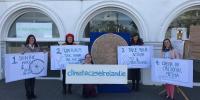
As part of the Creativity and Change postgrad course,(www.creativityandchange.ie) we created a street action. It was designed to raise awareness about climate change, and promote Climate Case Ireland, while also inspiring people to think of visions for the future and the actions they might take to avoid climate catastrophe. We wanted to do this in an accessible, creative, fun and interactive way.
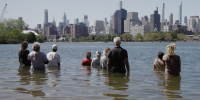
A site-specific, community-engaged process: Sarah and NYC collaborators gathered at the water’s edge every month from September 2020 (when the work was initially scheduled to take place but was postponed due to the pandemic) until September 2022, to build Kin To The Cove, a site-specific community-powered environmental public art process that connects local residents to the Cove and Water that surrounds NYC.