In 2023, it is impossible to be an apolitical artist in Eastern Europe. As war rages on in Ukraine, art serves as a powerful and necessary tool, according the members of the Sunflower Solidary Community Center in Warsaw: Maria Beburia, Sebastian Cichocki, Kuba Depczyński, Taras Gembik, Yulia Krivich, Kaja Kusztra, Natalia Sielewicz, and Bogna Stefańska.
The environment is one political topic that has become more significant in countries all around the world. One current example of this can be seen in Madrid with the Madrid Central program, introduced in an effort to lower carbon emissions in the city. With the new right winged candidate expected to be elected as the new president of the region, he plans to get rid of the program entirely.
Trade School is a self-organised, alternative learning space that runs on barter. It was started in 2010 in New York’s Lower East Side by Rich Watts, Louise Ma, and Caroline Woolard of OurGoods.org, a creative barter network. Over 800 students participated in 76 single-session classes during 35 days. Anyone can teach a class, and students sign up by agreeing to meet the barter requests of teachers.
Tennessee Rep. Justin Pearson never guessed he'd be expelled for leading a gun control protest on the House floor after a deadly school shooting. Nor did he predict that he'd be propelled into the national spotlight, placing his state at the forefront of the conversation on gun regulations.
Los Angeles is at a critical moment when it comes to art. Not because it's "underappreciated as a world art center" as The New York Times informed us in 2011. Or because it's a "burgeoning art capital" as The New York Times revised in 2014. No, it's because L.A. has actually moved past the "up-and-coming" stage into a fully integrated part of the art world.
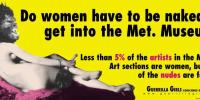
The Guerilla Girls are a group of feminist activist artists, who use facts, humor, and outrageous visuals to expose gender and ethnic bias and corruption in politics, art, film, and pop culture in their artworks. In 1989, they designed this billboard for the Public Art Fund (PAF) in New York, aimed to criticize the museum institutions for under-representing female artists and objectifying women.
Institute of psychology in Shenyang, a major city of China, recently reveals 6 most frequently used utterances in verbal abuse of children among local parents: “Garbage”, “You know nothing but eating”, “Pig head”, “Shame on you”, “Why don’t you die”, “No one else is lamer than you”.
In July and August 2013, O Teatrão, a Coimbra based theatre company, presented the project Arruinados, comprising three theatre performances in three abandoned spaces (‘ruins’), one in each of three cities in the Centre region of Portugal located along the Mondego River:Coimbra, Montemoro Velho, and Figueira da Foz.
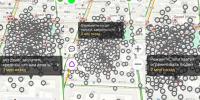
Russia is the midst of a strict COVID-19 lockdown. Although protesters cannot take to the streets, they are still holding mass demonstrations — digitally.
World Microphone (世界麦克风) is an organization created by students (most of them are Chinese) located in London. The organization has an account in RED, which is a popular social media in China. It often holds interviews and movements on the street in London, talking about world culture, food, and travel. Then, it makes short videos based on these interviews and movements and posts the videos on RED.
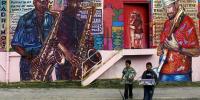
CENTRO San Antonio's Art Everywhere Project will celebrate its 5th anniversary in May.
As of May 2024, the project had seen numerous artists from the city's urbancore decorate areas of the city with elaborate murals reflecting the city's history and the diversity of cultures in the city.
No Home Gallery is a traveling gallery that curates exhibitions and happenings in various living and studio spaces in New York City. In an attempt to make contemporary art accessible and inviting, No Home offers emerging artists and art enthusiasts a forum for collaboration and creation.
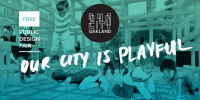
Our City is a startup nonprofit based in Oakland and working with cities everywhere. They work with governments, cultural institutions, companies, community organizations, designers, and residents to produce
events, installations, and workshops that use public design to improve cities.
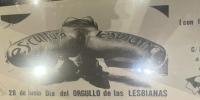
From 1993 to 1998, Spanish activist group Lesbianas Se Difunden (LSD) produced and published a collection of texts and visuals called Non-Grata (Snyder 10), using erotic images of the female body and sexual relationships to capture their audiences’ attention. Within these graphic publications would be calls for queer activism, female freedom, anti-capitalist critiques, and the overall necessity for protest (Snyder 10).
Ultra-Red is a collective founded by two AIDS activists in 1994 to explore the intersection of the political and aesthetic through "militant sound investigations".
La Casa Invisible project was started in 2007 in Malaga, Spain, when a group of socially involved participants squatted in a run-down building, aiming to eventually claim the legal rights to the property (Moor & Smart, 2016). The space was opened to local artists and creators, quickly becoming a hub for free local music, performances, and seminars as well as creating an important meeting space for social groups (Moor & Smart, 2016).
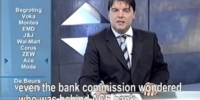
ACE Bank was a hoax bank developed as part of a bigger campaign by Netwerk Vlaanderen, a Belgian organization concerned with banks’ responsibilities for what they invest in. ACE bank was an elaborate deception, with a headquarters in central Brussels, parodying other banks. It claimed to be investigating whether there was a market for its special way of doing business.
A coalition of more than twenty national arts funders has launched an emergency relief fund that will provide millions of dollars to artists struggling financially in the wake of the COVID-19 outbreak in the United States, which has more than 400,000 confirmed cases of the virus. The Andrew W.
Project IMPACT is an 8-week leadership-through-storytelling workshop for teen survivors of commercial sexual exploitation. The goal of Project IMPACT is to introduce survivors to the idea that sharing their stories is a powerful advocacy tool that can impact the legislative process and work to combat sex trafficking and commercial sexual exploitation.
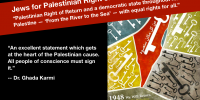
Jews For Palestinian Right of Return
January 1, 2013
“For Palestinians, the right to return home and the right to live in dignity and equality in their own land are not any less important than the right to live free of military occupation.”
–Prof. Saree Makdisi[1]
For more than a century, Zionists have sought to construct a “Jewish state” through forced removal of the indigenous Palestinian people.
A human tide swept through Paris last month for the type of event France knows only too well — a protest. Union leaders led the march, awash in a multicolored sea of flags. Demonstrators shouted fiery slogans. Clashes with the police erupted.
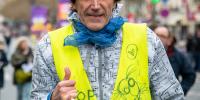
And, as in every protest, there was Jean-Baptiste Reddé.