"Writing Political Music in Today's World" I began studying composition with Fred Ho without knowing quite what I was getting myself into. I was 25 with a fresh graduate degree in composition under my belt, lost in that special way only millennial twenty-somethings get to be. I knew I wanted to write political works and, having met Fred twice before, I knew that he was the one who could help me do it.
The aim of the action is to create a fractal network of poets, where their poems will be recited, recorded, set to music, will be activistically acted as performance material in order to resist the censorship of art.
The field of action is the poets who will be born and the network that will be created by the restless artists.
On September 27, 2022, a song by Iranian musician Shervin Hajipour ‘broke’ Persian social media. Hajipour posted a video on Instagram of himself singing a song for the mass protests that began in Iran following the death of Jina (Mahsa) Amini. Its lyrics were composed of tweets from members of the Iranian Twittersphere explaining what the protests meant to them, what they were fighting for and what was at stake with the hashtag #برای (for the sake of).
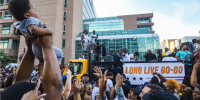
In response to white gentrifiers trying to silence go-go music on the corners of Florida Avenue and 7th Avenue, activists and D.C. residents poured into the streets by blasting go-go music and celebrating its rich history within the city. For those unfamiliar, go-go music is at the heart of D.C. culture and features live bands playing covers of, and sometimes original, music with all different types of drums and other percussion instruments.
A TYPICAL EPISODE of Journal Rappé begins with Senegalese rapper Makhtar “Xuman” Fall dressed in a suit and seated behind a news desk. At first glance, the show looks like an ordinary newscast. But then Xuman (pronounced human) launches into his intro, rapping in French instead of talking. “Welcome! Make yourself comfortable. These are the news for you. Some good ones and bad ones too. But they’re all news for you.”
Glowing softly in the West Texas desert night, artist Guadalupe Maravilla’s Mariposa Relámpago, was once an ordinary school bus but is now a richly decorated, mobile site for remembrance and healing. Like much of the artist’s work, this piece commemorates and confronts the artist’s journey to the United States as an unaccompanied, undocumented minor fleeing civil war in El Salvador in the 1980s.
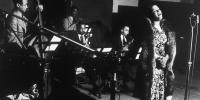
It is a clear, fresh New York night in March 1939. You're on a date and you've decided to investigate a new club in a former speakeasy on West 4th Street: Cafe Society, which calls itself "The Wrong Place for the Right People".
The new wave of hip-hop has arisen a woke generation. From it, Xiuhtezcatl — seventeen-year-old Indigenous rapper and activist — has emerged, stirring the comatose with his music.
From performing at the Standing Rock encampment with Immortal Technique and Nahko to leading the Youth v. Gov. lawsuit against the Federal Government, Xiuhtezcatl’s actions show his music is more than words.
Pussy Riot are spreading their protests and activism beyond Russia. Away from Vladimir Putin’s censorship, they’re bringing their voices to Canada – a place where their message of resistance is resonating. On Nov. 1, as a chilling cold filled the streets of Montreal, Pussy Riot kicked off the North American leg of their Riot Days tour with a sold out show at the Rialto Theatre. The tension in the room was palpable.
Replete with an unmistakable look, intense silence, and mime-like moves, the Red Rebels are, quite intentionally, riveting. In the words of artist and activist Doug Francisco, founder of the Red Rebels Brigade: "We divert, distract, delight, and inspire the people who watch us."
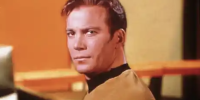
Hewlett-Packard pledged to stop using dangerous plastics in its computers by 2009. It broke that promise. Will a company-wide voicemail from William Shatner make it change its mind?
Fabled Asp is a multimedia online archive that documents forty years of activist history and creativity. Disabled lesbian activism is a radical assertion of self in the face of societal stigma and marginalization. The project illuminates the myriad ways disabled lesbians have been moving against invisibility through civil rights actions, theater, dance, sports, and visual arts.
"FTSE" is Birmingham-born producer and rapper Sam Manville. As an anti-captialist, he though it would be funny to take the name of the British stock market index (Financial Times and Stock Exchange), but he also jokes the acronym stands for "Fuck The System, Ennit.”
Can you finish the lyric? “Your driver could be LGBTQ, Your Tailor could be LGBTQ,…” If you can’t, you may be a part of the majority who doesn’t know about the song Wo Fie. However, for those in the LGBTQIA+ community, and followers of Ghanaian musician Angel Maxine, the song has become a Pride month anthem.
A New York blogger impersonating David Koch successfully prank called Wisconsin Gov. Scott Walker. David Koch is one of the two wealthy brothers who were big donors to his political campaign and GOP efforts generally.
“The real wealth of the Nation,” marine biologist and author Rachel Carson wrote in her courageous 1953 protest letter, “lies in the resources of the earth — soil, water, forests, minerals, and wildlife… Their administration is not properly, and cannot be, a matter of politics.” Carson’s legacy inspired the creation of Earth Day and the founding of the Environmental Protection Agency, whose hard-won environmental regulations are now being undone in the
The 1975’s ‘Love It If We Made It’ is a dystopian love story that feels appropriate for the last 18 months. Even though it was written before the pandemic, its relevancy has only increased tenfold since its release in 2018.
CHARLOTTE, N.C. -- Charlotte-Mecklenburg Police say no one was arrested during a loud – and very colorful – KKK rally and counter-protest in uptown Charlotte Saturday afternoon.
Members of the National Socialist Movement joined the Ku Klux Klan for an anti-immigration rally at Old City Hall on West Trade Street, but the counter-protesters outnumbered them at least five to one.
‘‘HAMILTON,’’ the new musical biography of Alexander Hamilton created by and starring Lin-Manuel Miranda, kicks off with a doozy of a question. The houselights rise on Aaron Burr, the third vice president of the United States and, infamously, the killer of Hamilton in a duel in 1804. Burr steps to center stage and reels off several lines of verse:
Born as a side project Las hijas de Violencia approaches the subject of street harassment and gender based violence through performance art, punk and video that is addressing socially legitimized male violence. "As actresses and as women we feel directly affected and consider it urgent to address the real cause of the problem: its ideological nature.
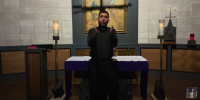
WEST MIAMI-DADE, FLA. (WSVN) - A seminarian and faculty member at a South Florida school is taking a creative approach to engaging with students about challenging issues during this time of uncertainty, including the coronavirus pandemic. He made a rap video.