By Evan Mulvihill, Queerty.
When Tea Party activists gathered in Boston yesterday afternoon, they weren’t given license to shout their Small Government slogans at disinterested passersby—liberal activists of all stripes showed up to shout them down.
Who doesn’t love a good counter-protest?
On the night of Thursday, Nov. 13, 1969, the “March Against Death” began. By the time that weekend was over, Washington, D.C., had seen more protesters than any single event in its history had drawn. Attendance was higher, by tens of thousands, than at the 1963 Civil Rights March on Washington. And despite a name that, 45 years later, may seem overblown or vague, the march was actually about something very specific.
Protests against state stay-at-home orders have attracted a wide range of fringe activists and ardent Trump supporters. They have also attracted a family of political activists whom some Republican lawmakers have called "scam artists."
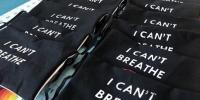
The Protest Mask Project was co-organized by Maggie Thompson and Jaida Grey Eagle. During the George Floyd protests, the artists' studio, Makwa Studio, created hundreds of masks to give to protestors in the city of Minneapolis where the demonstrations began.
A creative action against the introduction of mandatory immigration checks and upfront charging in the UK’s National Health Service, including a systematic social media campaign under the hashtag
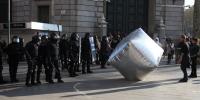
First: inflatables uplift a grim protest situation into a playful event. There is something magic about what inflatables induce in people. Their enormous size combined with the weightlessness and softness makes them irresistibly attractive and dreamlike. People have a natural tendency to touch the inflatable sculpture and to join the game of throwing inflatables in the air—changing a march into a poetic, joyful and participatory event.
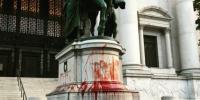
Just weeks after activists staged an alternative tour of the American Museum of Natural History to call for its removal, among other things, the equestrian statue of Teddy Roosevelt was vandalized early Thursday morning.
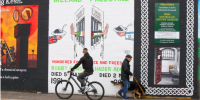
Palestinian and Israeli flags flutter in pro-Irish and pro-UK neighbourhoods in Northern Ireland, tapping into its own history of conflict and division that still affects everyday life despite a 1998 peace deal that largely ended violence.
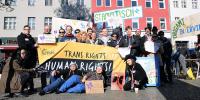
We demand that AATA respond to Karen Pence's stated commitment to our field by asking her to publicly take action for the rights of LGBTQIA people, Native people, Black and Brown people, Muslims, survivors of sexual assault, people with disabilities, immigrants, refugees and all people who are in danger as a result of the policies of the current administration.
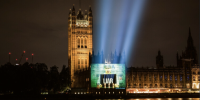
The creative fusion of art and activism in urban spaces has propelled the British collective Led by Donkeys into the spotlight, garnering millions of views for their interventions on social media. Their critical visual occupations - whether billboard messages during the day or large-scale projections at night - raise a compelling question: which medium holds the greater persuasive power?
On the opening day of the Spring/Summer 2011's season of Mercedes Benz's New York Fashion Week, former fashion editor, speaker, and fashion activist Michaela Angela Davis led a protest of approximately 20 black women, dressed in black suits, carrying signs with the names of every fashion editor in the 40 year history of African American fashion and lifestyle magazine, Essence Magazine.
As leaders across the world are getting ready to gather together to discuss climate change—and what to do about it—at the UN Climate Change Summit in New York next week, hundreds of young people across the world are going on birth strike to pressure policymakers into action.
As part of an international workshop (10-11 October 2015) with the Center for Artistic Activism, 17 trans activists and artists from 13 European countries developed a creative campaign to mark some of the spaces in Berlin which have symbolic significance for trans people.
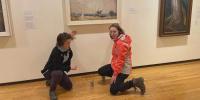
Two climate change activists targeted an Emily Carr painting at the Vancouver Art Gallery, Saturday.
In a social media post by the account Stop Fracking Around on Twitter, a video shows two activists dousing a painting with an unknown liquid that is said to be maple syrup per the tweet.
The two activists then apparently glued themselves to the wall underneath the painting.
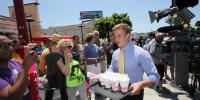
In the 20th century India's Mahatma Gandhi famously used the hunger strike as political protest. In America today we demonstrate by eating fast food.
Call it an “eat-in,” call it a “buycott”: By whatever name, it’s a tactic that’s growing in popularity. As Wednesday's Chick-fil-A Appreciation Day indicates, it’s a form of protest Americans find increasingly easy to swallow.
Essential workers at major companies like Amazon, Instacart, and Target across the United States on Friday protested for better safety protections, working conditions, and pay during the coronavirus pandemic.
"The Sisters of Perpetual Indulgence® is a leading-edge Order of queer nuns. Since our first appearance in San Francisco on Easter Sunday, 1979, the Sisters have devoted ourselves to community service, ministry and outreach to those on the edges, and to promoting human rights, respect for diversity and spiritual enlightenment.
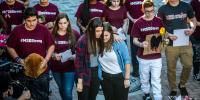
Shine, written by Stoneman Douglas students Sawyer Garrity and Andrea Peña in response to the tragic shooting at their school on February 14, 2018 to inspire unity, hope, and change. MSD alum Brittani Kagan collaborated with students and faculty to create this music video to honor the victims and the school.
IMPEACH
An online exhibition of art work by twenty artists
Katherine Aoki, Deborah Harris, Nicolas Lampert,Cicely Cottingham,
Art Hazelwood, Ilse Schreiber-Noll, Priscilla Stadler, Tim Fite, Anne Q McKeown, Anne Dushanko Dobek, Robyn Ellenbogen, Joseph O’Neal, Donna Coleman, Robert Geshlider, Michael Dal Cerro, Leona Strassberg Steiner, Barbara Madsen, Ray Must, Carol Radsprecher and Patricia Dahlman
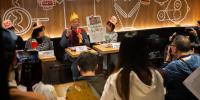
On a recent eight-hour shift at a McDonald’s in Hong Kong, Luke Ching, 52, wiped tables, cleared trays of half-eaten fries, emptied cups of soda and milk tea and lugged bulging trash bags to the dumpster.
For him, the main goal of the part-time work was not making ends meet. It was research for his main pursuit: using art to advocate for better treatment of people in menial jobs in a city with one of the widest income gaps in the world.
After the economic crisis of December 20, 2001 in Argentina, there was a growth in the participation in all types of protests and claims of the different sectors affected by the crisis (against banks by savers, roadblocks and mobilizations of picket movements, state employees in municipalities and government houses, neighborhood assemblies, etc). The situation that was experienced led the protesters to seek new and varied reporting strategies.
The Peace Piece was conceived by artist Adelle Lutz as a reaction to the declaration of the American war with Iraq in the Spring of 2003. Lutz combined her talents as a costume designer and artist to create a project that would remind the Americna public that the majority of war victims suffering in Iraq were women and children.
Brisbane, Australia — The flash mob descended on Brisbane’s city square, wearing double denim and blond wigs in the style of a legendary Australian singer as they danced with wild abandon to one of his 1980s hits.