A new exhibition titled “Afrofuturism: A History of Black Futures” will debut at the National Museum of African American History and Culture (NMAAHC) to examine Afrofuturist expression and culture as it relates to music, activism, art, and more.
"Myanmar has been engulfed in protest since February 1, when Burmese army general Min Aung Hlaing seized control of the government in a military coup, refusing to accept to the landslide election victory of the National League for Democracy and its leader, Aung San Suu Kyi.
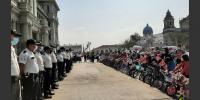
Non-profit organizations and a multitude of Guatemalan girls protested together demanding justice and security from the government. Guatemala's insecurity and cases of girls' disappearances have increased over the years. The protest started outside the Government Ministery (Ministerio de Gobernación) early in the morning, where protestors gathered riding their bikes.
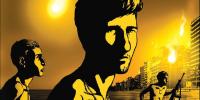
He had served in the army, either as a full-time soldier or as a reservist, for 22 years when he finally decided he wanted out. In 2003, Ari Folman, who had just turned 40, asked his commanders in the Israel Defence Forces to release him from the obligation to do a month's military service every year. They agreed - "so long as you go to the army therapist and talk about everything you went through".
Kendick Lamar is known as one of the most prolific, and socially conscious, rappers of our time. 'BLOOD.' is the second track off of Lamar's iconic album 'DAMN.' from 2017. What makes this song stand out is the sample used at the end of part one of the song.
Warscape Sonata is a transmedia project that documents and perform audiovisual information related to the current drug war in Mexico. Twitter hashtags, youtube viral videos and mass media are used as creative sources to document the militarized Mexico.
According to the Men's Rape Prevention Project in Washington DC, 58,000 soldiers died in the Vietnam war. During that same period of time, 51,000 women were killed mostly by men who supposedly loved them.
Forensic Architecture's Cloud Studies is a project that investigates the impact of toxic clouds on colonised and oppressed communities. The clouds, originating from sources like tear gas, industrial emissions, chemical weapons, and forest fires, often go unaddressed due to doubt and denialism.
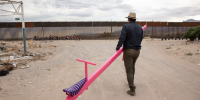
The US-Mexico border wall has become a battleground for political theater, but also various artistic interventions. One of these outstanding artworks is the pink seesaws. They went viral after they were installed by the two creative architects Ronald Rael and Virginia San Fratello. Between the erect giant steel posts of the border fence lie small gaps a couple of inches apart. It is this space where they installed the seesaws.
"For those who haven’t seen it, Big Bang Big Boom (2010) is yet another fabulous animated graffiti parable from the Blu
art collective. Their work is endlessly fascinating — animated
creatures sliding seamlessly from walls, through sand, along pipes and
under bridges into stop-motion interaction with beach garbage and
Artists4Ceasefire is a collective of actors, filmmakers, and other artists calling for an immediate and permanent ceasefire during the Gaza war in Gaza, the delivery of humanitarian aid to civilians, and the release of all hostages.The collective was started on October 20, 2023, two weeks after the October 7 attacks.
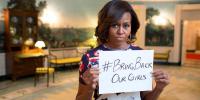
Michelle Obama tweeted her own portrait holding a sign reading #BringBackOurGirls and soon countless celebrities echoed this meme online. Throughout a week, this trending hashtag had been turned into a social-media supernova. The #BringBackOurGirls campaign spurred by online sharing brought the outrage against Chibok schoolgirls kidnapping to the global stage.
ONGOING ORGANIZATION:
CALLED: Iranti [pronounced írantì] is the Yoruba word for ‘memory’. Largely found in South West Nigeria and parts of Benin Republic, the Yoruba people consider memory a prized form of intelligence which determines how often one remembers what they see and hear.
William Banks is a comedian and artist who, prior to his viral prison saga in 2025, was best known for a community that he led called Call World, which he describes on the website as “a planet in an alternate universe ruled by human-headed Worms sexually obsessed with William Banks.” The story goes that Banks was first visited by a worm from Car World after getting stuck in an industrial freezer and coming to terms with his death before eventually being
It started as an experiment: what happens when you equip a vibrant youth community with the resources to express themselves through hip hop and electronic music? Last summer I traveled to Goma, Democratic Republic of Congo to find out and the results were more beautiful than I could have imagined.
The exhibition Law of the Journey is Ai Weiwei’s multi-layered, epic statement on the human condition: an artist’s expression of empathy and moral concern in the face of continuous, uncontrolled destruction and carnage.
The running world will come together for a virtual run on Friday, May 8, to celebrate and honor the life of Ahmaud Arbery, who was reportedly shot and killed while out on a run on February 23.
"The Scream: 21st Century Edition" was created by New York-based artist Jim Costanzo in response to the Iraq War. The piece is directly inspired by Edward Munch's painting, "The Scream." Costanzo expresses anger and frustration at the illegal American war and the attack on our civil liberties.
Wafaa Bilal's childhood in Iraq was defined by the horrific rule of Saddam Hussein, two wars, a bloody uprising, and time spent interned in chaotic refugee camps in Kuwait and Saudi Arabia. Bilal eventually made it to the U.S. to become a professor and a successful artist, but when his brother was killed at a U.S. checkpoint in 2005, he decided to use his art to confront those in the comfort zone with the realities of life in a conflict zone.
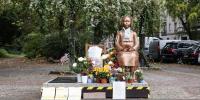
Photo taken on Oct. 15, 2020 shows a "comfort women" statue in Berlin, capital of Germany. The statue was built to commemorate the more than 200,000 girls and women from 14 countries and regions, so-called "comfort women," who were sexually enslaved by the Japanese military during World War II. (Xinhua/Shan Yuqi)
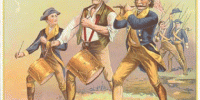
The Fourth of July is upon us, so it’s time once again to sing what is arguably our most baffling national ditty, “Yankee Doodle Dandy.” Maybe you’ve noticed: Some of the lyrics seem like the work of a prankster on acid. Who else could have conceived a vignette as bizarre as a man riding a pony into town, then sticking a feather in his cap that, for unknown reasons, he insists on calling “macaroni”?