The image is stark. And shocking.
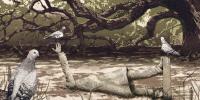
A black man, his ankles shackled, his head hanging away from the viewer, stands in relief on a field of white. Chains stretching to the image's borders on the left and right pull his arms taut. Fourteen crimson marks crosshatch his back. Within the dark fabric that frames "86 Lashes to Go," a small rectangle is labeled simply "salt."
In keeping with his activist turn on 2016’s 4 Your Eyez Only, J. Cole’s new album, KOD, is an exploration of addiction. The title has three different meanings that all speak to this aim: Kids On Drugs, King OverDosed, and Kill Our Demons. Each feeds into the next in this narcotic odyssey.
In 2013, Ghana ThinkTank received a Creative Capital Award for Emerging Fields, enabling them to begin the multi-year ThinkTank at the Border project. In this project, they are collecting problems from civilian border patrols like the Minutemen, "Patriot" groups, and Nativist organizations, and bringing them to be solved by think tanks of undocumented workers in San Diego and recently deported immigrants in Tijuana.
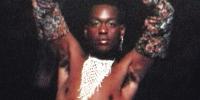
Topless queer men light spliffs on the beach. A trans man injects testosterone on the toilet. Drag queens nonchalantly scroll through their phones and smoke. These are just some of the images that make up the new book from Leo Adef. Titled WARP, it’s comprised of photographs captured across four years spent in Barcelona's queer underworld
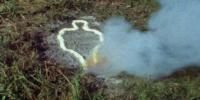
The annual Toronto film festival Hot Docs is underway, and one of the featured documentaries tackles the tragic and gruesome story of serial killer Robert Pickton. The notorious murderer was responsible for the deaths of at least 26 women, many of whom were Aboriginals, drug addicts and prostitutes from Vancouver's rough Downtown Eastside.
Play Safe is a documentary film series created and directed by NYU alum Eddie Einbinder. The film, much of which now appears for free on YouTube, was originally released in 2013 after being filmed between 2011 and 2012. It debuted at the International Harm Reduction conference in Vilnius, Lithuania in 2013.
My skin is black,” the first woman’s story begins, “my arms are long.” And, to a slow and steady beat, “my hair is woolly, my back is strong.” Singing in a club in Holland, in 1965, Nina Simone introduced a song she had written about what she called “four Negro women” to a young, homogeneously white, and transfixed crowd.
Matika Willbur was given a grant by Kickstarter (the worlds largest funding platform for creative projects) to travel around the U.S. for a year and photograph Native America. The goal of the 562 project is to change the way we think of the Native American race, by shifting our collective consciousness and creating a positive lasting legacy of Native America.
When Behnaz Babazadeh was young, her family moved from Afghanistan to the US. She loved almost everything about her new home — especially America’s amazing selection of candy — but she also loved wearing her familiar pink-flowered headscarf, which she’d grown used to wearing as part of her school uniform in her old home.