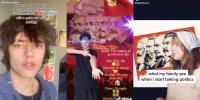
20-year-old Ilyssa, from New York, sees communism as the only viable alternative, one that will improve the societal issues we currently face. “From a young age, I was very aware of the stark class differences that existed,” she says. “I grew up with a single mother in a very poor family.
"Everyday Iran”, inspired by “Everyday Africa”, is the most widespread mobile photography project based on social networks in Iran which started since early in 2014.
We in Everyday Iran ask the whole people who live and work in Iran to send us their photos of daily life in the country with #everydayiran. Those photos which are selected by 5 Iranian curators are reposted on our social media pages.
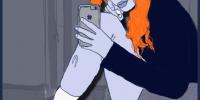
During a moment when the facade of social media seems to be cracking, it’s easy to look to Instagram stars and wonder what’s real and what’s fake. Last month, Essena O’Neill, the Australian teenager who racked up more than half a million Instagram followers, quit Instagram after claiming that social media is “not real life.”
Working in a grocery store has earned me and my co-workers a temporary status. After years of being overlooked, we suddenly feel a sense of responsibility, solidarity, and pride. On a private Facebook group page for my company, Trader Joe’s, one employee from Washington State posted a picture of a company-issued work shirt hanging from the ceiling of the store. A sign attached to the shirt read not all heroes wear scrubs.
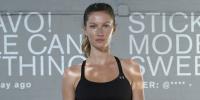
I Will What I Want is a campaign launched by Under Armour which speaks to women who do not wait for permission or affirmation in order to go after what they want. The campaign highlights various models and athletes who encourage women to tune out society's standards and pursue their dreams. The campaign began by highlighting Misty Copeland, a soloist at the American Ballet Theater.
On November twelfth, 2008, over 80,000 copies of a replica of the New York Times were distributed in several cities around the United States. The paper included 14 pages of “best case scenario” news set nine months in the future.
See the The New York Times Special Edition website.
Artist Daniel Soares pasted Photoshop toolbar stickers on these H&M posters as a nice little reminder that not all is as it seems. Y'all know how Photoshop messes with our perception of beauty, and I think this is a smart little stunt to snap us back into reality when we start to wonder why we never look like the girls on the posters we walk past every day.
Earlier this month, an anonymous message was posted to the discussion-board Web site 4chan. In it, the author threatened to hurt the video-game developer Zoe Quinn: “Next time she shows up at a conference we … give her a crippling injury that’s never going to fully heal … a good solid injury to the knees. I’d say a brain damage, but we don’t want to make it so she ends up too retarded to fear us.”
This weekend marks the one-year anniversary of Donald Trump's inauguration. It also marks the one-year anniversary of the Women's March his election inspired, the largest single-day protest in the nation's history.
A performance art piece by a student who sat in a cage to protest a draconian lockdown of the Beijing Film Academy (BFA) recently went viral, and was censored just as quickly. Like many other Chinese citizens, university students have been living under strict lockdowns, and are beginning to chafe at the restrictions—and at administrators’ lack of responsiveness to students’ concerns.
A TYPICAL EPISODE of Journal Rappé begins with Senegalese rapper Makhtar “Xuman” Fall dressed in a suit and seated behind a news desk. At first glance, the show looks like an ordinary newscast. But then Xuman (pronounced human) launches into his intro, rapping in French instead of talking. “Welcome! Make yourself comfortable. These are the news for you. Some good ones and bad ones too. But they’re all news for you.”
The Guardian
By Tania Branigan
In the opaque world of Chinese censorship, a few red lines shine through the murk. One of the clearest is: no gossip about top political leaders, their families or internal party affairs.
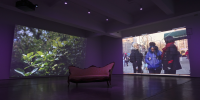
Artist Zoran Naskovski continued his project "Mandala and Cross / farewell to arms” with analysis of media representations of social processes in 2015, that resulted with a new installation: “Mandala and Cross / blackness, refugees and economic gamble”.
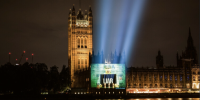
The creative fusion of art and activism in urban spaces has propelled the British collective Led by Donkeys into the spotlight, garnering millions of views for their interventions on social media. Their critical visual occupations - whether billboard messages during the day or large-scale projections at night - raise a compelling question: which medium holds the greater persuasive power?
Filmed in Harlem, New York, and in Claude Monet's gardens in Giverny, France, THE GIVERNY SUITE is a cinematic poem that advocates for the safety and bodily autonomy of Black women. Employing techniques including hand-painted film animation and montage editing, Gary first developed the work during an artist residency in Giverny, where the gardens offered a space of respite.
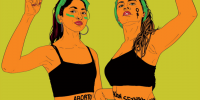
The rise in feminism and feminist advocacy has changed history forever in terms of how women are viewed and treated in society. Though great progress has been made, women are still fighting for their rights even today. Abortion and body vulnerability are just two issues that are still being confronted and fought for in the public view.
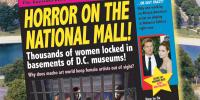
“The Washington Post” asked the Guerrilla Girls to create a full page for their section on feminism and art, which was published on April 22, 2007. The Guerrilla Girls’ page contains an image of a fake tabloid, called “NOT OK! The Guerrilla Girls’ Scandal Rag,”. The tabloid’s cover features a sensational headline and some statistics, which highlight the fact that national museums rarely feature female artists and artists of color.
Last November, when you Googled the phrase “ugly Black woman,” Vanessa Rochelle Lewis’s photograph was the second to come up.
“Which I’m offended by,” says Lewis, a Bay Area–based artist and writer, “since I’m an Aries and I like to be number one in everything.”
The internet has reshaped the ways we learn and communicate. Information becomes heuristic, concomitantly - knowledge becomes protean. If you dedicate enough time to any particular platform, you are likely to acquire a community with congenial individuals. Social media’s proliferation has obfuscated the lines between reality and fiction. Embraced as a tool for many, these digital spaces typically have no monitoring process.
Ahead of a recent exhibition at the prestigious modern art museum OCAT Shanghai, the artist Song Ta described the process of creating his multimedia piece “Uglier and Uglier.” After secretly filming thousands of unsuspecting female college students, Song and three assistants painstakingly ranked them by their perceived attractiveness; those deemed most appealing featured early in the show, with the women on display getting progressively “uglier” as the
Reading the introduction to Animal Farm by Christopher Hitchens a few years ago, I was stunned to learn that George Orwell, then a struggling writer in London, worked by letter with a group of refugees to publish the novel in Ukrainian in the displaced persons camps of postwar Europe.
In her 2021 graduation project from the Central Academy of Fine Arts (CAFA), Chinese performance artist Zou Yaqi staged a provocative social experiment titled “21-Day Survival Challenge.” For three weeks, Zou assumed the persona of a wealthy socialite, using counterfeit luxury items, strategic self-presentation, and social engineering to access elite spaces in Beijing—such as five-star hotel lobbies, first-class airport lounges, and high-end restaurants
CNN calls itself "The Most Trusted Name in News," but for years they provided a platform for Lou Dobbs to spread dangerous myths about immigrants and use dehumanizing and disrespectful language towards the Latino community. In 2009 Presente.org fought back, spearheading a multi-stage, national campaign with dozens of partners demanding that CNN remove Dobbs.
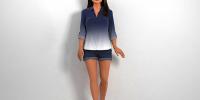
"Many people have criticized Barbie dolls for their unrealistic proportions, claiming that they give young girls a warped idea of what beauty should be. To tackle this problem, Nikolay Lamm created digital visualizations of a regular-sized “Barbie” doll, hoping to promote realistic beauty standards.